
Creative Biolabs is offering the most comprehensive services for antibody development projects. With strict regulation and effective execution, we are dedicated to providing the most valuable solutions to complete your projects.
HighlightsCreative Biolabs is offering the most comprehensive services for antibody development projects. With strict regulation and effective execution, we are dedicated to providing the most valuable solutions to complete your projects.
HighlightsCreative Biolabs has established a broad range of platforms for developing novel antibodies or equivalents. These cutting-edge technologies enable our scientists to meet your demands from different aspects and tailor the most appropriate solution that contributes to the success of your projects.
HighlightsWith deep understanding in antibody-related realms and extensive project experience, Creative Biolabs offers a variety of references to help you learn more about our capacities and achievements, including infographic, flyer, case study, peer-reviewed publications, and all kinds of knowledge that can assist your projects. You are also welcome to contact us directly for more specific solutions.
HighlightsGet a real taste of Creative Biolabs, one of the most professional custom service providers in the world. We are committed to providing highly customized comprehensive solutions with the best quality to advance your projects.
Highlights Loading...
All listed services and products are For Research Use Only. Do Not use in any diagnostic or therapeutic applications.
Uncoupling protein 2 (UCP2) is a mitochondrial inner-membrane carrier whose transport substrates and biochemical roles remain under investigation. Early work proposed a role in proton leak, while other studies support transport of four-carbon metabolites. When a mitochondrion functions normally, the electron transport chain pumps protons out of the matrix, and those protons then pass back through the ATP synthase turbine, which converts the proton gradient into usable energy. Under the proposed uncoupling model, UCP2-associated proton conductance could reduce the coupling efficiency of oxidative phosphorylation; however, this mechanism is not established as its sole or defining transport activity. UCP2 was initially discovered via a genetic association with obesity related phenotypes in animal studies. It quickly joined a group of mitochondrial uncoupling proteins and has become a staple of research into the regulation of metabolism. UCP2's promiscuous nature has been connected to several potential substrates including four-carbon intermediates, fatty acid derivatives and reactive oxygen species-linked regulation. Although there are many unanswered questions regarding the mechanism of action of UCP2, there are some things that are clearly defined. One thing that is clear is the biological effects of UCP2. UCP2 is found in many different types of tissues—immune cells, pancreatic islet cells, brain tissue, liver tissue—any area that requires sensing and adjusting of metabolic states. In immune system research, UCP2 is used to determine what influences the metabolic switch that controls macrophage activation states. In islet cell research, UCP2 is studied to understand how glucose sensing cells regulate their responses to glucose. Also, across energy stress conditions, UCP2 has been implicated in the regulation of mitochondrial metabolism and reactive oxygen species, although the contribution of proton conductance remains debated. Because UCP2 affects so many different aspects of cell function, it receives considerable attention from researchers. Many metabolic research projects view UCP2 levels as an adjustable parameter connecting nutritional status to cellular response. Many inflammatory response research projects investigate UCP2's role in regulating the metabolic state of immune cells. Many neurobiological research projects study UCP2's neuroprotective properties in animal models subjected to energy stress. Lastly, the ongoing debate about UCP2's primary substrate continues to drive research on its structural properties and transport functions.
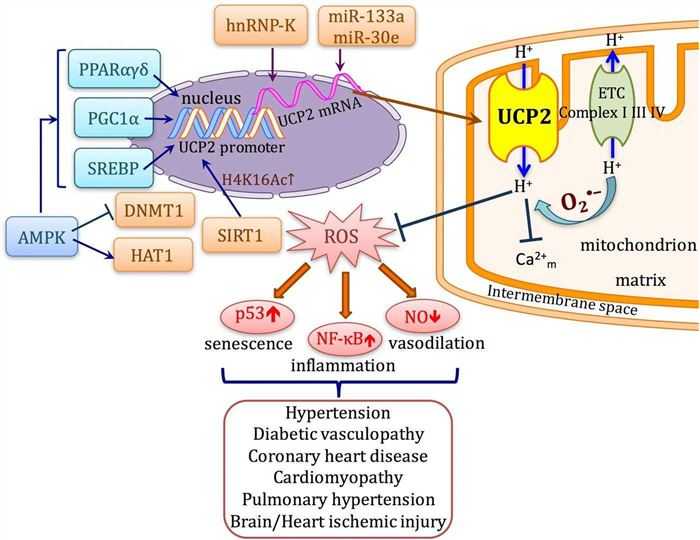 Fig.1 Schematic diagram describing the transcriptional regulation and function of UCP2 in cardiovascular system.1
Several research currents keep converging on this carrier:
UCP2 is produced as a functional protein (conductance measured in a membrane, or no conductance at all) through the use of an optimal eukaryotic expression system, with appropriate folding support to match the six-helix carrier architecture; and selection of formats to maintain the protein in the bilayer context, which defines its behavior. Release testing includes purity via SDS-PAGE; monodispersity via analytical size exclusion chromatography; aggregation status via light scattering analysis; and confirmation of functionality including conductance competence. If your research involves a specific variant background, a defined activator condition, or a presentation compatible with a particular conductance or export assay, we can adjust the protocol accordingly – the format is determined by the experiment.
Not finding the membrane protein product you need? Contact us to start your one-stop custom service!
The use of cellular models to study UCP2 is based on the interaction between UCP2's expression levels and its ability to target mitochondria — if a carrier doesn't reach the inner mitochondrial membrane, it has no effect on the proton leak that it was designed to regulate. Both the overexpression lines containing the wild type protein, and the engineered variant lines can allow us to distinguish between proton conductance and metabolite interactions. Before each clone is released, we characterize it, so that we know how it behaves before starting any experiments. If your project requires a specific variant background, a particular cell density level, or an expression regimen that is compatible with your respirometric timeline, our platform can be customized to meet those needs; each cell line is developed to support the specific experiment that it will be used for.
Not finding the stable cell line product you need? Contact us to start your one-stop custom service!
The use of antibodies to study UCP2 has encountered the issue of the family. The three other members of this uncoupling protein family share the same six-helix mitochondrial carrier structure. In addition, the amino acid sequence of these proteins is similar enough that generic antibody clones have cross-reactivity with each other, thus affecting the accuracy of quantitative analyses when two or more carriers are present in a sample. Therefore, the recombinant antibody panel used in this study is evaluated for its ability to discriminate among the different uncoupling proteins, especially UCP2. Recombinant antibody production with defined sequences ensures consistency in performance from one batch to the next. Also, if a project requires a different conjugate, validation of the antibody for use on a specific sample type, or changing the clone format to accommodate a specific laboratory procedure, such modifications can be made as requested — i.e., the antibody will adjust to suit the experimental design it supports.
Not finding the recombinant antibody product you need? Contact us to start your one-stop custom service!
Extending well beyond our standard catalog, we deliver fully customizable discovery and manufacturing solutions meticulously tailored to the sophisticated demands of UCP2-targeted research and compound development:
Yes. Custom formats and integrated multi-component engagements are routine, with unified quality frameworks keeping specifications aligned across components.
Yes. Readout selection guidance is part of the consultation step—describing the biological question is usually enough for the team to recommend a fitting measurement approach.
All UCP2 products and services are provided strictly for preclinical research. They are not designed, validated, or authorized for any use involving human subjects.
It depends on the question. Conductance-region substitutions suit proton-leak mapping, while regulator-region variants suit gating-mechanism studies. Describing the biological question usually clarifies which background earns its place in the design.









