Creative Biolabs is offering the most comprehensive services for antibody development projects. With strict regulation and effective execution, we are dedicated to providing the most valuable solutions to complete your projects.
HighlightsCreative Biolabs is offering the most comprehensive services for antibody development projects. With strict regulation and effective execution, we are dedicated to providing the most valuable solutions to complete your projects.
HighlightsCreative Biolabs has established a broad range of platforms for developing novel antibodies or equivalents. These cutting-edge technologies enable our scientists to meet your demands from different aspects and tailor the most appropriate solution that contributes to the success of your projects.
HighlightsWith deep understanding in antibody-related realms and extensive project experience, Creative Biolabs offers a variety of references to help you learn more about our capacities and achievements, including infographic, flyer, case study, peer-reviewed publications, and all kinds of knowledge that can assist your projects. You are also welcome to contact us directly for more specific solutions.
HighlightsGet a real taste of Creative Biolabs, one of the most professional custom service providers in the world. We are committed to providing highly customized comprehensive solutions with the best quality to advance your projects.
Highlights Loading...
All listed services and products are For Research Use Only. Do Not use in any diagnostic or therapeutic applications.
Very low density lipoprotein receptor (VLDLR) is a type I transmembrane receptor in the LDL receptor family, encoded by the VLDLR gene on chromosome 9p24.2. The gene spans roughly 40 kb and contains 19 exons. Its mature protein comprises 846 amino acids, preceded by a 27-residue signal peptide. VLDLR shares the same five-domain architecture as LDLR: an N-terminal ligand-binding domain with eight cysteine-rich LA repeats; an EGF precursor-homologous region containing three EGF-like repeats and a YWTD β-propeller that drives acid-dependent ligand release; an O-linked sugar domain; a single transmembrane segment; and a 54-amino-acid cytoplasmic tail with an NPXY motif for clathrin-coated pit clustering. Alternative splicing of exons 4 and 16 yields several transcript variants, including neuronal isoforms that skip exon 4. Expression is highest in heart, skeletal muscle, adipose tissue, and brain, and is essentially absent from liver.
VLDLR acts in both lipoprotein metabolism and intracellular signaling. It binds and internalizes triacylglycerol-rich ApoE-containing lipoproteins, including VLDL, thereby helping deliver VLDL-triglyceride-derived fatty acids to peripheral tissues. Beyond its endocytic function, VLDLR serves as a receptor for Reelin, an extracellular matrix protein that controls neuronal positioning during brain development. Reelin binds directly to the first LA repeat of VLDLR in a calcium-dependent manner, inducing receptor clustering and tyrosine phosphorylation of the intracellular adaptor protein Disabled-1 (Dab1). Phosphorylated Dab1 then recruits downstream SH2 domain-containing proteins including Crk, Nckβ, and PI3K, activating signaling cascades that regulate neuronal migration and synaptic plasticity. VLDLR also undergoes regulated proteolytic processing, with α-secretase and γ-secretase releasing soluble extracellular and intracellular domains. Biallelic loss-of-function variants in VLDLR cause cerebellar hypoplasia, impaired intellectual development, and dysequilibrium syndrome 1 (CAMRQ1), characterized by non-progressive cerebellar ataxia and moderate-to-profound intellectual disability. These properties make VLDLR an important research target for studies of Reelin signaling, neuronal migration, lipoprotein metabolism, and the molecular basis of VLDLR-associated neurodevelopmental disorders.
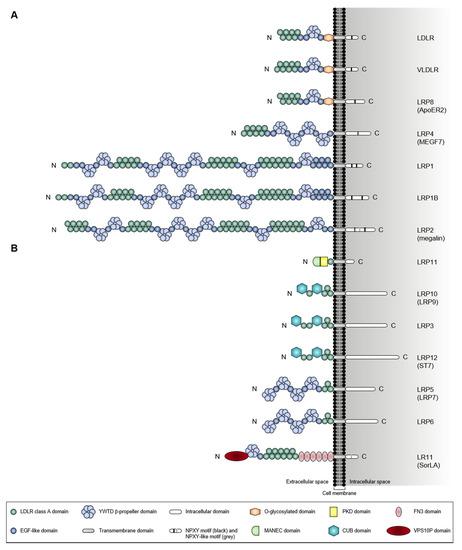 Fig. 1 Human LDLR family members.1
VLDLR, encoded by the VLDLR gene, functions as a multifunctional type I transmembrane receptor with dual roles in signaling and endocytosis:
Creative Biolabs offers high-quality VLDLR membrane protein products produced using optimized expression systems. These include full-length type I transmembrane protein that retains the native membrane-spanning domain and cytoplasmic NPXY motif, as well as isolated extracellular domain variants containing the LA repeats and EGF-like domains. The LA repeats mediate ligand binding to Reelin and ApoE-containing lipoproteins, making these proteins suitable for studies of Reelin-VLDLR interactions, lipoprotein binding, and receptor-mediated signaling characterization. All VLDLR proteins undergo strict quality control to support consistent performance across applicable research platforms.
Not finding the protein product you need? Contact us to start your one-stop custom service!
Creative Biolabs provides custom-engineered VLDLR stable cell lines, including overexpression and knockdown models. These cell lines are optimized for studies of Reelin-Dab1 signaling, neuronal migration, lipoprotein endocytosis, and VLDLR-mediated signaling pathways. Each cell line undergoes stringent validation to ensure stable expression profiles and consistent functional performance in diverse experimental contexts.
Not finding the stable cell line product you need? Contact us to start your one-stop custom service!
High-specificity recombinant antibodies targeting VLDLR are developed using antibody engineering technologies for research applications involving VLDLR expression and localization. These antibodies can be used in studies of VLDLR distribution in neuronal tissues and lipoprotein-metabolizing tissues and may also support characterization of VLDLR-containing signaling complexes in combination with appropriate detection reagents.
Not finding the recombinant antibody product you need? Contact us to start your one-stop custom service!
Beyond catalog products, Creative Biolabs offers specialized custom services for VLDLR research:
VLDLR is a multifunctional type I transmembrane receptor that binds Reelin to activate Dab1-dependent signaling for neuronal migration, and also mediates endocytosis of ApoE-containing lipoproteins for lipid metabolism.
VLDLR is a key receptor in the Reelin signaling pathway controlling brain development. Its loss-of-function mutations cause cerebellar hypoplasia and intellectual disability, and it also plays roles in lipoprotein metabolism, making it important for neurodevelopmental and metabolic research.
No, all VLDLR products and services are strictly for research use only, not intended for clinical diagnosis or treatment.
Offerings include full-length VLDLR membrane proteins, extracellular domain variants, specific detection antibodies, and custom stable cell lines for Reelin signaling and lipoprotein metabolism research.
VLDLR proteins are validated via ligand binding assays, Dab1 phosphorylation assays, and relevant functional characterization in applicable research platforms.