Creative Biolabs is offering the most comprehensive services for antibody development projects. With strict regulation and effective execution, we are dedicated to providing the most valuable solutions to complete your projects.
HighlightsCreative Biolabs is offering the most comprehensive services for antibody development projects. With strict regulation and effective execution, we are dedicated to providing the most valuable solutions to complete your projects.
HighlightsCreative Biolabs has established a broad range of platforms for developing novel antibodies or equivalents. These cutting-edge technologies enable our scientists to meet your demands from different aspects and tailor the most appropriate solution that contributes to the success of your projects.
HighlightsWith deep understanding in antibody-related realms and extensive project experience, Creative Biolabs offers a variety of references to help you learn more about our capacities and achievements, including infographic, flyer, case study, peer-reviewed publications, and all kinds of knowledge that can assist your projects. You are also welcome to contact us directly for more specific solutions.
HighlightsGet a real taste of Creative Biolabs, one of the most professional custom service providers in the world. We are committed to providing highly customized comprehensive solutions with the best quality to advance your projects.
HighlightsThe development of antibody therapeutics is often hindered by challenges such as inconsistent glycosylation, complex regulatory requirements for post-translational modifications, and difficulties in correlating glycan profiles with clinical outcomes. To address these critical issues, Creative Biolabs offers Therapeutic Antibody Glycan Characterization Services. Our platform integrates advanced high-throughput mass spectrometry, automated capillary electrophoresis, and predictive analytics to deliver precise, comprehensive glycan mapping. This service provides you with regulatory-ready data, actionable insights for process optimization, and the confidence that your product's critical quality attributes are fully characterized for safety, efficacy, and consistent manufacturability.
Therapeutic antibodies face immunogenicity risks driven by their uptake and presentation by dendritic cells (DCs). A key regulator of this process is antibody glycosylation, especially the Fc N-glycan at Asn297. Specific glycan features (e.g., mannose, fucose, sialic acid) modulate interactions with DC receptors (FcγRs, CLRs), directly influencing internalization, trafficking, and antigen presentation to T cells. Therefore, detailed glycan characterization is essential for assessing immunogenic potential and enables glyco-engineering to design safer, more effective antibody therapeutics.
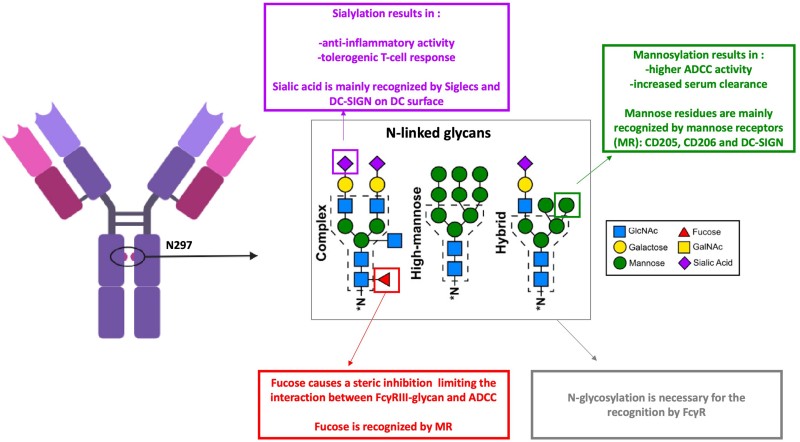 Fig.1 N-Glycan structures on antibodies and their interactions with dendritic cell receptors.1
Creative Biolabs provides an end-to-end analytical suite designed to resolve the heterogeneity of antibody glycosylation. We deliver precise structural identification and quantification of N-glycans, sialic acid distribution, and immunogenic epitopes. By leveraging our services, you can move from clone selection to IND filing with absolute confidence in your molecule's effector functions and stability.
In addition to standard Therapeutic Antibody Glycan Characterization, our distinctive Antibody Glycosylation Analysis & Characterization platform offers a suite of multidimensional extended services. This integrated approach empowers you to comprehensively deconvolute glycosylation heterogeneity, optimize antibody functional attributes, and accelerate the entire development workflow.
Our Glycan Characterization Services offer a suite of specialized analyses designed to address the critical link between antibody glycosylation and therapeutic performance. The following modules provide targeted insights for key development challenges.
This service provides precise quantification of sialic acid species, including Neu5Ac and Neu5Gc (NGNA), on therapeutic antibodies. Accurate measurement is critical for predicting in vivo half-life and ensuring product safety by identifying and mitigating the presence of potentially immunogenic non-human sialic acid residues, thereby supporting robust biotherapeutic development and regulatory compliance.
We offer a comprehensive profiling service to characterize the complex N-glycan structures (e.g., G0F, G1F, G2F, high-mannose) present at the conserved Asn297 site of antibodies. This detailed analysis is essential for lot-to-lot consistency, understanding the impact of glycosylation on effector functions like ADCC and CDC, and optimizing upstream cell culture processes for desired glycoform profiles.
This service provides a comprehensive qualitative and quantitative assessment of the entire glycan population released from your therapeutic antibody. By enzymatically cleaving all N- and O-glycans from the protein backbone and analyzing them in their intact form, we generate a global fingerprint of glycosylation heterogeneity, including the distribution of major classes such as high-mannose, complex, and afucosylated species.
This specialized service focuses on characterizing the glycan structures of ADCs, with particular attention to site-specific conjugation strategies that utilize the sugar chain. By analyzing glycoforms, we help ensure conjugation consistency, verify stable Drug-to-Antibody Ratios (DAR), and confirm that the glycosylation profile does not adversely affect the stability, potency, or pharmacokinetics of the final ADC product.
To begin the service, please provide the starting material for your antibody. This can be a purified protein, unpurified culture supernatant, or detailed sequence and production host information.
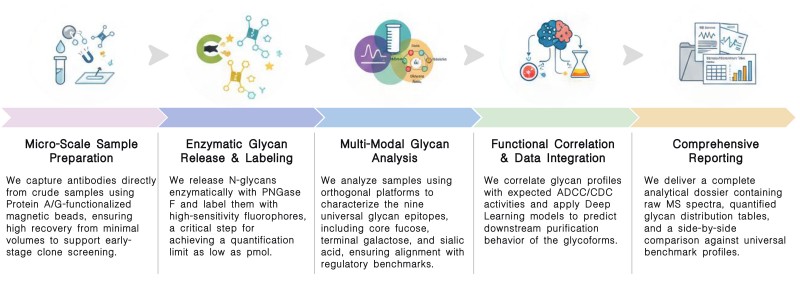
Estimated Timeframe: The standard project timeline is 1 to 3 weeks. The duration depends on project complexity, specifically the required glycan structure refinement and whether chemo-enzymatic synthesis steps are involved.
Choose us for a paradigm shift in glycan analysis. We integrate cutting-edge digital twin and deep learning technologies to not only characterize but also predict glycan impact on safety and manufacturability. Our innovative high-throughput platform accelerates turnaround by 60% over conventional methods, delivering insights that drive smarter development decisions.
"Creative Biolabs' Glycan Characterization Service provided the precise mass spectrometry data critical for our successful IND submission." Dra* M.
"The platform's ability to directly link afucosylation levels to ADCC potency was instrumental in optimizing our lead oncology candidate." Jam* L.
"Implementing their high-throughput 96-well platform enabled real-time bioreactor monitoring, allowing us to dynamically achieve target galactosylation levels." Sar* K.
Our cutting-edge glycan characterization platform delivers unparalleled depth and speed, enabling you to optimize product safety, function, and manufacturability. Contact our technical specialists today for a detailed consultation to define a tailored analysis strategy for your program.
Reference
All listed services and products are For Research Use Only. Do Not use in any diagnostic or therapeutic applications.