Creative Biolabs is offering the most comprehensive services for antibody development projects. With strict regulation and effective execution, we are dedicated to providing the most valuable solutions to complete your projects.
HighlightsCreative Biolabs is offering the most comprehensive services for antibody development projects. With strict regulation and effective execution, we are dedicated to providing the most valuable solutions to complete your projects.
HighlightsCreative Biolabs has established a broad range of platforms for developing novel antibodies or equivalents. These cutting-edge technologies enable our scientists to meet your demands from different aspects and tailor the most appropriate solution that contributes to the success of your projects.
HighlightsWith deep understanding in antibody-related realms and extensive project experience, Creative Biolabs offers a variety of references to help you learn more about our capacities and achievements, including infographic, flyer, case study, peer-reviewed publications, and all kinds of knowledge that can assist your projects. You are also welcome to contact us directly for more specific solutions.
HighlightsGet a real taste of Creative Biolabs, one of the most professional custom service providers in the world. We are committed to providing highly customized comprehensive solutions with the best quality to advance your projects.
HighlightsEffective drug development requires moving beyond simple target binding to understand a compound's functional impact on cellular signaling pathways. Creative Biolabs' In Vitro Cellular & Signaling Investigation Services provide a comprehensive suite of quantitative assays, including phosphorylation analysis, PARP inhibition studies, immune cell profiling, and safety evaluations like phospholipidosis and RBC agglutination testing. We deliver precise, mechanism-driven insights using advanced technologies such as high-content imaging and multiplex detection. Our tailored, physiologically relevant approach clarifies mechanism of action (MOA), de-risks novel targets, and accelerates your therapeutic development from discovery to preclinical validation.
Multidrug resistance (MDR) severely compromises the efficacy of chemotherapy, primarily attributed to mechanisms such as ABC transporter-mediated drug efflux, detoxification processes, and dysregulation of cellular survival pathways. Therefore, developing new agents or utilizing specific antibody-based drugs to reverse MDR holds considerable promise. To systematically evaluate these therapeutic candidates, advanced in vitro assays are essential to analyze drug-cell interactions, transporter activity, cell death pathways, and key signaling cascades. Such experimental platforms are critical for validating mechanisms of resistance reversal and accelerating the advancement of promising candidates into clinical development.
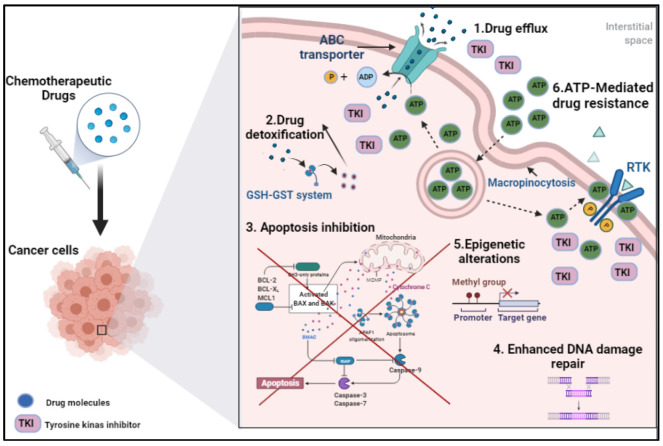 Fig.1 Mechanisms of chemotherapeutic drug resistance in cancer cells. 1
Creative Biolabs' In Vitro Cellular & Signaling Investigation Services deliver precise, quantitative analysis of how compounds modulate intracellular communication. We provide deep mechanistic insights into therapeutic candidates, from target validation to safety assessment. Utilizing advanced platforms and multiplexed detection, we convert molecular engagement into functional cellular outcomes, accelerating your drug development with physiologically relevant and customized assays.
Our In Vitro Cellular & Signaling Investigation Services provide a suite of targeted assays to quantitatively evaluate drug effects on cellular health, signaling pathways, immune function, and key pathological processes in physiologically relevant models.
We quantify markers of cellular aging, such as SA-β-Gal activity and p16/p21 expression, to evaluate drug-induced senescence. This service supports senolytic drug screening, toxicology studies, and cancer drug resistance research.
We measure a drug's ability to inhibit Poly (ADP-ribose) Polymerase (PARP) activity in live-cell models, often through detection of PAR chain formation or NAD⁺ levels. This is critical for developing PARP inhibitors in oncology and DNA damage response pathways.
We provide high-throughput, multiplexed analysis of drug-induced changes in protein phosphorylation using Western blot, ELISA, and so on. This enables mechanism-of-action validation, kinase inhibitor screening, and detailed signaling pathway mapping.
We evaluate compounds for their potential to induce phospholipid accumulation in lysosomes, a common side effect of cationic amphiphilic drugs. Using fluorescent probes and high-content imaging, we support early-stage safety and toxicity screening.
We perform comprehensive immunophenotyping and functional profiling of immune cells (T cells, NK cells, DCs, macrophages) via multicolor flow cytometry, cytokine release assays, and functional readouts. Applications include immuno-oncology, autoimmune disease research, and vaccine development.
We monitor and quantify α-synuclein aggregation kinetics in cellular models using high-content imaging, supporting drug discovery for Parkinson's disease and related synucleinopathies.
We test drug candidates for hemolytic or agglutination potential on red blood cells, providing essential safety data for injectable biologics, IV formulations, and antibodies targeting RBC surface antigens.
Required starting materials:
Key Steps:
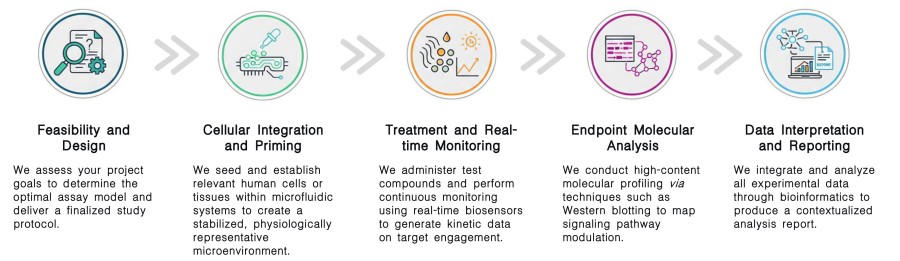
Final Deliverables
Our In Vitro Cellular & Signaling Investigation Services deliver precise, mechanism-oriented data for therapeutic development. We perform high-sensitivity quantitative analysis of key signaling pathways, spanning phosphorylation, immune activity, and protein aggregation, using advanced platforms such as high-content imaging and multiplex detection. Our tailored, physiologically aligned assays convert molecular interactions into functional cellular phenotypes, elucidating MOA, confirming target relevance, and expediting progression from discovery to preclinical validation.
Ready to move beyond target binding and elucidate your compound's functional impact? cell biology team today to discuss how our tailored In vitro Cellular & Signaling Investigation Services can accelerate your therapeutic development.
All listed services and products are For Research Use Only. Do Not use in any diagnostic or therapeutic applications.