Creative Biolabs is offering the most comprehensive services for antibody development projects. With strict regulation and effective execution, we are dedicated to providing the most valuable solutions to complete your projects.
HighlightsCreative Biolabs is offering the most comprehensive services for antibody development projects. With strict regulation and effective execution, we are dedicated to providing the most valuable solutions to complete your projects.
HighlightsCreative Biolabs has established a broad range of platforms for developing novel antibodies or equivalents. These cutting-edge technologies enable our scientists to meet your demands from different aspects and tailor the most appropriate solution that contributes to the success of your projects.
HighlightsWith deep understanding in antibody-related realms and extensive project experience, Creative Biolabs offers a variety of references to help you learn more about our capacities and achievements, including infographic, flyer, case study, peer-reviewed publications, and all kinds of knowledge that can assist your projects. You are also welcome to contact us directly for more specific solutions.
HighlightsGet a real taste of Creative Biolabs, one of the most professional custom service providers in the world. We are committed to providing highly customized comprehensive solutions with the best quality to advance your projects.
HighlightsCreative Biolabs provides an In Vitro Mitochondrial Function Analysis Service to address key challenges in drug discovery, including inconsistent metabolic data, difficulty isolating high-purity organelles, and the detection of subtle drug-induced mitochondrial toxicity. This service enables accurate bioenergetic profiling through advanced oxygen consumption rate (OCR) monitoring, multi-parameter flow cytometry, and high-resolution respirometry technologies. By delivering quantitative and reproducible insights into mitochondrial function and cellular metabolism, Creative Biolabs supports the identification of potential toxicity risks and accelerates the development of safer and more effective therapeutic candidates.
Mitochondria are the metabolic "gatekeepers" of the cell, regulating ATP production, calcium signaling, and apoptosis. Disruptions in mitochondrial dynamics, specifically the balance between fission and fusion, are hallmarks of neurodegenerative and metabolic diseases. Scientific literature emphasizes that in vitro assays are essential for dissecting the molecular machines that drive membrane remodeling. Creative Biolabs leverages these gold-standard methodologies to provide a high-resolution window into organelle function, ensuring that your research is supported by the latest advancements in mitochondrial biology.
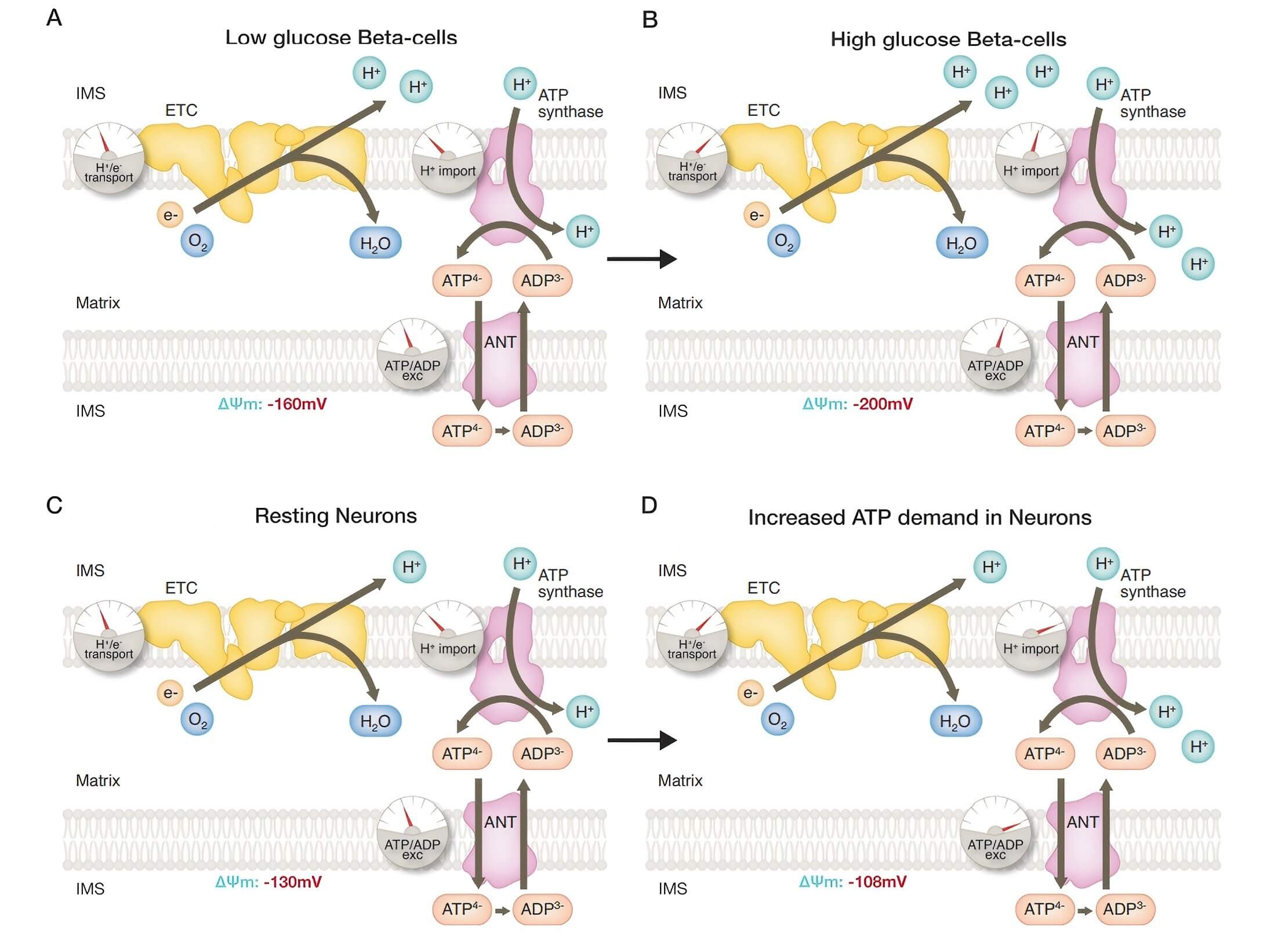 Fig.1 Mitochondrial membrane potential, respiration, and ATP synthesis.1
Creative Biolabs provides a suite of assays designed to decode the functional state of mitochondria in both health and disease. By partnering with us, you gain access to high-end infrastructure that bridges the gap between basic organelle biology and clinical drug development. We assist your project by delivering precise measurements of respiratory capacity, membrane potential, and molecular signaling, ensuring your candidates are evaluated with the highest scientific rigor.
Our key capabilities include bioenergetic performance profiling. This service provides quantitative analysis of mitochondrial respiration and cellular energy production, revealing how compounds or genetic modifications affect metabolic activity. Mitochondrial health is assessed via membrane potential, oxidative phosphorylation efficiency, and ATP generation. Oxidative stress and ROS are measured to evaluate oxidative damage and cellular stress responses. Functional toxicity screening identifies early mitochondrial liabilities to reduce safety risks. These assays also support mechanistic research into metabolic disorders, neurodegenerative diseases, and aging-related mitochondrial dysfunction.
Discover How We Can Help - Request a Consultation
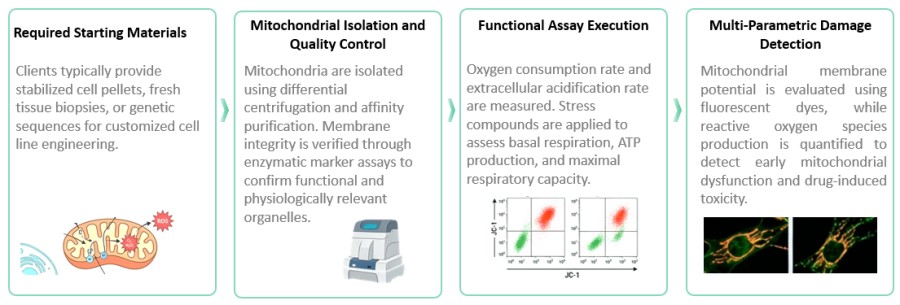
Final Deliverables: Clients receive a Bioenergetic Profile Report, which includes raw and normalized data sets, high-resolution microscopy images of mitochondrial morphology, and a detailed statistical interpretation of metabolic shifts.
| Analysis Parameter | Key Indicators Measured | Typical Assays | Research Significance |
| Mitochondrial Membrane Potential (MMP) Assay | Mitochondrial membrane potential, mitochondrial depolarization, mitochondrial integrity | Membrane potential assays using potential-sensitive probes, live-cell imaging analysis | Evaluates mitochondrial health and early mitochondrial dysfunction |
| Mitochondrial ATP Production Assay | Cellular ATP levels, mitochondrial ATP generation rate | ATP production assays, intracellular ATP measurement | Measures mitochondrial energy output and cellular metabolic activity |
| Mitochondrial Respiration Rate Analysis | Oxygen consumption rate, basal respiration, maximal respiration capacity, spare respiratory capacity | Respiration rate analysis, mitochondrial metabolic stress experiments | Assesses mitochondrial oxidative phosphorylation efficiency |
| Mitochondrial DNA (mtDNA) Copy Number Quantification | mtDNA copy number, mitochondrial genome abundance | mtDNA quantification experiments | Indicates mitochondrial biogenesis and mitochondrial content |
| Mitochondrial Calcium Retention Capacity Assay | Calcium uptake capacity, calcium retention threshold | Mitochondrial calcium uptake assays | Evaluates mitochondrial calcium homeostasis and metabolic regulation |
| Mitochondrial Permeability Transition Pore (mPTP) Opening Assay | mPTP opening events, mitochondrial membrane permeability | mPTP opening assays, mitochondrial swelling experiments | Detects mitochondrial stress and permeability transition related to cell death |
| Real-Time Cell Metabolic Analysis | Oxygen consumption rate, extracellular acidification rate, metabolic flux changes | Real-time metabolic profiling experiments | Monitors dynamic cellular metabolism and mitochondrial activity |
| Mitophagy Analysis | Mitophagy activation, mitochondrial degradation rate | Mitophagy reporter assays, mitochondrial autophagy analysis | Evaluates mitochondrial quality control mechanisms |
| Mitochondrial Oxidative Stress & Antioxidant System Assay | Mitochondrial ROS production, antioxidant enzyme activity, oxidative stress markers | ROS generation assays, antioxidant capacity measurement | Investigates oxidative stress and mitochondrial redox balance |
| Mitochondrial Respiratory Chain Complex Activity Analysis | Activity of respiratory chain complexes I–V | Electron transport chain complex activity assays | Determines the functionality of the mitochondrial oxidative phosphorylation system |
Creative Biolabs serves as your dedicated partner for navigating the complexities of mitochondrial biology. Our In Vitro Mitochondrial Function Analysis Service delivers precise and professional support ranging from high-throughput screening to in-depth mechanistic studies, advancing projects from the bench to the clinic. Our expert team offers tailored technical consultations to meet your specific experimental needs, and you are welcome to contact us at any time to accelerate your research progress.
Reference
All listed services and products are For Research Use Only. Do Not use in any diagnostic or therapeutic applications.