Creative Biolabs is offering the most comprehensive services for antibody development projects. With strict regulation and effective execution, we are dedicated to providing the most valuable solutions to complete your projects.
HighlightsCreative Biolabs is offering the most comprehensive services for antibody development projects. With strict regulation and effective execution, we are dedicated to providing the most valuable solutions to complete your projects.
HighlightsCreative Biolabs has established a broad range of platforms for developing novel antibodies or equivalents. These cutting-edge technologies enable our scientists to meet your demands from different aspects and tailor the most appropriate solution that contributes to the success of your projects.
HighlightsWith deep understanding in antibody-related realms and extensive project experience, Creative Biolabs offers a variety of references to help you learn more about our capacities and achievements, including infographic, flyer, case study, peer-reviewed publications, and all kinds of knowledge that can assist your projects. You are also welcome to contact us directly for more specific solutions.
HighlightsGet a real taste of Creative Biolabs, one of the most professional custom service providers in the world. We are committed to providing highly customized comprehensive solutions with the best quality to advance your projects.
HighlightsPhage Display Technology is a powerful and versatile platform for exploring protein-ligand interactions at the molecular level. This bacteriophage-based screening approach enables the presentation of peptides, antibody fragments, or other protein scaffolds on the surface of viral particles, linking genotype to phenotype in a physically tractable way. Researchers use this technology to interrogate complex libraries, identify high-affinity binders, and map functional epitopes with remarkable precision. By providing a bridge between molecular diversity and experimental selection, phage display allows rapid and efficient discovery of ligands across a wide range of targets.
Creative Biolabs leverages phage display to support foundational research, from understanding immune repertoire diversity to generating candidate molecules for downstream experimental studies. The platform's flexibility allows it to be applied to both human and non-human libraries, supporting diverse research objectives and library formats.
Phage display creates a direct connection between the DNA encoding a peptide or protein and its corresponding displayed product. Each phage particle presents a specific ligand on its coat, while harboring the genetic information required for replication. This enables iterative selection of functional binders without the need for individual cloning or prior knowledge of binding motifs.
Large, combinatorial libraries are generated to maximize molecular diversity. Creative Biolabs designs libraries with controlled complexity to ensure broad coverage of potential interaction surfaces. The diversity of these libraries directly affects the likelihood of identifying rare or high-affinity candidates.
The selection process requires the target molecule to be properly presented, often immobilized on solid supports. Correct orientation and preservation of native conformation are critical to achieving meaningful binding. Techniques include biotin-streptavidin capture, coated plates, or other surfaces optimized for functional accessibility.
Phage populations are subjected to multiple rounds of binding, washing, and elution. Each cycle enriches high-affinity or high-specificity binders while eliminating non-specific or weakly interacting clones. This iterative process enhances the signal-to-noise ratio in downstream analysis.
After iterative selection, enriched phages are analyzed using sequencing, ELISA, or functional assays to identify candidates with desired characteristics. This provides both qualitative and quantitative insights into binding performance and specificity.
Selected clones can be further expressed, engineered, or characterized. Creative Biolabs integrates phage display outputs with molecular characterization pipelines, including affinity measurement, structural analysis, and functional testing.
Connect with Creative Biolabs to learn how our phage-based screening platforms can be tailored for your research goals.
M13 and related filamentous phages are widely used for displaying peptides or antibody fragments. Their flexible coat proteins accommodate a range of insert sizes while maintaining infectivity and stability, allowing efficient library amplification.
T7 bacteriophages provide an alternative display system with rapid replication cycles and high tolerance for diverse protein inserts. These platforms are particularly useful for functional selections requiring robust amplification or expression of larger proteins.
Short peptides displayed on phage coat proteins enable mapping of linear epitopes and discovery of novel binding motifs. Peptide libraries can be tailored in length and composition to target specific binding characteristics.
Single-chain variable fragments (scFv) or Fab fragments can be expressed on phage surfaces to discover human or non-human antibodies. These formats facilitate rapid identification of high-affinity binders suitable for downstream engineering or characterization.
Beyond traditional antibodies, non-immunoglobulin scaffolds can be displayed. Creative Biolabs applies these libraries to expand the discovery potential for structurally diverse targets.
Libraries can be designed with synthetic diversity, biased amino acid distributions, or site-directed variability. This allows researchers to explore targeted regions or motifs with high precision.
Researchers seeking custom library design and phage display system selection are encouraged to contact Creative Biolabs for guidance.
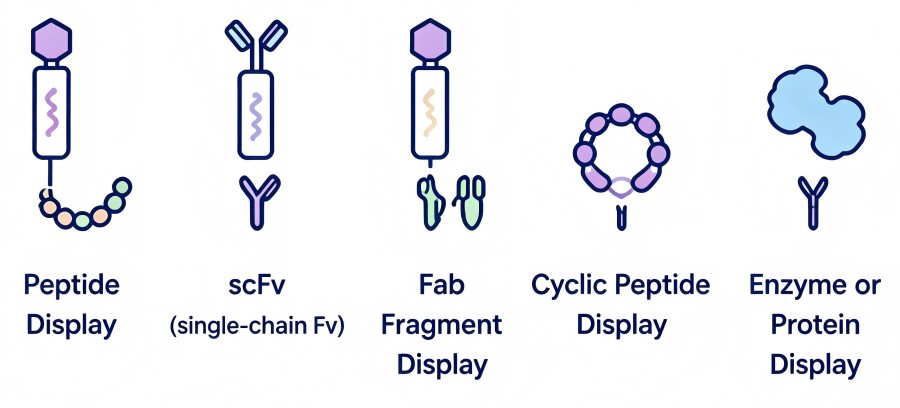 Fig.1 Common Display Formats.
 Versatility across targets
Phage display can be applied to proteins, peptides, small molecules, and even non-protein ligands. Its adaptability makes it suitable for a wide range of molecular recognition studies.
Rapid enrichment of high-affinity binders
Iterative selection cycles allow fast identification of strong binders, reducing the time required compared with conventional screening methods.
Linkage of genotype and phenotype
The inherent connection between displayed protein and encoding DNA streamlines candidate identification, sequencing, and downstream engineering. This feature enables high-throughput and data-driven selection processes.
Compatibility with diverse library sizes
Phage display tolerates extremely large libraries, often exceeding 109 unique clones. This allows comprehensive exploration of binding diversity and increases the probability of identifying rare or subdominant interactions.
Integration with analytical technologies
Enriched phage populations can be evaluated using sequencing, ELISA, flow cytometry, or structural assays. Creative Biolabs integrates these analyses to provide comprehensive assessment of binding quality and specificity.
Support for mechanistic and functional studies
Phage display outputs can feed into downstream studies, including structural characterization, epitope mapping, or mutagenesis analysis, providing mechanistic insight beyond simple binder identification.
Contact Creative Biolabs to learn how phage-based screening platforms can support broad research objectives.
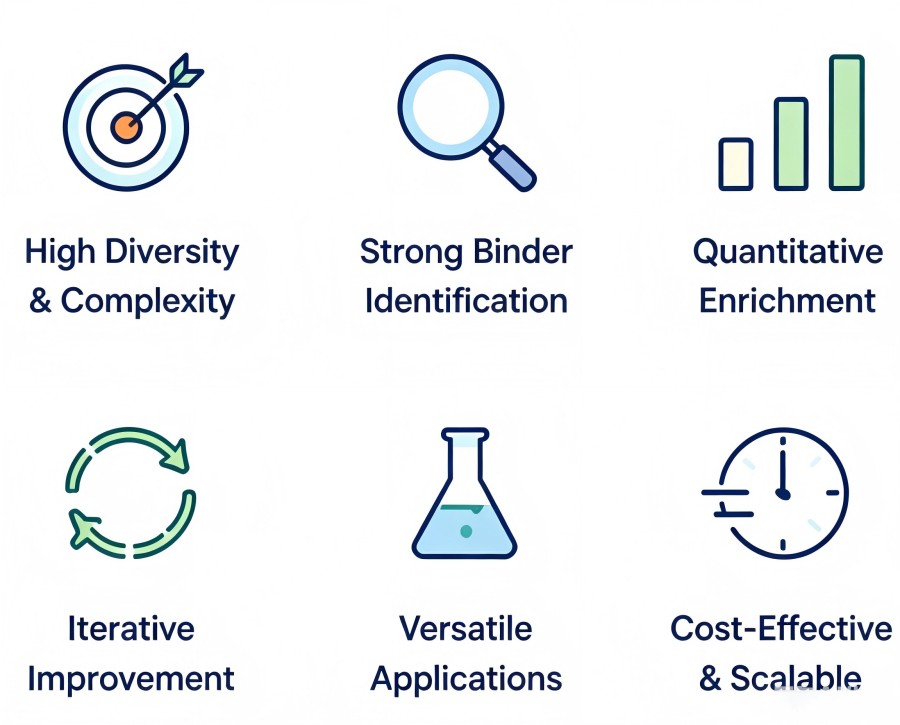 Fig.2 Key Advantages of Phage Display.

Antibody discovery
Phage display remains a cornerstone for identifying monoclonal antibodies and therapeutic leads in research contexts. Its ability to explore both human and non-human repertoires accelerates discovery timelines.

Epitope mapping and functional analysis
Libraries of peptides or fragments allow precise identification of binding sites, facilitating mechanistic understanding and functional characterization.
Protein-protein interaction studies
By displaying interaction partners on phage surfaces, researchers can systematically interrogate molecular interfaces and identify critical contact residues.
Targeted ligand discovery
Phage-based screening enables identification of ligands against difficult or novel targets, including multi-domain or conformationally flexible proteins.

Biomarker and diagnostic development
Affinity-enriched binders can be used in assay development, providing high specificity and sensitivity for biomarker detection or research tools.
Educational and methodological research
Phage display is used to teach fundamental principles of molecular recognition, selection, and protein engineering, offering a hands-on platform for experimental training.
Reach out to Creative Biolabs to discuss how phage display technology can be integrated into your research program.
The initial library complexity determines the range of potential binders. High-quality libraries increase the likelihood of identifying functional candidates.
Proper immobilization and preservation of native structure are critical for meaningful selection. Misfolded targets can lead to non-specific enrichment or false negatives.
Washing, incubation, and elution conditions must be optimized to balance specificity and recovery. Creative Biolabs designs conditions to retain functional diversity while enriching high-affinity clones.
Multiple panning rounds are used to progressively enrich high-quality binders. Each round requires careful monitoring to prevent loss of rare but valuable clones.
Sequencing, ELISA, or other readouts provide feedback on enrichment trends, guiding iterative adjustments to the workflow.
Recovered clones can be expressed, characterized, or engineered for further studies. Creative Biolabs ensures that selection outputs are compatible with downstream experimental pipelines.
Contact Creative Biolabs to learn how these technical considerations are applied to ensure robust phage display workflows.
Creative Biolabs creates tailored libraries for specific project goals, whether peptide, antibody fragment, or alternative scaffold based.
Each project receives a carefully designed screening workflow to maximize enrichment, specificity, and functional relevance.
Sequencing, ELISA, and binding assays are incorporated for iterative monitoring and data-driven optimization.
Protocols are adapted for proteins, peptides, post-translationally modified targets, and structurally complex molecules.
Creative Biolabs provides guidance on experimental design, assay optimization, and interpretation of phage display results.
Clients receive detailed documentation on library composition, enrichment trends, and candidate characteristics.
Connect with Creative Biolabs to explore how our expertise in phage display technology can support your research objectives.
Phage Display Technology provides a versatile, high-throughput platform for exploring protein-ligand interactions, discovering antibodies, and probing molecular recognition. By linking genotype to phenotype, enabling iterative enrichment, and supporting diverse library formats, it offers unparalleled flexibility and precision. Creative Biolabs combines technical expertise, customized workflows, and integrated analytical support to ensure that researchers can fully leverage this technology for discovery, functional analysis, and mechanistic studies. Researchers interested in implementing phage-based screening in their research programs are invited to contact Creative Biolabs to discuss tailored solutions.
All listed services and products are For Research Use Only. Do Not use in any diagnostic or therapeutic applications.