
Creative Biolabs is offering the most comprehensive services for antibody development projects. With strict regulation and effective execution, we are dedicated to providing the most valuable solutions to complete your projects.
HighlightsCreative Biolabs is offering the most comprehensive services for antibody development projects. With strict regulation and effective execution, we are dedicated to providing the most valuable solutions to complete your projects.
HighlightsCreative Biolabs has established a broad range of platforms for developing novel antibodies or equivalents. These cutting-edge technologies enable our scientists to meet your demands from different aspects and tailor the most appropriate solution that contributes to the success of your projects.
HighlightsWith deep understanding in antibody-related realms and extensive project experience, Creative Biolabs offers a variety of references to help you learn more about our capacities and achievements, including infographic, flyer, case study, peer-reviewed publications, and all kinds of knowledge that can assist your projects. You are also welcome to contact us directly for more specific solutions.
HighlightsGet a real taste of Creative Biolabs, one of the most professional custom service providers in the world. We are committed to providing highly customized comprehensive solutions with the best quality to advance your projects.
HighlightsSequential Guided Selection is a structured, stepwise approach designed to gradually convert non-human or early-discovery antibodies into human-compatible candidates. Rather than applying abrupt modifications that could disrupt function, the staged humanization workflow allows researchers to retain the functional integrity of each candidate. Creative Biolabs applies this approach to ensure that promising binders discovered through guided selection campaigns transition seamlessly into human-compatible frameworks suitable for downstream research applications.
Gradually introducing human sequence elements into antibody frameworks ensures that critical structural and functional motifs are preserved. Each stage of modification is carefully planned to maintain binding affinity while reducing immunogenicity. Creative Biolabs evaluates framework compatibility at every step to minimize the risk of functional loss.
Binding residues critical for target interaction are maintained throughout the humanization process. Structural analysis and empirical screening guide which residues can be modified safely. This ensures that target specificity and affinity remain stable across each refinement stage.
After every round of humanization, candidates are evaluated using phage display, ELISA, or alternative screening platforms. This continuous monitoring identifies any reduction in binding performance early. Weak or suboptimal variants are either optimized or removed, improving the quality of the final candidate set.
The selection of germline scaffolds is based on structural and sequence compatibility. Gradual integration avoids introducing destabilizing changes. By carefully balancing the humanization level, Creative Biolabs ensures functional integrity and experimental reliability.
Multiple iterative cycles allow progressive refinement without compromising candidate diversity. Each round incorporates feedback from binding assessments and sequence analysis. This staged approach strengthens both structural stability and functional retention.
Predictive modeling guides residue selection, framework choice, and structural assessments. By combining in silico predictions with empirical data, Creative Biolabs improves the efficiency and accuracy of the humanization workflow.
Connect with Creative Biolabs to learn how these principles can be applied to your specific antibody candidates.
Sequential humanization ensures that top-performing candidates from discovery campaigns retain their functional properties. By preserving both paratope architecture and binding specificity, researchers can maintain high-quality clones throughout refinement.
Staged workflows minimize off-target interactions by carefully selecting which residues and frameworks to replace. This ensures that target recognition remains robust while human compatibility increases.
Humanized antibodies are compatible with structural studies, mechanistic investigations, and biochemical assays. Sequential refinement prepares candidates for a broad range of laboratory applications.
Stepwise adaptation reduces potential immunogenicity and increases molecular stability. This improves solubility, expression, and overall experimental robustness of humanized candidates.
By progressively integrating human frameworks, researchers can examine sequence-function relationships across multiple variants. Insights into structural determinants of binding inform further optimization.
This workflow complements initial discovery campaigns by providing a controlled path from diverse non-human or synthetic repertoires to human-compatible antibody candidates.
Creative Biolabs invites inquiries to discuss how sequential guided humanization can integrate with your antibody discovery program.
Not all human germline scaffolds are equally compatible with non-human sequences. Structural alignment and stability analysis are critical to avoid functional disruption during humanization.
Rapid or aggressive modifications may inadvertently reduce target recognition. Stepwise refinement minimizes this risk by evaluating binding at each stage.
Overly restrictive selection early in humanization can eliminate valuable variants. Maintaining sufficient diversity allows for continued optimization in subsequent rounds.
Correct folding and conformational stability must be maintained as human residues are introduced. Improper modifications can compromise both function and developability.
Sequential modifications accumulate; careful monitoring ensures that incremental changes do not collectively compromise binding or stability.
Empirical feedback, combined with computational predictions, guides each refinement step. This iterative approach ensures functional preservation and maximizes the success of humanized candidates.
For detailed guidance on designing humanization workflows that address these challenges, Creative Biolabs is available for consultation.
01 Strategic planning of selection steps
Each stage of humanization is pre-defined using structural and sequence insights. Creative Biolabs ensures systematic and reproducible refinement that preserves functional activity.
02 Integration with screening platforms
Phage display and alternative screening methods are used to monitor binding throughout the workflow. This ensures that functional performance is maintained while human sequences are incorporated.
03 Framework compatibility assessment
Human germline scaffolds are selected based on structural alignment and functional prediction. The approach reduces disruption while enhancing sequence compatibility.
04 Monitoring sequence integrity and diversity
Sequencing tracks changes across rounds to ensure desired modifications and prevent drift. Library quality is continuously assessed and optimized.
05 Iterative feedback and adjustment
Screening data guides modifications for each subsequent round. Suboptimal variants can be corrected or deprioritized, maintaining candidate robustness.
06 Final validation of humanized candidates
Top candidates undergo comprehensive characterization for binding affinity, specificity, and structural stability. Creative Biolabs provides detailed reporting for downstream research readiness.
Contact Creative Biolabs to discuss how we can implement sequential humanization for your discovery candidates.
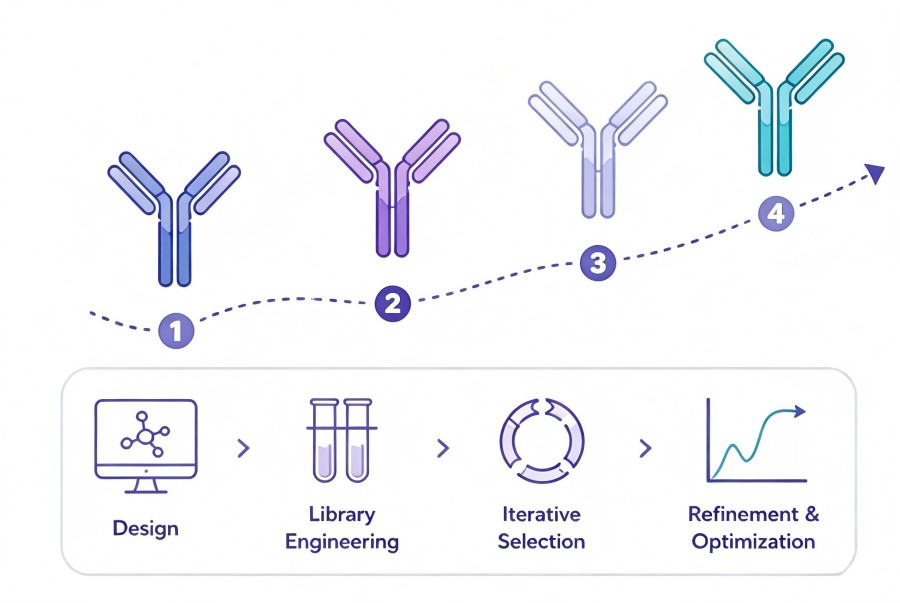 Fig.1 Humanization via Sequential Guided Selection.
 Preserves functional binding profiles
Sequential Guided Selection maintains both affinity and specificity of initial discovery candidates.
Reduces risk of functional loss
Stepwise refinement ensures that gradual framework changes do not compromise binding integrity.
Enhances candidate developability
Humanized antibodies gain improved stability, solubility, and experimental robustness.
Facilitates downstream applications
Candidates integrate seamlessly into structural, mechanistic, and biochemical studies.
Combines computational and empirical guidance
Creative Biolabs merges predictive modeling with experimental data to optimize humanization decisions.
Customizable workflow for diverse targets
Approaches are tailored to antigen types, candidate origin, and project goals, maximizing discovery potential.
Researchers seeking reliable humanization strategies are encouraged to connect with Creative Biolabs for project-specific guidance.
Sequential Guided Selection for Humanization offers a controlled, data-driven framework to convert non-human or early-discovery antibodies into human-compatible candidates. By integrating staged refinement, iterative screening, and computational guidance, Creative Biolabs ensures functional retention, human sequence compatibility, and robust downstream applicability. Researchers seeking efficient and reproducible humanization workflows are invited to contact Creative Biolabs to explore tailored strategies for their antibody discovery programs.
All listed services and products are For Research Use Only. Do Not use in any diagnostic or therapeutic applications.








