
Creative Biolabs is offering the most comprehensive services for antibody development projects. With strict regulation and effective execution, we are dedicated to providing the most valuable solutions to complete your projects.
HighlightsCreative Biolabs is offering the most comprehensive services for antibody development projects. With strict regulation and effective execution, we are dedicated to providing the most valuable solutions to complete your projects.
HighlightsCreative Biolabs has established a broad range of platforms for developing novel antibodies or equivalents. These cutting-edge technologies enable our scientists to meet your demands from different aspects and tailor the most appropriate solution that contributes to the success of your projects.
HighlightsWith deep understanding in antibody-related realms and extensive project experience, Creative Biolabs offers a variety of references to help you learn more about our capacities and achievements, including infographic, flyer, case study, peer-reviewed publications, and all kinds of knowledge that can assist your projects. You are also welcome to contact us directly for more specific solutions.
HighlightsGet a real taste of Creative Biolabs, one of the most professional custom service providers in the world. We are committed to providing highly customized comprehensive solutions with the best quality to advance your projects.
HighlightsNon-Human Donor Guided Selection leverages immune repertoires from non-human sources to facilitate the identification of human-compatible antibodies. By harnessing diverse paratope landscapes unavailable in human donors, this strategy expands the pool of potential binders while maintaining a focus on specificity and functional relevance. The approach is particularly advantageous for challenging antigens or conserved targets that may not be immunogenic in human-only libraries. Creative Biolabs integrates these methodologies into tailored screening campaigns to optimize discovery efficiency and candidate quality.
Non-human donor repertoires provide a wider variety of paratopes, increasing the likelihood of identifying binders that recognize challenging or conserved targets. This diversity can uncover interactions that may be underrepresented or absent in purely human libraries.
Certain antigens are highly conserved and may not elicit strong human immune responses. Screening with non-human repertoires allows researchers to capture antibodies against these conserved regions without compromising specificity.
Non-human antibodies often exhibit structural frameworks and binding modalities distinct from human antibodies. Exploring these alternative landscapes can generate novel binding profiles and functional candidates.
Combining non-human donor repertoires with humanized or synthetic libraries provides complementary coverage, improving the probability of successful candidate identification across multiple epitopes.
Weakly immunogenic or structurally complex antigens often require enriched repertoires from non-human donors to generate high-quality binders that maintain recognition under physiologically relevant conditions.
Human-only libraries are limited by natural immune exposure and tolerance. Non-human guided selection extends the discovery space, providing access to previously inaccessible binding motifs and increasing the potential for functional diversity.
Researchers seeking access to broader immune diversity and unique binding profiles are encouraged to contact Creative Biolabs for technical consultation.
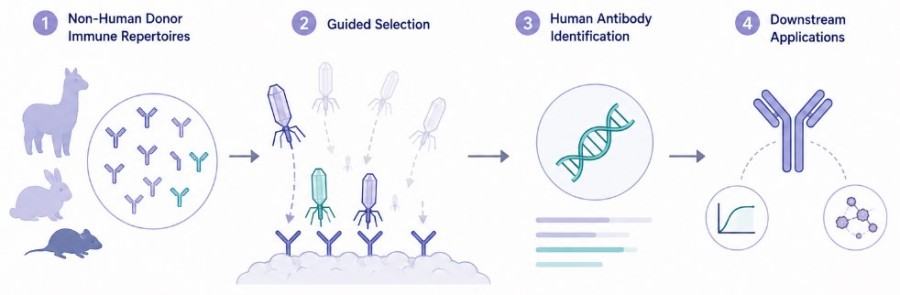 Fig.1 Streamlined Workflow for Human Antibody Identification from Non-Human Repertoires.
Non-human guided approaches improve the likelihood of identifying binders for targets with low immunogenicity, complex conformations, or structural flexibility. By leveraging alternative immune repertoires, rare or weakly recognized epitopes become accessible, increasing overall discovery success. This method supports foundational research objectives by expanding the pool of candidate antibodies that can be further characterized or refined for experimental studies.
Using repertoires from alternative species enables screening against evolutionarily conserved epitopes that may not trigger strong human immune responses. These conserved regions are often functionally critical, making their recognition valuable for mechanistic studies. Non-human guided selection helps identify binders capable of engaging these regions reliably, providing a more complete understanding of target biology.
Subdominant or hidden epitopes that are typically masked in human-only libraries can be revealed when dominant immune responses are bypassed. This approach uncovers interaction sites that may play key roles in molecular recognition or functional modulation. Capturing these rare epitopes enriches the dataset for downstream evaluation and increases the likelihood of finding novel and unique binders.
Combining non-human repertoires with controlled screening strategies allows researchers to assess a wide spectrum of binding interactions. Candidates with unique structural or functional characteristics are more likely to emerge, offering alternative paratope profiles. This broader exploration enhances the diversity and quality of the candidate pool, supporting robust early-stage discovery programs.
Examining how antibodies derived from non-human donors interact with the same target can reveal differences in binding modes, specificity, and affinity. Comparative analysis informs rational candidate prioritization and guides subsequent refinement steps. Insights gained through this approach support better design decisions for humanization or downstream mechanistic studies.
Non-human guided strategies are particularly suited for exploratory research phases where broad binder recovery is critical. They provide access to candidates that might otherwise be missed in human-only libraries, facilitating mechanistic understanding and structural analysis. This approach ensures that promising clones are preserved and evaluated before committing resources to downstream optimization or humanization efforts.
Reach out to our team to discuss how non-human donor guided strategies can enhance your antibody discovery program.
Once promising binders have been identified through non-human donor guided selection, the next step is to refine these candidates for human compatibility. Creative Biolabs' Sequential Guided Selection for Humanization workflow builds on these initial discoveries by progressively adapting non-human antibodies toward human frameworks while preserving binding specificity and functional integrity. This staged approach ensures that early candidate diversity is maintained and that each iteration of refinement is informed by empirical binding data. Explore this strategy to understand how guided humanization can convert broad discovery potential into high-quality, human-compatible antibody candidates.
Contact Creative Biolabs to discuss how these humanization-focused strategies can be integrated into your pipeline.
 Expertise with diverse donor repertoires
Creative Biolabs has extensive experience leveraging non-human immune sources to maximize candidate identification across multiple target classes.
Project-specific selection strategies
Every screening campaign is tailored to antigen characteristics, library format, and desired downstream applications, ensuring optimal discovery outcomes.
Integrated analysis and monitoring
Sequencing, enrichment tracking, and structural evaluation are incorporated throughout the workflow to guide iterative optimization and binder prioritization.
Preservation of binding diversity
Controlled enrichment and selective screening ensure that rare or subdominant interactions are retained for downstream humanization and characterization.
Strong communication and collaboration
Clients receive detailed guidance and updates on workflow design, observed enrichment trends, and strategic decisions throughout the project.
Focused on foundational research
All workflows support early discovery, mechanistic studies, and exploratory antibody identification without introducing clinical or therapeutic claims.
To leverage Creative Biolabs' expertise in guided antibody discovery and tailored screening, connect with our scientific team today.
Non-Human Donor Guided Selection represents a strategic approach to expand antibody discovery beyond the constraints of human-only repertoires. By leveraging diverse immune sources, researchers can uncover novel binding profiles, access subdominant epitopes, and generate candidates suitable for downstream humanization. At Creative Biolabs, we integrate this strategy with careful workflow design, empirical monitoring, and scientific expertise to ensure discovery efforts are both efficient and informative. We invite you to connect with our team to explore how this approach can enhance your next phage display program.
All listed services and products are For Research Use Only. Do Not use in any diagnostic or therapeutic applications.








