
Creative Biolabs is offering the most comprehensive services for antibody development projects. With strict regulation and effective execution, we are dedicated to providing the most valuable solutions to complete your projects.
HighlightsCreative Biolabs is offering the most comprehensive services for antibody development projects. With strict regulation and effective execution, we are dedicated to providing the most valuable solutions to complete your projects.
HighlightsCreative Biolabs has established a broad range of platforms for developing novel antibodies or equivalents. These cutting-edge technologies enable our scientists to meet your demands from different aspects and tailor the most appropriate solution that contributes to the success of your projects.
HighlightsWith deep understanding in antibody-related realms and extensive project experience, Creative Biolabs offers a variety of references to help you learn more about our capacities and achievements, including infographic, flyer, case study, peer-reviewed publications, and all kinds of knowledge that can assist your projects. You are also welcome to contact us directly for more specific solutions.
HighlightsGet a real taste of Creative Biolabs, one of the most professional custom service providers in the world. We are committed to providing highly customized comprehensive solutions with the best quality to advance your projects.
Highlights Loading...
All listed services and products are For Research Use Only. Do Not use in any diagnostic or therapeutic applications.
Atypical chemokine receptor 3 (ACKR3) is a seven-transmembrane class A GPCR encoded by the ACKR3 gene, anchored to plasma membranes of endothelial and neural somatic cell populations. Unlike canonical signaling chemokine receptors with robust cytoplasmic effector coupling, ACKR3 contains seven transmembrane helices and extracellular ligand loops specialized for high-affinity chemokine sequestration without strong downstream kinase activation. It appears to operate as a chemokine scavenging receptor to buffer local extracellular chemokine concentrations under tissue cell migration steady-state conditions. Excess unbound chemokine gradients without ACKR3-mediated clearance create unrestricted directional cell movement, and ACKR3 sustains moderate ligand uptake rates to flatten extreme chemokine gradients across vascular tissue microenvironments. Distinct tissue developmental zones generate divergent chemokine concentration peaks, requiring continuous ACKR3 ligand internalization to maintain uniform chemoattractant availability for migrating cell populations. Membrane-localized ACKR3 binds circulating chemokine ligands and triggers constitutive receptor-ligand endocytosis, removing free attractant molecules from interstitial fluid compartments. Conserved extracellular ligand-binding pockets of ACKR3 support broad-spectrum recognition of multiple chemokine subfamilies without subtype selectivity bias.
ACKR3 may continuously recycle back to plasma membranes after intracellular ligand degradation to sustain prolonged scavenging capacity. Sequence variants within the ACKR3 gene alter chemokine ligand binding affinity and correlate with distorted tissue chemoattractant gradient profiles. No other atypical chemokine receptor fully recapitulates ACKR3's dual capacity for broad chemokine capture and constitutive ligand internalization. Variations in ACKR3 expression levels likely correspond to tissue cell migration regulatory demand, rendering the receptor a suitable research target for atypical GPCR structural analysis. ACKR3 localizes exclusively to outer plasma leaflets and endosomal recycling compartments, never releasing free soluble receptor into cytoplasm. Its integral seven-transmembrane topology separates it from soluble chemokine binding factors, bearing dual potential roles in shaping tissue chemokine gradients and limiting overactive cell migratory signals. Loss of functional ACKR3 elevates unregulated extracellular chemokine levels, making ACKR3 a research subject for scavenger GPCR studies.
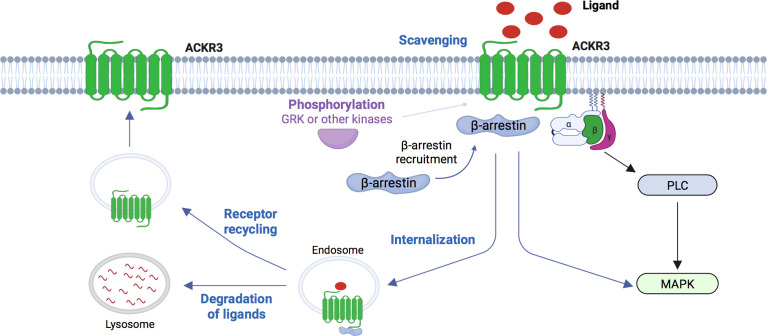 Fig. 1 Putative functional cycle of human ACKR3, illustrating ligand scavenging, receptor internalization, ligand degradation within lysosome and receptor recycling back to plasma membrane.1
The biological functions of integral membrane ACKR3 atypical chemokine receptor are focused on multi-ligand capture and constitutive endocytic scavenging:
Creative Biolabs offers purified ACKR3 membrane protein samples produced under unified preparation workflows, including full-length ACKR3 constructs and isolated extracellular ligand-binding variants. Truncated fragments cannot support broad chemokine recognition and constitutive conformational cycling activity, while full-length constructs fit atypical scavenger receptor research. All batches receive uniform quality screening. Functional assessments may only be performed under simulated lipid bilayer microenvironment setups. Transmembrane bundle and ligand pocket structural integrity are retained across batches for comparative chemokine binding testing. Full-length ACKR3 membrane samples preserve intact multi-chemokine binding surfaces post-purification, supporting reliable detection of transient peptide-receptor complexes in functional analysis.
Not finding the Membrane Protein product you need? Contact us to start your one-stop custom service!
Creative Biolabs provides cell research models with adjustable ACKR3 expression levels, suitable for structural observation of seven-transmembrane atypical GPCRs and chemokine scavenging research. Sample assessment covers sustained membrane receptor detection and multi-peptide ligand binding analysis, enabling side-by-side comparison of chemokine uptake capacity under varying ACKR3 abundances. These cell models can be paired with migration gradient detection schemes to track chemoattractant distribution shifts linked to receptor dosage.
Not finding the stable cell line product you need? Contact us to start your one-stop custom service!
Anti-ACKR3 recombinant antibodies are generated via standardized workflows, compatible with endothelial membrane localization mapping and chemokine-receptor complex identification. The antibody series supports multi-dimensional visualization of ACKR3 distribution within vascular tissue cell populations.
Not finding the recombinant antibody product you need? Contact us to start your one-stop custom service!
Beyond catalog products, Creative Biolabs offers specialized custom services for ACKR3 research:
ACKR3 may act as an integral seven-transmembrane atypical chemokine receptor to sequester diverse extracellular chemokines and modulate local chemoattractant gradients.
ACKR3 expression stays may alter tissue chemokine gradient profiles, serving as a key mediator of ordered cell migration homeostasis biological processes.
No, all ACKR3 related products and services are strictly for research use only, and cannot be applied in clinical workflows. All material design and functional screening are optimized exclusively for basic laboratory research, without meeting clinical application criteria.
Offerings include full-length ACKR3 membrane protein, target-specific recombinant antibodies and tunable expression cell research models, supporting research on broad chemokine sequestration and tissue greater regulation.
Laboratory analysis schemes may include multi-peptide chemokine binding assays to assess broad ligand recognition capacity under simulated lipid bilayer environments.








