
Creative Biolabs is offering the most comprehensive services for antibody development projects. With strict regulation and effective execution, we are dedicated to providing the most valuable solutions to complete your projects.
HighlightsCreative Biolabs is offering the most comprehensive services for antibody development projects. With strict regulation and effective execution, we are dedicated to providing the most valuable solutions to complete your projects.
HighlightsCreative Biolabs has established a broad range of platforms for developing novel antibodies or equivalents. These cutting-edge technologies enable our scientists to meet your demands from different aspects and tailor the most appropriate solution that contributes to the success of your projects.
HighlightsWith deep understanding in antibody-related realms and extensive project experience, Creative Biolabs offers a variety of references to help you learn more about our capacities and achievements, including infographic, flyer, case study, peer-reviewed publications, and all kinds of knowledge that can assist your projects. You are also welcome to contact us directly for more specific solutions.
HighlightsGet a real taste of Creative Biolabs, one of the most professional custom service providers in the world. We are committed to providing highly customized comprehensive solutions with the best quality to advance your projects.
Highlights Loading...
All listed services and products are For Research Use Only. Do Not use in any diagnostic or therapeutic applications.
ADGRG1 (Adhesion G protein-coupled receptor G1) encodes a multi-pass transmembrane adhesion G protein-coupled receptor, detected widely across nervous and multiple other tissue compartments within mammalian cell populations. This membrane-anchored receptor features a large extracellular adhesive domain, seven transmembrane helical segments, and intracellular cytoplasmic regions capable of interacting with assorted cytosolic G-protein and adaptor components. Following biosynthesis, newly-synthesized ADGRG1 undergoes folding, proteolytic processing and endomembrane-system quality-control processing. Mature receptor molecules are anchored onto plasma-membrane surfaces, while partial protein pools remain stored within intracellular vesicular compartments to sustain receptor maturation, membrane trafficking and physiological protein turnover. Cell-surface abundance of ADGRG1 can be dynamically tuned to satisfy tissue-specific cell-matrix interaction and membrane-signaling adaptive demands.
At cell-surface membrane microenvironments, ADGRG1 may assemble into reversible heteromeric multiprotein receptor complexes with other membrane-resident receptor subunits and extracellular matrix binding partners. Complex stability and membrane-localized receptor abundance are modulated by local biochemical microenvironments, shaping the scope of membrane-based intermolecular communication. Perturbations to ADGRG1 structural integrity or expression magnitude may interfere with surface-localized receptor-partner complex organisation and shift measurable readouts derived from adhesion-receptor interaction studies. Tissue microenvironments requiring cell-matrix communication rely on properly assembled multimeric receptor assemblies to sustain local membrane-associated physiological homeostasis, and membrane-anchored ADGRG1 may support such physiological status through cooperative interactions with adjacent receptor subunits and intracellular regulatory binding partners. Genetic-sequence alterations within the ADGRG1 coding locus may impair protein folding, extracellular matrix-binding interfaces, transmembrane-region packing, and intracellular G-protein coupling capacity. Closely related adhesion GPCR paralogues cannot fully reproduce ADGRG1-unique complex-forming profiles and tissue-distribution characteristics. Variations in ADGRG1 protein abundance correspond to cellular adaptive requirements for adhesion-dependent membrane signaling responses, rendering this transmembrane receptor a valuable research subject for dissecting adhesion-GPCR biology and cell-matrix associated membrane homeostasis. Without appropriate heteromeric partner-subunit assembly, ADGRG1-containing receptor complexes are unlikely to sustain stable downstream signaling outputs. Its characteristic multi-pass transmembrane topology and large extracellular adhesive domain architecture differentiate ADGRG1 from numerous other cell-surface GPCR molecules, supporting ordered spatial organisation of membrane-localised receptor complexes and mediating selective reversible contacts with diversified extracellular partner moieties. Diminished functional competence of ADGRG1 may trigger disorganised receptor-partner complex arrangement and weaken tissue-level cell-matrix adaptive buffering capacity, highlighting its research relevance for adhesion-GPCR-oriented laboratory investigations.
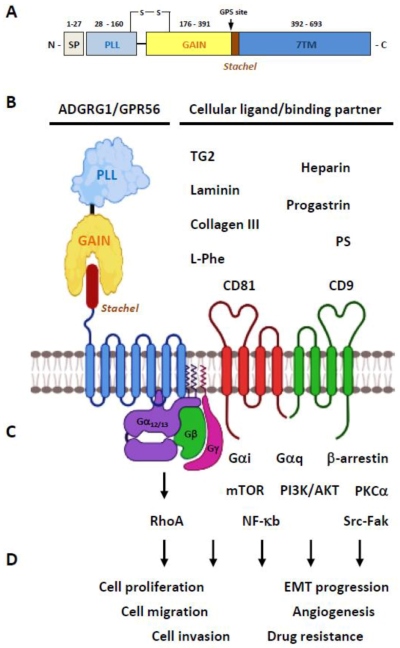 Fig. 1 Schematic domain architecture of human ADGRG1 (GPR56) and its molecular binding partners, for ADGRG1 membrane protein, stable cell line and recombinant antibody research reagent characterization.1
The biological functions of transmembrane ADGRG1 adhesion G protein-coupled receptor G1 protein are focused on sustained heteromeric partner-complex interaction and membrane-signaling-homeostasis coordination:
Creative Biolabs offers purified ADGRG1 membrane protein samples generated under unified preparation workflows, including full-length constructs and isolated domain-truncated variants. Truncated domain fragments cannot support complete surface-partner-complex assembly behaviours, whereas full-length constructs suit research focused on partner-complex interaction and adhesion-GPCR-related functional observation. All batches receive uniform quality screening. Function-oriented observation may only be performed using full-length samples under simulated plasma-membrane-microenvironment setups. Consistent structural features are preserved across batches to support comparative laboratory analysis across separate test groups. Full-length ADGRG1 samples retain intact partner-interaction-domain conformation after standardized purification, supporting reliable detection of weak and transient receptor-partner contacts for comparative functional analysis.
Not finding the Membrane potein product you need? Contact us to start your one-stop custom service!
Creative Biolabs provides adjustable ADGRG1 expression cell research models with tunable target-expression levels, applicable to structural observation of multi-pass adhesion G protein-coupled receptor membrane protein and research into membrane-partner molecular interaction. Sample evaluation includes sustained target-protein expression detection and preliminary partner-interaction observation, enabling side-by-side comparison of receptor-binding behaviours under differing target-protein abundances. These cell systems can pair with diverse laboratory analysis schemes to track changes in partner-assembly efficiency alongside shifting ADGRG1 protein levels.
Not finding the stable cell line product you need? Contact us to start your one-stop custom service!
Anti-ADGRG1 recombinant antibodies are generated via standardized protein preparation workflows, compatible with routine laboratory detection techniques for plasma-membrane localization mapping and identification of receptor-partner molecular complexes. The antibody series can work alongside common laboratory detection reagents to realise multi-dimensional observation of target-protein distribution within membrane-enriched sample materials.
Not finding the recombinant antibody product you need? Contact us to start your one-stop custom service!
Beyond catalog products, Creative Biolabs offers specialized custom services for ADGRG1 research:
ADGRG1 might act as a multi-pass adhesion G protein-coupled receptor membrane protein and participate in heteromeric surface-complex assembly to modulate receptor-complex arrangement and membrane-signaling homeostasis.
ADGRG1 expression status could alter surface-receptor-complex assembly efficiency and local plasma-membrane-coupled molecular-interaction balance, serving as an important mediator of cell-matrix-associated membrane-homeostasis-related biological processes.
No, ADGRG1-associated research reagents from Creative Biolabs are exclusively built for exploring adhesion-GPCR-family-dependent membrane regulatory mechanisms, and shall not be deployed for any clinical-oriented workflows. These preparations are optimized for basic laboratory investigation and do not satisfy performance benchmarks required for clinical implementation.
Offerings include full-length ADGRG1 membrane protein, target-specific recombinant antibodies and tunable-expression cell research models, supporting research on membrane-signaling homeostasis and receptor-mediated membrane-partner perception.
Laboratory observation schemes may include receptor-partner-interaction related tests to analyse molecular-binding associated behaviours under simulated plasma-membrane-microenvironment conditions.









