
Creative Biolabs is offering the most comprehensive services for antibody development projects. With strict regulation and effective execution, we are dedicated to providing the most valuable solutions to complete your projects.
HighlightsCreative Biolabs is offering the most comprehensive services for antibody development projects. With strict regulation and effective execution, we are dedicated to providing the most valuable solutions to complete your projects.
HighlightsCreative Biolabs has established a broad range of platforms for developing novel antibodies or equivalents. These cutting-edge technologies enable our scientists to meet your demands from different aspects and tailor the most appropriate solution that contributes to the success of your projects.
HighlightsWith deep understanding in antibody-related realms and extensive project experience, Creative Biolabs offers a variety of references to help you learn more about our capacities and achievements, including infographic, flyer, case study, peer-reviewed publications, and all kinds of knowledge that can assist your projects. You are also welcome to contact us directly for more specific solutions.
HighlightsGet a real taste of Creative Biolabs, one of the most professional custom service providers in the world. We are committed to providing highly customized comprehensive solutions with the best quality to advance your projects.
Highlights Loading...
All listed services and products are For Research Use Only. Do Not use in any diagnostic or therapeutic applications.
CD244, also known as SLAMF4 or NAIL, is an approximately 40–70 kDa type I transmembrane glycoprotein that belongs to the signaling lymphocyte activation molecule (SLAM) family in the CD2 superfamily. CD244 is widely expressed on various hematopoietic cells, including NK, subsets of CD8+ cytotoxic T lymphocytes, γδ T cells as well as monocytes macrophages basophils eosinophils dendritic cells and myeloid-derived suppressor cell (MDSCs). CD48 is a GPI-anchored glycoprotein widely expressed on almost all hematopoietic cells. The CD244–CD48 interaction is one of the best characterized axes in SLAM receptor network, and serves as an important regulator of both innate and adaptive immune responses. In contrast to many immune receptors that function solely as activating or inhibitory molecules, CD244 displays striking functional plasticity—activation of lymphocytes can be either augmented by or inhibited via engagement with this receptor and is determined by other factors such as cellular context, differentiation stage, and intracellular availability of appropriate adapter proteins.
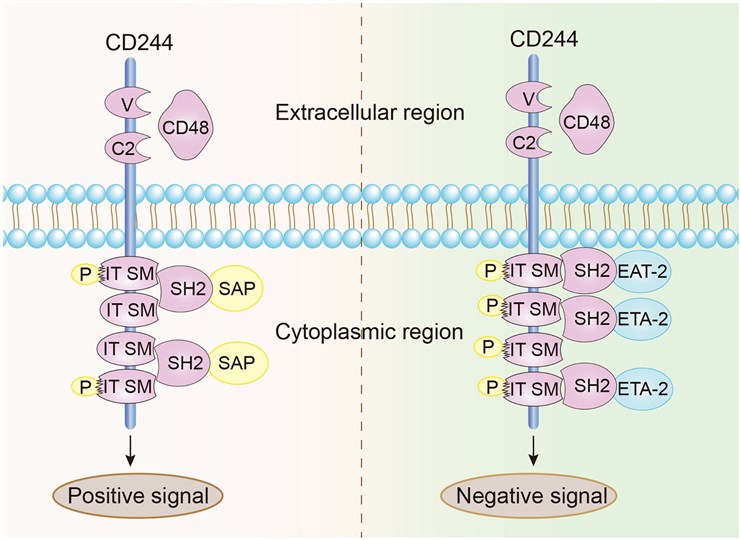 Fig.1 Structural characteristics and signal transmission model of CD244.1
CD244 functional repertoire is focused on cancerous integration of activating/inhibitory signals by competitive adaptor recruitment:
Accelerate your research in Immunology and Immuno-Oncology with our catalogue of carefully manufactured recombinant CD244 membrane proteins. The IgV/IgC2 extracellular architecture, single-pass transmembrane topology and ITSM-dependent signaling of CD244 have all been identified as unique challenges for production. To tackle these challenges we utilize different expression platforms (mammalian HEK293 cells, insect cell systems and VLP formats) to yield correctly-folded, fully glycosylated CD244 constructs maintaining native CD48-binding affinity as well as SAP-recruitment competence. We provide membrane-bound, soluble extracellular domain fragments and variants of cytoplasmic tails for full-length CD244. All preparations are characterized biophysically to ensure they can be used for structural studies, ligand binding assays and antibody screening.
Not finding the membrane protein product you need? Contact us to start your one-stop custom service!
Well-defined, reproducible cellular models are essential for analyzing CD244-mediated biology and therapeutic candidates. We specialize in stable cell lines expressing wild or engineered forms of mouse, and rat CD244 as well as regulated endogenous expression for loss-of-function studies. The platforms are designed for Low-access immune-oncology to high-throughput NK cell cytotoxicity assays, modeling CD8+ T-cell exhaustion and suppression assay of MDSC utilizing effective phenotype stimulations or blockade studies targeting CD48 with assurances of experimental consistency necessary to exploit the complexities generated by multi-phase areas in translational research.
Not finding the stable cell line product you need? Contact us to start your one-stop custom service!
Our extensive portfolio of engineered high-affinity recombinant antibodies against CD244 in formats designed to withstand the rigors of most experimental protocols. These antibodies obtained by a state-of-the-art recombinant process demonstrate remarkable specificity, sensitivity and reproducibility as compared to conventional polyclonal antibodies. We offer a range of CD244 recombinant antibodies that have been validated for use in various applications, including WB, ELISA, FCM; IF IHC and ICC IP, allowing precise disclosure of CD244 detection and quantification from several sample types (e.g., NK cell lysates; TIL preparations & tissue sections) derived from cancer models.
Not finding the recombinant antibody product you need? Contact us to start your one-stop custom service!
In addition to products in our catalog, we also provide custom services for membrane protein and antibody discovery & development. With some of the highest level expertise in SLAM family receptor biology and immune checkpoint pharmacology, we are equipped to help you with:
No, all reagents and services provided are for research purposes only and not intended to be used in diagnostic testing or therapeutic repair.
We can develop customized CD244/CD48 co-expression cell models according to specific research requirements. Cell model design, expression strategy, and appropriate readouts for receptor expression, cell–cell interaction, or synapse-related studies can be determined based on the intended experimental design.
Yes. The immunogen is directed towards a hyper-conserved region among mammalian species, allowing for consistent detection in human, mouse and rat lymphoid preparations without the need for numerous specific reagents from different sources.
Absolutely. We routinely generate Tetracycline-inducible systems and lines co-expressing CD244 with eitherCD48, SAP or EAT-2 reporter constructs for comprehensive pathway analysis. We welcome extensive conversations around your expression architecture and phenotypic needs.








