
Creative Biolabs is offering the most comprehensive services for antibody development projects. With strict regulation and effective execution, we are dedicated to providing the most valuable solutions to complete your projects.
HighlightsCreative Biolabs is offering the most comprehensive services for antibody development projects. With strict regulation and effective execution, we are dedicated to providing the most valuable solutions to complete your projects.
HighlightsCreative Biolabs has established a broad range of platforms for developing novel antibodies or equivalents. These cutting-edge technologies enable our scientists to meet your demands from different aspects and tailor the most appropriate solution that contributes to the success of your projects.
HighlightsWith deep understanding in antibody-related realms and extensive project experience, Creative Biolabs offers a variety of references to help you learn more about our capacities and achievements, including infographic, flyer, case study, peer-reviewed publications, and all kinds of knowledge that can assist your projects. You are also welcome to contact us directly for more specific solutions.
HighlightsGet a real taste of Creative Biolabs, one of the most professional custom service providers in the world. We are committed to providing highly customized comprehensive solutions with the best quality to advance your projects.
Highlights Loading...
All listed services and products are For Research Use Only. Do Not use in any diagnostic or therapeutic applications.
CD82, originally named KAI1, was first identified as a metastasis suppressor gene. To put it simply, when it first came to scientists' attention, it was classified into this category of metastasis-suppressing genes only after researchers discovered its ability to block the spread of cancer cells. It is one of the founding members of the tetraspanin protein family. Proteins in this family are all small in size, with four structures that cross the cell membrane, yet their overall impact on the physiological activities of the cell membrane is far beyond what their small size would lead one to expect. The structure of tetraspanins has distinct characteristics: four helical transmembrane structures enclose two extracellular loops, one small and one large. On the side facing the interior of the cell, there are also short terminal sequences, making the entire structure regular and well-defined. This research history first began in the field of cancer research. When prostate tumors progress from localized disease to metastatic spread — that is, when they worsen from a local tumor confined to the primary lesion to metastatic cancer capable of spreading throughout the body — the chromosomal fragment carrying CD82 is frequently lost. Conversely, reintroducing this protein into experimental cells that have already acquired metastatic ability can suppress the spread of cancer cells without affecting the growth of the cells themselves. This is equivalent to only halting their spread, without disrupting their own proliferation rhythm. Its mechanism of action still ties back to the tetraspanin web. CD82 organizes its cooperating adhesion molecules and signaling proteins into the same membrane microdomain. The structure of this region restricts the cell's motility, preventing the cell from moving freely. If CD82 is lost, the entire protein web rearranges, integrin-dependent cell migration speed increases, and the cell gains the invasive behavior required for metastasis, enabling it to penetrate other tissues and establish new growth sites.
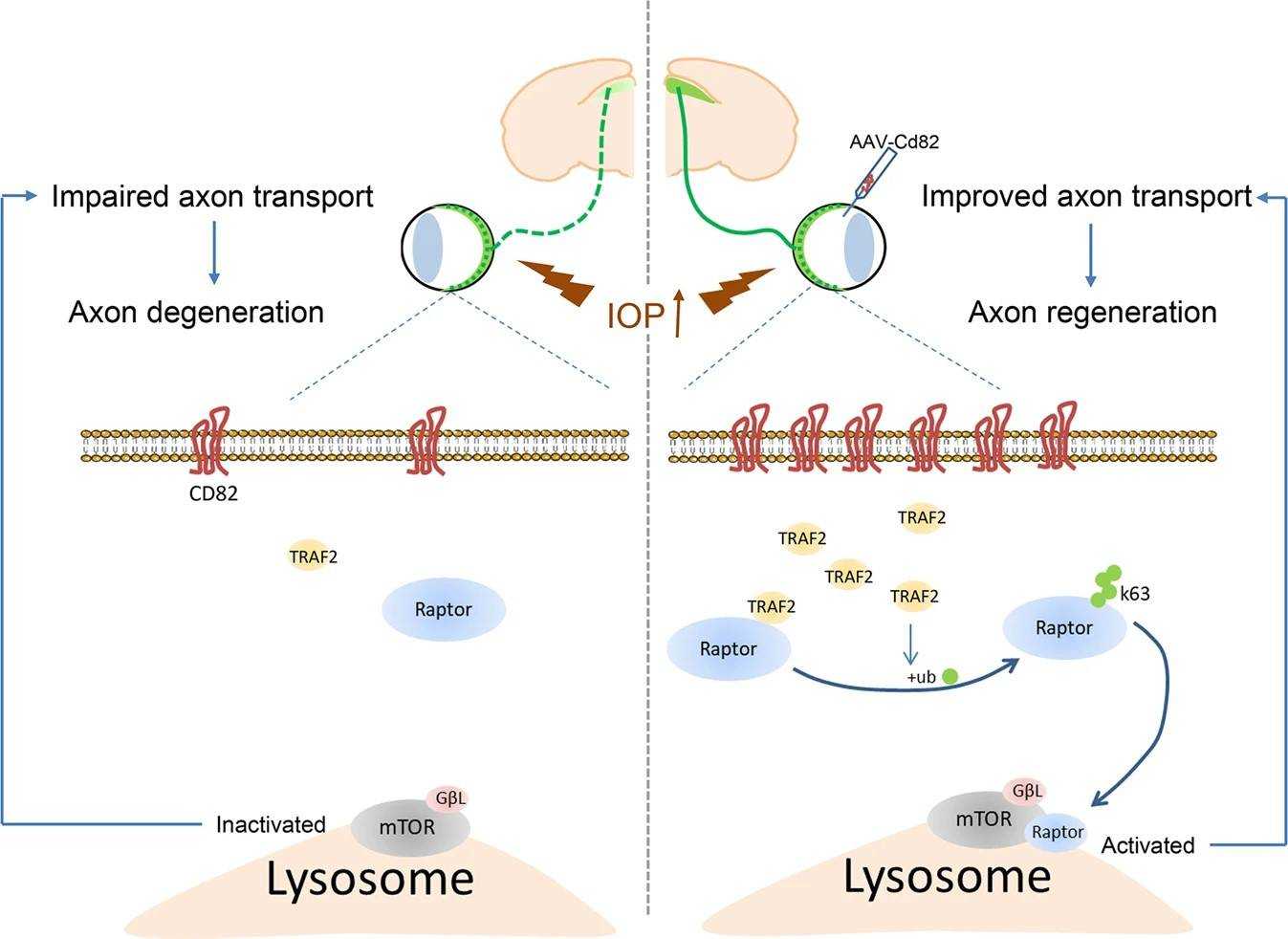 Fig.1 Schematic representation of CD82 neuroprotection effect after ocular hypertension.1
Currently, multiple independent research trends have simultaneously turned their attention to this tetraspanin:
To produce a CD82 protein that meets functional criteria, its two extracellular loops and the four-helix scaffold that supports these two loops must be fully protected. These two structures form the foundation for CD82 to carry out all its normal functions; even a minor problem renders the entire protein nonfunctional. However, all subsequent binding partner interaction assays and antibody recognition assays that support valid research will fail, and all data generated will be invalid, completely unusable for your research. Our full-length CD82 protein is derived from an optimized eukaryotic expression system. The folding support capacity of this system is fully compatible with the conserved structure of tetraspanins. Every batch of protein undergoes dual quality inspections before leaving the facility: SDS-PAGE is used to verify purity, ensuring no contaminating proteins are present; analytical size-exclusion chromatography is used to verify monodispersity, confirming that proteins do not aggregate and remain in an independent, active state. If your research requires a background with specific loop mutations, a chemically defined cell membrane, or a protein presentation format adapted to specific interaction or assembly experiments, we can readjust the preparation protocol and construct vectors fully in line with your experimental framework. Your experiments will never need to adapt to off-the-shelf products; we will customize the product to exactly meet your requirements.
Not finding the membrane protein product you need? Contact us to start your one-stop custom service!
Our cell line panel includes both CD82 wild-type overexpression strains and a full range of CD82 mutant strains. Researchers can use these cell lines to pinpoint which cell surface regions mediate interprotein interactions, and clarify the exact binding site between CD82 and its partner proteins. Every cell clone completes a full set of characterization assays before shipment, so its baseline state is already validated before you run your first experiment. You will not need to spend several weeks conducting preliminary cell characterization assays; you can directly advance your core research as soon as you receive the cells. If your research requires a specific mutation background, a specific expression level tier, or a protein expression timeline aligned with the schedule of a migration assay, this cell platform can be customized to your needs. Cell lines are purpose-built for the experiments they will support, so you will never have to modify your experimental protocol to adapt to off-the-shelf cell lines.
Not finding the stable cell line product you need? Contact us to start your one-stop custom service!
Developing antibodies for CD82 research can present a cross-reactivity challenge because the tetraspanin family contains more than 30 members that share a conserved four-transmembrane topology. Structural similarities among family members may increase the need to evaluate antibody selectivity, particularly in samples where multiple tetraspanins are co-expressed. Potential cross-reactivity can complicate quantitative interpretation if signals from related proteins are not adequately distinguished. Our recombinant anti-CD82 antibody panel is developed for selective recognition of CD82, with specificity and family counter-screening data provided where available for individual clones. All antibodies are produced from defined recombinant sequences, which supports lot-to-lot consistency and reproducibility. If your project requires different conjugates, validation for specific sample types, or adjustments to antibody clone formats, appropriate options can be evaluated according to the intended experimental workflow and available validation data.
Not finding the recombinant antibody product you need? Contact us to start your one-stop custom service!
In addition to our catalog products, Creative Biolabs specializes in custom services for membrane protein and antibody discovery & development. Using our deep knowledge and sophisticated platforms we can support you with:
Oncogenes drive proliferation, while metastasis suppressors gate the dissemination step specifically. CD82's restoring suppresses spread without suppressing growth, defining the suppressor category and shaping how mechanism research is framed.
All CD82 products and services are provided strictly for preclinical research. They are not designed, validated, or authorized for any use involving human subjects.
Metastasis-suppression mechanism, tetraspanin-web biology, membrane-microdomain research, and cancer migration studies are the standing territories of use.
Conformation-sensitive clones distinguish the organized, partner-engaged state from other conformations, letting researchers track web participation rather than merely protein presence.









