
Creative Biolabs is offering the most comprehensive services for antibody development projects. With strict regulation and effective execution, we are dedicated to providing the most valuable solutions to complete your projects.
HighlightsCreative Biolabs is offering the most comprehensive services for antibody development projects. With strict regulation and effective execution, we are dedicated to providing the most valuable solutions to complete your projects.
HighlightsCreative Biolabs has established a broad range of platforms for developing novel antibodies or equivalents. These cutting-edge technologies enable our scientists to meet your demands from different aspects and tailor the most appropriate solution that contributes to the success of your projects.
HighlightsWith deep understanding in antibody-related realms and extensive project experience, Creative Biolabs offers a variety of references to help you learn more about our capacities and achievements, including infographic, flyer, case study, peer-reviewed publications, and all kinds of knowledge that can assist your projects. You are also welcome to contact us directly for more specific solutions.
HighlightsGet a real taste of Creative Biolabs, one of the most professional custom service providers in the world. We are committed to providing highly customized comprehensive solutions with the best quality to advance your projects.
Highlights Loading...
All listed services and products are For Research Use Only. Do Not use in any diagnostic or therapeutic applications.
Cholinergic receptor nicotinic alpha 3 subunit (CHRNA3), also known as NACHRA3 or ACHA3, is encoded by the CHRNA3 gene on chromosome 15q25.1. The gene contains 9 exons and lies within the CHRNA5–CHRNA3–CHRNB4 gene cluster, a region repeatedly implicated in nicotine dependence and lung cancer susceptibility. The encoded protein is a member of the nicotinic acetylcholine receptor (nAChR) family and contains the characteristic adjacent cysteine residues that define alpha-type subunits. CHRNA3 is a multi-pass membrane protein with an extracellular ligand-binding domain (residues 33–238) and a neurotransmitter-gated ion-channel transmembrane domain (residues 246–493) comprising four transmembrane helices (TM1–TM4), in which the TM2 helix lines the ion-conducting pore. CHRNA3 is expressed in the adrenal gland, autonomic ganglia, and specific regions of the central nervous system, where it assembles with other nAChR subunits.
CHRNA3 is a core component of ganglionic nicotinic acetylcholine receptors, which mediate fast excitatory synaptic transmission in the autonomic nervous system. CHRNA3 assembles with CHRNB4 to form the ganglionic-type receptor (CHRNA3:CHRNB4), and also forms heteropentameric receptors with CHRNA5 and CHRNB2 or CHRNB4. These pentameric, ligand-gated cation channels are highly permeable to calcium and open upon acetylcholine binding, transmitting efferent sympathetic and parasympathetic activity to postganglionic neurons. In the habenulo-interpeduncular tract, CHRNA3-containing receptors modulate the mesolimbic dopamine system and affect reward circuits and addiction. Hypothalamic CHRNA3:CHRNB4 receptor activation by nicotine activates POMC neurons and reduces food intake. CHRNA3 is also expressed in the urothelium, where it modulates reflex bladder activity by increasing intracellular calcium and basal ATP release. Mutations in CHRNA3 cause familial autonomic ganglionopathy with diffuse autonomic failure, and biallelic mutations have been linked to functional lower urinary tract obstruction and congenital anomalies of the kidney and urinary tract (CAKUT), with some affected individuals showing impaired pupillary light reflexes. These features make CHRNA3 an important research target for studies of nicotinic receptor assembly, autonomic neurotransmission, channel gating, and the molecular mechanisms of ganglionic acetylcholine receptor disorders.
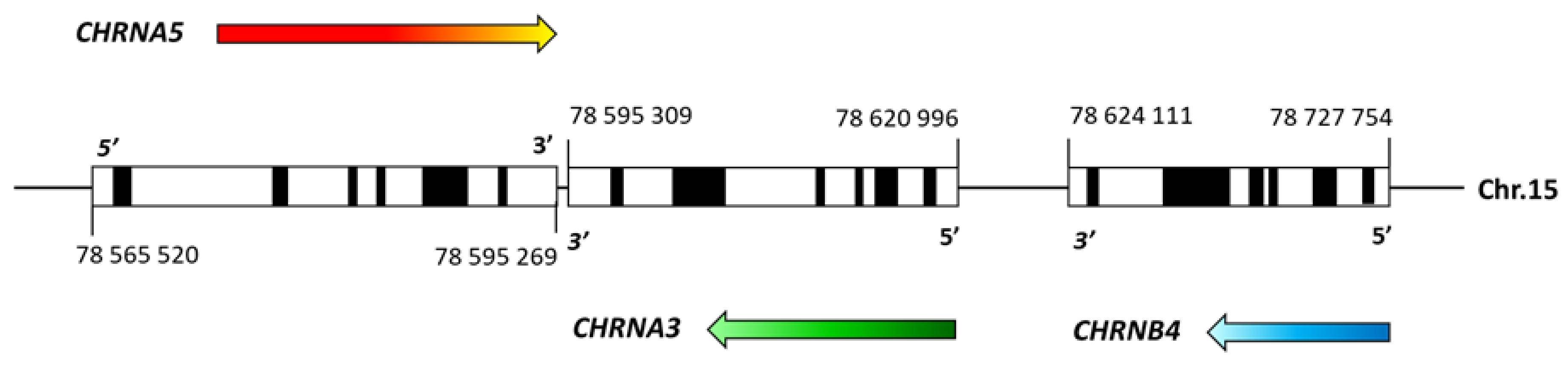 Fig. 1 Diagram of the human CHRNA5/A3/B4 gene cluster.1
CHRNA3, encoded by the CHRNA3 gene, functions as the acetylcholine-binding subunit of ganglionic nicotinic receptors that mediate fast synaptic transmission in the autonomic nervous system:
Creative Biolabs offers high-quality CHRNA3 membrane protein products produced using optimized expression systems. These include full-length multi-pass transmembrane protein that retains the native four-transmembrane domain architecture (TM1–TM4), the extracellular ligand-binding domain, and the intracellular loop, as well as isolated ligand-binding domain variants. The extracellular domain contributes to the acetylcholine-binding site, and the TM2 helix lines the ion-conducting pore, making these proteins suitable for studies of nicotinic receptor assembly, ligand binding, channel gating, and receptor complex characterization. All CHRNA3 proteins undergo strict quality control to support consistent performance across applicable research platforms.
Not finding the protein product you need? Contact us to start your one-stop custom service!
Creative Biolabs provides custom-engineered CHRNA3 stable cell lines, including overexpression and knockdown models. These cell lines support studies of CHRNA3 expression, localization and receptor assembly; acetylcholine-gated channel studies require compatible β subunits (such as CHRNB4 or CHRNB2) and a verified functional receptor complex. Each cell line undergoes stringent validation to ensure stable expression profiles and consistent functional performance in diverse experimental contexts.
Not finding the stable cell line product you need? Contact us to start your one-stop custom service!
High-specificity recombinant antibodies targeting CHRNA3 are developed using antibody engineering technologies for research applications involving CHRNA3 expression and localization. These antibodies can be used in studies of CHRNA3 distribution in autonomic ganglia and the central nervous system and may also support characterization of CHRNA3-containing nicotinic receptor complexes in combination with appropriate detection reagents.
Not finding the recombinant antibody product you need? Contact us to start your one-stop custom service!
Beyond catalog products, Creative Biolabs offers specialized custom services for CHRNA3 research:
CHRNA3 is the acetylcholine-binding subunit of ganglionic nicotinic acetylcholine receptors. It assembles with CHRNB4 and other subunits to form pentameric, ligand-gated cation channels that mediate fast excitatory synaptic transmission in the autonomic nervous system.
CHRNA3-containing ganglionic receptors are essential for autonomic neurotransmission. Its mutations cause familial autonomic ganglionopathy and have been linked to urinary tract malformations and dysautonomia, making it important for studies of nicotinic receptor biology and autonomic disorders.
No, all CHRNA3 products and services are strictly for research use only, not intended for clinical diagnosis or treatment.
Offerings include full-length CHRNA3 membrane proteins, ligand-binding domain variants, specific detection antibodies, and custom stable cell lines for nicotinic receptor and autonomic nervous system research.
CHRNA3 proteins may support studies of acetylcholine binding and channel gating, depending on protein format and experimental context.









