
Creative Biolabs is offering the most comprehensive services for antibody development projects. With strict regulation and effective execution, we are dedicated to providing the most valuable solutions to complete your projects.
HighlightsCreative Biolabs is offering the most comprehensive services for antibody development projects. With strict regulation and effective execution, we are dedicated to providing the most valuable solutions to complete your projects.
HighlightsCreative Biolabs has established a broad range of platforms for developing novel antibodies or equivalents. These cutting-edge technologies enable our scientists to meet your demands from different aspects and tailor the most appropriate solution that contributes to the success of your projects.
HighlightsWith deep understanding in antibody-related realms and extensive project experience, Creative Biolabs offers a variety of references to help you learn more about our capacities and achievements, including infographic, flyer, case study, peer-reviewed publications, and all kinds of knowledge that can assist your projects. You are also welcome to contact us directly for more specific solutions.
HighlightsGet a real taste of Creative Biolabs, one of the most professional custom service providers in the world. We are committed to providing highly customized comprehensive solutions with the best quality to advance your projects.
Highlights Loading...
All listed services and products are For Research Use Only. Do Not use in any diagnostic or therapeutic applications.
Chloride voltage-gated channel 1 (CLCN1) is a multi-membrane integrated ion channel encoded by CLCN1 gene, which is located in the lipid bilayer structure of skeletal muscle cell membrane in the form of homodimer. Compared with soluble cytoplasmic ion regulatory proteins without transmembrane helix structure, CLCN1 has multiple hydrophobic transmembrane segments, which can form chloride ion permeable channels with ion screening function, and contains cytoplasmic CBS domains that contribute to channel gating regulation. In the physiological resting state of skeletal muscle, CLCN1 mainly plays the role of voltage-regulated anion channel and participates in maintaining the stable balance of skeletal muscle resting membrane potential. The loss of CLCN1 function will lead to the loss of control of chloride ion transmembrane flux, which will cause the resting potential of skeletal muscle to deviate from the steady-state level and destroy the stability of cell membrane potential. The opening probability of the channel is influenced by membrane voltage and chloride occupancy, and the charge balance of muscle fiber cell membrane can be stabilized through the voltage-dependent graded opening and closing mode, thus ensuring the electrical steady state of skeletal muscle at rest. The physiological states of skeletal muscle at rest and contraction have different requirements for chloride ion permeability, while the precise gating control of CLCN1 homodimer can adapt to different physiological states and maintain the dynamic stability of the charge gradient of muscle fiber membrane. Membrane-located CLCN1 dimer can change conformation in response to membrane voltage fluctuation, dynamically adjust channel conductance level, effectively inhibit excessive depolarization of cell membrane and avoid muscle fiber contraction rhythm disorder. In addition, the highly conservative anion selective screening sites in the transmembrane domain of CLCN1 can strictly limit the nonspecific leakage of cations, accurately regulate the orderly transmembrane transport of chloride ions, and ensure the specificity of ion permeability and the stability of membrane electrical environment, which is the key ion channel to maintain the normal excitability and contraction function of skeletal muscle.
CLCN1 gating involves a fast (protopore) gate for each pore and a common (slow) gate that controls both protopores. The conserved gating glutamate E232 contributes to fast gating, whose voltage dependence is closely coupled to chloride occupancy. Sequence variants within the CLCN1 gene alter pore gating kinetics and correlate with disrupted sarcolemmal potential balance states. CLCN1 combines voltage- and chloride-dependent gating with selective chloride permeation in skeletal muscle tissue. Variations in CLCN1 expression levels likely correspond to muscle fiber resting stability requirements, rendering the channel a suitable research target for CLC family ion channel structural analysis. CLCN1 embeds fully within sarcolemmal bilayers, with cytoplasmic CBS domains exposed to intracellular fluid compartments. Its multi-spanning topology distinguishes it from soluble ion buffering proteins, holding dual potential roles in setting resting membrane charge and limiting aberrant depolarization events. Impaired CLCN1 pore function elevates spontaneous membrane depolarization frequency, making CLCN1 a research subject for skeletal muscle chloride channel studies.
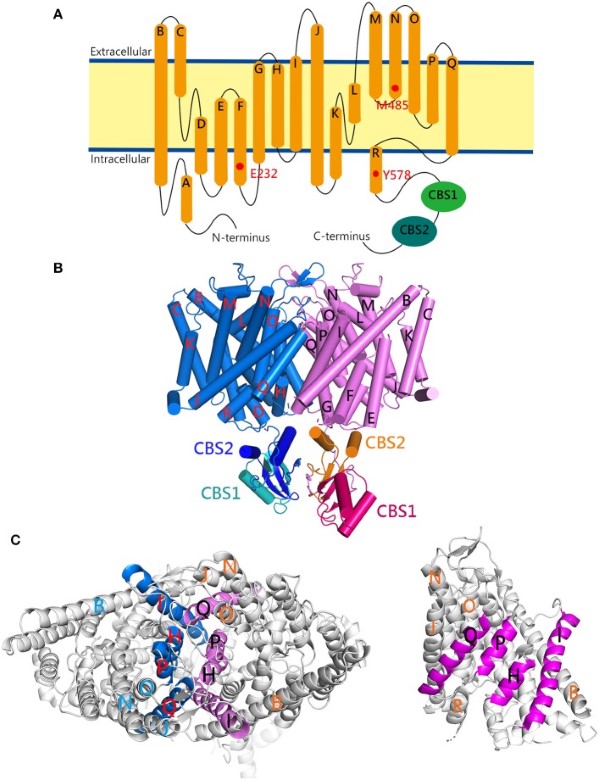 Fig. 1 Panel A shows membrane‑topology schematic of human CLCN1 single subunit with multi‑spanning helices and cytoplasmic CBS domains. Panel B presents cryo‑EM structure of CLCN1 homodimer complex.1
The biological functions of integral multi-spanning CLCN1 chloride channel are focused on voltage-dependent gating and anion selective transport:
Creative Biolabs offers purified CLCN1 membrane protein samples produced under unified preparation workflows, including full-length homodimer CLCN1 constructs and isolated pore domain variants. Truncated fragments cannot support complete voltage-dependent gating and selective anion permeation activity, while full-length forms fit skeletal muscle ion channel research. All batches receive uniform quality screening. Functional assessments may only be performed under simulated lipid bilayer microenvironment setups. Transmembrane selectivity filter and gating-related structures are preserved across batches for comparative electrophysiological analysis. Full-length CLCN1 membrane samples retain intact pore architecture and gating-related conformation post-purification, supporting reliable detection of voltage-triggered conformational shifts in functional assays.
Not finding the Membrane Protein product you need? Contact us to start your one-stop custom service!
Creative Biolabs provides cell research models with adjustable CLCN1 expression levels, suitable for structural observation of multi-spanning CLC channels and sarcolemmal potential research. Sample assessment covers sustained membrane channel detection and chloride conductance analysis, enabling side-by-side comparison of voltage gating behavior under varying CLCN1 abundances. These cell models can be paired with electrophysiological recording schemes to track resting potential shifts linked to channel dosage changes.
Not finding the stable cell line product you need? Contact us to start your one-stop custom service!
Anti-CLCN1 recombinant antibodies are generated via standardized workflows, compatible with skeletal muscle membrane localization mapping and homodimer channel complex identification. The antibody series supports multi-dimensional visualization of CLCN1 distribution within muscle fiber sarcolemma.
Not finding the recombinant antibody product you need? Contact us to start your one-stop custom service!
Beyond catalog products, Creative Biolabs offers specialized custom services for CLCN1 research:
CLCN1 may act as a multi-spanning voltage-gated chloride channel to mediate selective anion flux and stabilize skeletal muscle resting membrane potential.
CLCN1 expression status may alter sarcolemmal chloride conductance, serving as a key mediator of skeletal muscle resting potential homeostasis biological processes.
No, all CLCN1 related products and services are strictly for research use only, and cannot be applied in clinical workflows. All material design and functional screening are optimized exclusively for basic laboratory research, without meeting clinical application criteria.
Offerings include full-length CLCN1 membrane protein, target-specific recombinant antibodies and tunable expression cell research models, supporting research on voltage-gated chloride permeation and sarcolemmal charge balance.
Laboratory analysis schemes may include chloride flux recording assays to assess voltage-dependent anion permeation capacity under simulated lipid bilayer environments.








