
Creative Biolabs is offering the most comprehensive services for antibody development projects. With strict regulation and effective execution, we are dedicated to providing the most valuable solutions to complete your projects.
HighlightsCreative Biolabs is offering the most comprehensive services for antibody development projects. With strict regulation and effective execution, we are dedicated to providing the most valuable solutions to complete your projects.
HighlightsCreative Biolabs has established a broad range of platforms for developing novel antibodies or equivalents. These cutting-edge technologies enable our scientists to meet your demands from different aspects and tailor the most appropriate solution that contributes to the success of your projects.
HighlightsWith deep understanding in antibody-related realms and extensive project experience, Creative Biolabs offers a variety of references to help you learn more about our capacities and achievements, including infographic, flyer, case study, peer-reviewed publications, and all kinds of knowledge that can assist your projects. You are also welcome to contact us directly for more specific solutions.
HighlightsGet a real taste of Creative Biolabs, one of the most professional custom service providers in the world. We are committed to providing highly customized comprehensive solutions with the best quality to advance your projects.
Highlights Loading...
All listed services and products are For Research Use Only. Do Not use in any diagnostic or therapeutic applications.
Cytochrome c oxidase assembly factor 3 (COA3), encoded by the COA3 gene on chromosome 17q21.2 and also known as CCDC56, MITRAC12, or hCOA3, is a single-pass transmembrane protein localized to the mitochondrial inner membrane. The gene contains 2 exons and encodes a 106-amino-acid protein. Topologically, residues 2–57 form the mitochondrial matrix domain, residues 58–78 constitute the transmembrane helix, and residues 79–106 comprise the intermembrane space domain. COA3 is widely expressed across human tissues, with notable expression in kidney and duodenum. The protein is a core component of the mitochondrial translation regulation assembly intermediate of cytochrome c oxidase (MITRAC) complex.
COA3 functions within the MITRAC complex to regulate cytochrome c oxidase (COX, complex IV) assembly, the terminal enzyme of the mitochondrial respiratory chain. The MITRAC complex couples the translation of mitochondrially encoded COX subunits with their assembly into the holoenzyme. COA3 is required for efficient translation of MT-CO1 (COX1) and stabilizes nascent COX1 during early assembly steps. Studies in yeast have shown that Coa3 and Cox14 promote a latent state that down-regulates COX1 expression as part of a negative feedback regulatory mechanism. COA3 participates in the formation of 250–400 kDa cytochrome oxidase assembly intermediates (COA complexes) that include COX14, COX5A, SHY1, and SSC1. Biallelic mutations in COA3 cause mitochondrial complex IV deficiency, nuclear type 14 (MC4DN14), an autosomal recessive disorder characterized by developmental delay, cognitive impairment, motor delay, sensorimotor demyelinating polyneuropathy, exercise intolerance, obesity, and short stature. These properties make COA3 an important research target for studies of mitochondrial respiratory chain assembly, COX biogenesis, mitochondrial translation regulation, and the molecular mechanisms underlying COA3-associated mitochondrial disease.
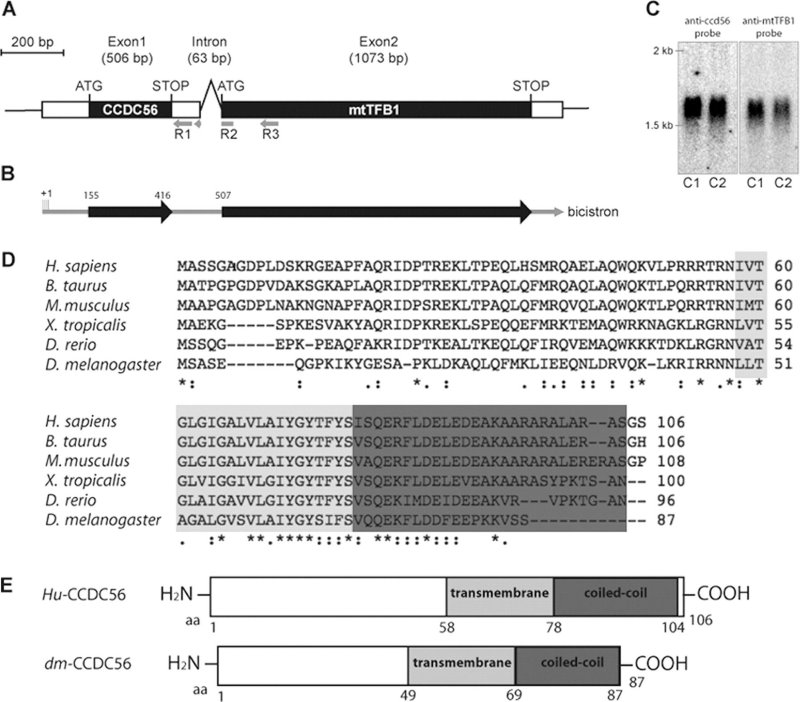 Fig. 1 The protein CCDC56, encoded in a bicistronic transcript together with mt-TFB1 in D. melanogaster, is conserved in metazoans.1
COA3, encoded by the COA3 gene, functions as a mitochondrial inner membrane assembly factor that regulates cytochrome c oxidase biogenesis:
Creative Biolabs offers high-quality COA3 membrane protein products produced using optimized expression systems. These include full-length single-pass transmembrane protein that retains the native mitochondrial inner membrane topology, as well as isolated domain variants containing the matrix and intermembrane space domains. The transmembrane helix and flanking domains mediate inner membrane integration and interaction with MITRAC complex components, making these proteins suitable for studies of mitochondrial membrane protein function, MITRAC complex assembly, and COX1 translation regulation characterization. All COA3 proteins undergo strict quality control to support consistent performance across applicable research platforms.
Not finding the protein product you need? Contact us to start your one-stop custom service!
Creative Biolabs provides custom-engineered COA3 stable cell lines, including overexpression and knockdown models. These cell lines are optimized for studies of COX1 translation regulation, MITRAC complex function, cytochrome c oxidase assembly, and COA3-associated mitochondrial dysfunction. Each cell line undergoes stringent validation to ensure stable expression profiles and consistent functional performance in diverse experimental contexts.
Not finding the stable cell line product you need? Contact us to start your one-stop custom service!
High-specificity recombinant antibodies targeting COA3 are developed using antibody engineering techniques for research applications involving COA3 expression and localization. These antibodies can be used in studies of COA3 distribution in mitochondrial inner membrane fractions and may also support characterization of COA3-containing MITRAC complexes in combination with appropriate detection reagents.
Not finding the recombinant antibody product you need? Contact us to start your one-stop custom service!
Beyond catalog products, Creative Biolabs offers specialized custom services for COA3 research:
COA3 is a mitochondrial inner membrane protein that functions as a core component of the MITRAC complex, regulating COX1 translation and cytochrome c oxidase assembly in the mitochondrial respiratory chain.
COA3 mutations cause mitochondrial complex IV deficiency (MC4DN14), making it important for mitochondrial respiratory chain assembly and mitochondrial disease research.
No, all COA3 products and services are strictly for research use only, not intended for clinical diagnosis or treatment.
Offerings include full-length COA3 membrane proteins, domain variants, specific detection antibodies, and custom stable cell lines for mitochondrial biogenesis and COX assembly research.
COA3 proteins are validated via protein-protein interaction assays, mitochondrial membrane integration assays, and relevant functional characterization in applicable research platforms.









