Creative Biolabs is offering the most comprehensive services for antibody development projects. With strict regulation and effective execution, we are dedicated to providing the most valuable solutions to complete your projects.
HighlightsCreative Biolabs is offering the most comprehensive services for antibody development projects. With strict regulation and effective execution, we are dedicated to providing the most valuable solutions to complete your projects.
HighlightsCreative Biolabs has established a broad range of platforms for developing novel antibodies or equivalents. These cutting-edge technologies enable our scientists to meet your demands from different aspects and tailor the most appropriate solution that contributes to the success of your projects.
HighlightsWith deep understanding in antibody-related realms and extensive project experience, Creative Biolabs offers a variety of references to help you learn more about our capacities and achievements, including infographic, flyer, case study, peer-reviewed publications, and all kinds of knowledge that can assist your projects. You are also welcome to contact us directly for more specific solutions.
HighlightsGet a real taste of Creative Biolabs, one of the most professional custom service providers in the world. We are committed to providing highly customized comprehensive solutions with the best quality to advance your projects.
Highlights Loading...
All listed services and products are For Research Use Only. Do Not use in any diagnostic or therapeutic applications.
Cell death defense factor-1 (DAD-1) is a highly conserved multiple transmembrane endoplasmic reticulum integration protein encoded by DAD-1 gene. It is widely expressed in almost all mammalian somatic cells and embryonic cells, firmly embedded in the lipid bilayer of endoplasmic reticulum, and is the core functional subunit of oligosaccharide transferase (OST) glycosylation complex. Different from the single-function apoptosis regulator, DAD1 has two indispensable core biological functions: on the one hand, it stabilizes the whole OST enzyme structure and maintains the stable state of protein N-glycosylation modification in the whole cell; On the other hand, as a potent endogenous inhibitor, it blocks the caspase-dependent programmed cell death pathway. Under the physiological steady state of cells, moderate expression of DAD1 can ensure the orderly modification and processing of glycoprotein, inhibit the spontaneous activation of apoptosis pathway and maintain the normal survival of tissues and cells. When cells encounter severe endoplasmic reticulum stress or lack of development signals, the expression level of DAD1 is significantly decreased, which not only destroys the quality control system of glycoprotein folding, but also releases pro-apoptosis signals, and finally triggers programmed cell clearance. Other endoplasmic reticulum complex subunits can't compensate for the dual functions of maintaining glycosylation and anti-apoptosis. Knock-out of DAD1 gene will lead to large-scale apoptosis in embryonic period and lead to embryo death. Tumor cells can resist the cell death induced by chemotherapy by up-regulating DAD1, making it the core target of steady-state regulation of endoplasmic reticulum and screening of anti-apoptosis targeted drugs.
DAD1 is anchored on the endoplasmic reticulum membrane network, which plays a dual role in glycosylation modification and cell protection, and integrates into the OST complex by virtue of the conservative transmembrane helix structure, while blocking the activation and release of apoptosis-promoting factors to the cytoplasm. This unique bifunctional structure makes it different from endoplasmic reticulum protein which only plays an anti-apoptosis or auxiliary glycosylation role, and forms a unique molecular switch connecting protein processing and cell survival fate. The regulatory pathway mediated by DAD1 can link the regulation of endoplasmic reticulum glycoprotein biosynthesis and apoptosis threshold, and dynamically balance cell stress tolerance according to nutritional status and development signal intensity. This molecule is widely involved in key biological processes, such as embryonic tissue development, tumor chemotherapy resistance and endoplasmic reticulum stress response. The lack of function of DAD1 will lead to the disorder of N-glycosylation modification and the over-activation of apoptosis signal. To sum up, DAD1 is an important research target for studying the mechanism of endoplasmic reticulum membrane protein and developing anti-tumor targeted drugs.
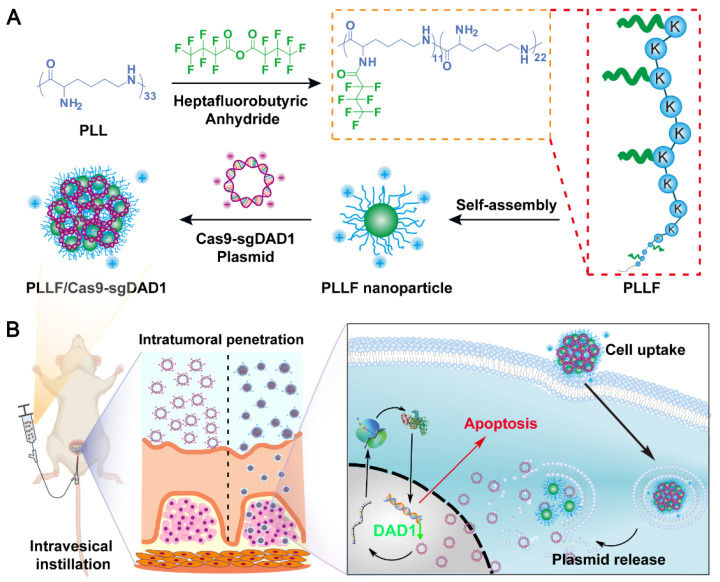 Fig. 1 Graphical Abstract Schematic (A-B): Synthesis and self-assembly of PLLF/Cas9-sgDAD1 gene delivery nanoparticle and intravesical instillation therapeutic cascade knocking down DAD1 to induce bladder cancer cell apoptosis.1
The biological functions of DAD1 are fully focused on OST holoenzyme assembly and endogenous apoptotic inhibition:
Creative Biolabs offers high-quality DAD1 proteins through optimized eukaryotic expression systems, including full-length multi-pass ER protein and isolated OST-interacting domain variants. These products retain native complex assembly and anti-apoptotic biological activity, suitable for glycosylation and apoptotic signaling functional screening assays. All DAD1 proteins undergo strict quality control to ensure consistent performance and reliable application across diverse research platforms.
Not finding the membrane protein product you need? Contact us to start your one-stop custom service!
Creative Biolabs provides custom-engineered DAD1 stable cell lines, including overexpression and blank empty vector control models. These cell lines are optimized for ER complex profiling and apoptotic signal functional analysis. Each cell line undergoes stringent validation to ensure stable expression profiles during long-term continuous cell culture, and can be deployed for large-scale chemoresistance compound screening workflows.
Not finding the stable cell line product you need? Contact us to start your one-stop custom service!
High-specificity recombinant antibodies targeting DAD1 are developed via advanced antibody engineering technologies. These antibodies are validated for ER membrane localization detection and embryonic/tumor tissue expression profiling, and can be combined with ER stress marker reagents to analyze complete DAD1-containing glycosylation complexes in cell models.
Not finding the recombinant antibody product you need? Contact us to start your one-stop custom service!
Beyond catalog products, Creative Biolabs offers specialized custom services for DAD1 research:
DAD1 is an ER OST complex subunit that maintains protein glycosylation while acting as an endogenous inhibitor of caspase-mediated cell death.
DAD1 couples glycoprotein processing and cell survival, serving as a key biomarker for tumor chemoresistance and embryonic developmental survival.
No, all DAD1 products and services are strictly for research use only, not intended for clinical diagnosis or human therapeutic trials.
Offerings include full-length ER DAD1 proteins, isoform-specific detection antibodies and custom stable cell lines for glycosylation and apoptosis research.
DAD1 proteins are validated via OST complex co-binding and apoptotic rescue functional testing.