Creative Biolabs is offering the most comprehensive services for antibody development projects. With strict regulation and effective execution, we are dedicated to providing the most valuable solutions to complete your projects.
HighlightsCreative Biolabs is offering the most comprehensive services for antibody development projects. With strict regulation and effective execution, we are dedicated to providing the most valuable solutions to complete your projects.
HighlightsCreative Biolabs has established a broad range of platforms for developing novel antibodies or equivalents. These cutting-edge technologies enable our scientists to meet your demands from different aspects and tailor the most appropriate solution that contributes to the success of your projects.
HighlightsWith deep understanding in antibody-related realms and extensive project experience, Creative Biolabs offers a variety of references to help you learn more about our capacities and achievements, including infographic, flyer, case study, peer-reviewed publications, and all kinds of knowledge that can assist your projects. You are also welcome to contact us directly for more specific solutions.
HighlightsGet a real taste of Creative Biolabs, one of the most professional custom service providers in the world. We are committed to providing highly customized comprehensive solutions with the best quality to advance your projects.
Highlights Loading...
All listed services and products are For Research Use Only. Do Not use in any diagnostic or therapeutic applications.
The coagulation factor II thrombin receptor F2R, widely known as protease-activated receptor 1 (PAR1), resolved a signaling transmission problem that classic receptor theory could not explain: how could a protease whose core function is to cleave other proteins activate a GPCR—the largest family of transmembrane signaling molecules in human biology? The moment this mechanism was uncovered, it completely rewrote the inherent rules of receptor signaling transmission. Hidden within PAR1's own extracellular N-terminus is a protease-activated tethered ligand sequence, which remains inaccessible under resting conditions—until the serine protease thrombin cleaves the receptor at a specific site within its extracellular N-terminal region. This cleavage releases the distal N-terminal fragment and exposes a new receptor N-terminus beginning with the tethered ligand sequence (e.g., SFLLRN). Because this newly exposed N-terminus remains covalently attached to PAR1, it can bind intramolecularly to the receptor and activate the seven-transmembrane core, initiating downstream signaling. Beyond its core physiological role in hemostasis, PAR1 has repeatedly emerged in research on chronic inflammation and neural signaling transmission, as well as vascular biology studies that link systemic coagulation cascades to whole-tissue-level responses, long outgrowing its status as a research subject limited to the coagulation field. It also exhibits biased signaling behavior—meaning it can engage distinct downstream pathways depending on its mode of activation, a property that has established it as a useful research model for understanding how a single receptor can produce divergent outcomes in different tissue and cellular contexts.
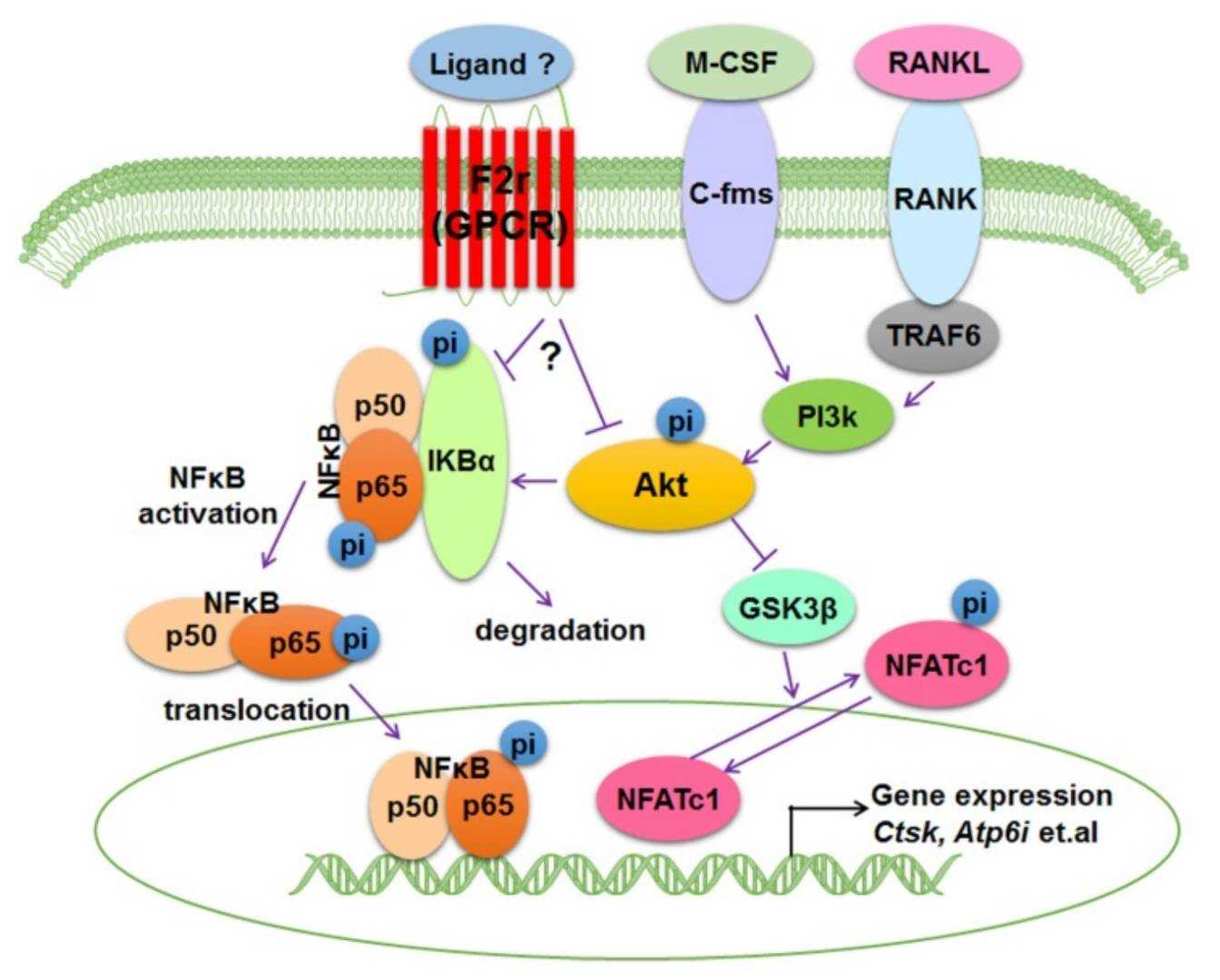 Fig.1 Working model of F2r negative regulation of osteoclasts.1
Several research currents keep converging on this receptor:
If the produced sample cannot be cleaved at the designated site, it cannot be activated and will fail to perform its normal functions; if improper operation damages its inherent tethered ligand, the sample will not reflect the true natural state of the receptor, and the experimental results obtained from it will naturally not reflect the real situation. Full-length F2R must be prepared from an optimized eukaryotic expression system. This system comes with folding support, and after calibration, it perfectly matches its seven-transmembrane structure, ensuring that the produced F2R has a correct structure and can function normally. In addition to the full-length natural form, there are several configurations with different activation states, which are specially developed for experiments studying the receptor cleavage mechanism, to facilitate researchers to accurately study the activation process of F2R. If your experiment requires a cleavage-resistant background, a designated activation state configuration, or a presentation format adapted to a specific signal detection experiment, the preparation protocol can be adjusted to align with your experimental workflow—the entire process is built around your experimental design, and we can produce any form of F2R you require.
Not finding the membrane protein product you need? Contact us to start your one-stop custom service!
A cell model for F2R research must meet two conditions to be usable: first, the expression level of F2R on the cell must be appropriate, and second, these expressed F2R must be able to activate normally. Even if the receptor can reach the cell surface but cannot be cleaved, it cannot transmit signals, and such a cell model is completely unusable; using it for experiments will only produce invalid data. Cell lines with wild-type overexpression can provide a stable and clear expression level for activation and signal-related research, so you do not need to spend more than half a month optimizing conditions on your own. Every clonal cell line undergoes comprehensive testing before delivery: the expression level on the cell surface is quantified using a calibrated standard, so the baseline performance of the cell line is already confirmed before you formally start your experiment. You can use it immediately upon receipt, without spending additional time verifying the reliability of the cell line. If your project requires a specific mutant gene background, a designated level of expression, or an expression timeline that matches your custom stimulation experiment workflow, this platform can provide customized solutions—the cell line is tailored to the specific experiment it will participate in, and we can produce a cell model that meets whatever conditions your experiment requires.
Not finding the stable cell line product you need? Contact us to start your one-stop custom service!
To develop antibodies for F2R research, you must first confront the core problem brought about by its cleavage state: this receptor exists in at least two morphologically distinguishable forms at the antigen level, one that is intact and uncleaved, and another that has been cleaved and activated. If you only use a single antibody that can recognize only one of these forms, you can at most answer half of the questions in your experiment, and you will completely miss the other half of the core changes. Our recombinant antibody package fills this gap: it includes distinct antibodies that can distinguish between the intact inactive receptor and the post-activation receptor, enabling precise tracking of the F2R activation process. It also includes broadly reactive antibodies that can recognize all F2R, which are used to count the total receptor amount, allowing you to calculate exactly how many receptors have been activated. All these antibodies have been screened to accurately distinguish F2R from its closely related PAR family members in the same family. They will not misidentify targets, and will not attribute signals from other family members to F2R, ensuring the accuracy of experimental data. Antibody validation covers quantitative detection of cell lysates, as well as surface staining of F2R-expressing cell lines, so they can be used for both biochemical assays and cell staining. We produce these antibodies with sequence-defined methods to ensure stable performance across different batches, eliminating the problem of one batch working well and the next encountering issues. If your project requires different conjugates, validation tailored to specific sample types, or adjustments to the antibody format to adapt to your custom experimental workflow, all can be modified on demand—this antibody package can be flexibly adapted to the experimental design it serves, and we can produce an antibody product that fits whatever way your experiment requires.
Not finding the recombinant antibody product you need? Contact us to start your one-stop custom service!
Extending well beyond our standard catalog, we deliver fully customizable discovery and manufacturing solutions meticulously tailored to the sophisticated demands of F2R-targeted research and precompound development:
The receptor is activated by cleavage, not by a diffusible ligand—an exposed tethered sequence docks into the receptor's own pocket. Reagents must therefore preserve, and where relevant verify, the cleavage machinery that makes activation possible.
Yes. The tethered-ligand sequence can be supplied as a defined peptide to activate the receptor directly, giving researchers a protease-independent handle where experiments require it.
Cleaved receptors internalize and require resynthesis for the cell to respond again, which means the timing between successive stimuli shapes what can be observed. Study designs account for this reset kinetics.
All F2R products and services are provided strictly for preclinical research. They are not designed, validated, or authorized for any use involving human subjects.