
Creative Biolabs is offering the most comprehensive services for antibody development projects. With strict regulation and effective execution, we are dedicated to providing the most valuable solutions to complete your projects.
HighlightsCreative Biolabs is offering the most comprehensive services for antibody development projects. With strict regulation and effective execution, we are dedicated to providing the most valuable solutions to complete your projects.
HighlightsCreative Biolabs has established a broad range of platforms for developing novel antibodies or equivalents. These cutting-edge technologies enable our scientists to meet your demands from different aspects and tailor the most appropriate solution that contributes to the success of your projects.
HighlightsWith deep understanding in antibody-related realms and extensive project experience, Creative Biolabs offers a variety of references to help you learn more about our capacities and achievements, including infographic, flyer, case study, peer-reviewed publications, and all kinds of knowledge that can assist your projects. You are also welcome to contact us directly for more specific solutions.
HighlightsGet a real taste of Creative Biolabs, one of the most professional custom service providers in the world. We are committed to providing highly customized comprehensive solutions with the best quality to advance your projects.
Highlights Loading...
All listed services and products are For Research Use Only. Do Not use in any diagnostic or therapeutic applications.
Fc gamma receptor IIb (FCGR2B), commonly known as CD32b, is a type I transmembrane glycoprotein with a molecular weight of 40kDa, belonging to the immunoglobulin superfamily. The structure of this protein is divided into three parts: one segment extending outside the cell, one segment passing through the cell membrane, and a small segment remaining inside the cell. Its extracellular portion contains two Ig-like domains, which can bind to the Fc segment of a single free IgG with low affinity, while its binding affinity to immune complexes formed by multiple aggregated IgG molecules is much higher. It is precisely through binding to these immune complexes that it can initiate subsequent functional signal transduction. In pathological scenarios, if its regulation malfunctions and it cannot function normally, it will lead to excessive production of autoantibodies, and will also cause the continuous operation of immunosuppressive programs in myeloid cells that have infiltrated tumor tissues, helping tumors evade attacks from the immune system. These diverse and interconnected immune functions make FCGR2B a core strategic target for basic B cell biology research, immune checkpoint mechanism research, and Precompound Research Target.
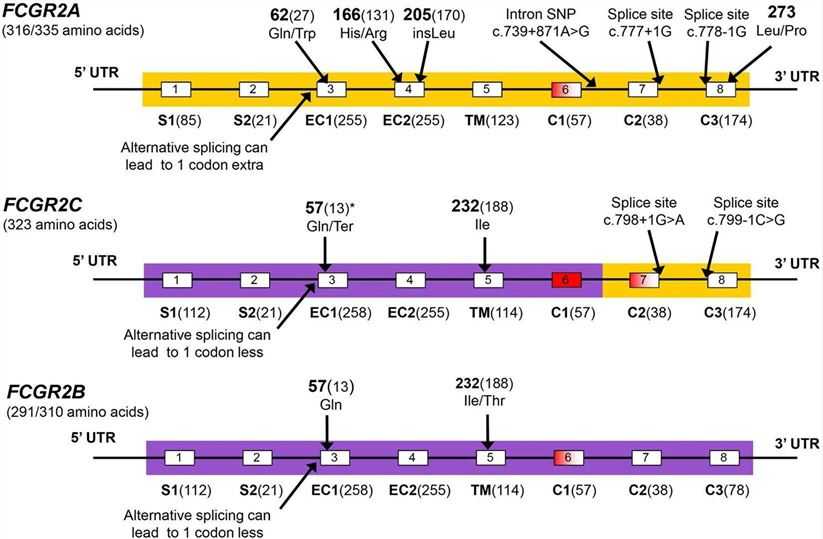 Fig.1 FCGR2 exons.1
FCGR2B coordinates diverse immunological programs that extend considerably beyond its nominal designation as a simple Fc receptor:
We have developed a complete, conformationally accurate FCGR2B membrane protein, specifically designed to address common biochemical experimental difficulties in the study of inhibitory Fc receptors. The inherent structural properties of this type of membrane protein make it difficult for researchers to obtain a protein in the laboratory that is identical to its natural state for experiments: either a part is truncated so that its function cannot be fully restored, or the folded spatial shape is incorrect, leading to completely inaccurate experimental results. Our protein was developed to solve this pain point. Our production process integrates advanced protein engineering technologies, supporting various biochemical experiments and mechanism studies. Each product has passed strict quality testing, and can be adapted to different experimental platforms and research directions. No matter what experimental system you use or which research direction you want to study, this qualified protein material can be applied.
Not finding the membrane protein product you need? Contact us to start your one-stop custom service!
To carry out immune regulation research and evaluate candidate compounds, a cell platform that can completely reproduce the natural inhibitory signal transduction of FCGR2B is essential. If the FCGR2B on the cell platform cannot normally transmit inhibitory signals like the natural protein in the human body, then whether it is basic research on immune regulation or studying candidate compounds targeting this protein, the results obtained will be untenable. Building such a reliable cell platform is the prerequisite for all research. We use advanced biochemical technologies to construct FCGR2B cell lines with stable functions. All models are prepared in a unified cell background, completely avoiding the problem of inconsistent experimental variables. Each cell line has passed strict identification through multiple molecular experiments, confirming that it can indeed stably express this protein and exert normal functions. These scalable cell resources are essential experimental materials for studying immune tolerance mechanisms and optimizing research reagents targeting the FCGR2B pathway. With these mass-producible cells, researchers no longer have to worry about finding suitable experimental materials to advance their projects.
Not finding the stable cell line product you need? Contact us to start your one-stop custom service!
You can use the series of sequence-specific, high-affinity monoclonal antibodies we have carefully developed to advance your FCGR2B research projects. These antibodies are precisely designed to effectively solve complex problems encountered in the structural and functional research of inhibitory Fc receptors. FCGR2B has a complex structure and antibody performance can vary with epitope accessibility, sample context, and assay format. The monoclonal antibodies are designed to address these challenges. Selected antibody clones may be evaluated in specific applications according to available internal validation data. Application suitability and assay conditions should be determined for the specific clone, sample type, and experimental context. Available validation data can help guide clone selection for FCGR2B expression studies and basic immunology research. Performance should be interpreted within the validated application and sample context.
Not finding the recombinant antibody product you need? Contact us to start your one-stop custom service!
Extending well beyond our standard catalog, we deliver fully customizable discovery and manufacturing solutions meticulously tailored to the sophisticated demands of FCGR2B-targeted research and precompound development:
No. The entire collection of FCGR2B-directed proteins, stable expression systems, and affinity reagents is designated exclusively for preclinical investigation. These items have not been evaluated for application to biological specimens collected with the aim of profiling source immune competence or defensive capacity.
Yes. All products in our recombinant protein series have undergone specialized engineering modifications, and the complete topology of the protein is fully retained.
Yes. We provide engineered cell models in which the target receptor is stably presented on the cell surface, and its functional integrity has been experimentally verified——when it is co-bound by a ligand with other adjacent membrane receptors on the cell, it can normally output negative regulatory signals, meeting the requirements of experimental research.
Yes. In addition to the three standard products of proteins, cell lines, and antibodies, we can also undertake full-process customized modification projects to produce specific structural variants that meet your requirements—we can not only produce modified proteins with a specific cytoplasmic sequence deleted, but also introduce any sequence changes you specify in the regulatory tail of the protein.









