
Creative Biolabs is offering the most comprehensive services for antibody development projects. With strict regulation and effective execution, we are dedicated to providing the most valuable solutions to complete your projects.
HighlightsCreative Biolabs is offering the most comprehensive services for antibody development projects. With strict regulation and effective execution, we are dedicated to providing the most valuable solutions to complete your projects.
HighlightsCreative Biolabs has established a broad range of platforms for developing novel antibodies or equivalents. These cutting-edge technologies enable our scientists to meet your demands from different aspects and tailor the most appropriate solution that contributes to the success of your projects.
HighlightsWith deep understanding in antibody-related realms and extensive project experience, Creative Biolabs offers a variety of references to help you learn more about our capacities and achievements, including infographic, flyer, case study, peer-reviewed publications, and all kinds of knowledge that can assist your projects. You are also welcome to contact us directly for more specific solutions.
HighlightsGet a real taste of Creative Biolabs, one of the most professional custom service providers in the world. We are committed to providing highly customized comprehensive solutions with the best quality to advance your projects.
Highlights Loading...
All listed services and products are For Research Use Only. Do Not use in any diagnostic or therapeutic applications.
The FZD4 gene maps to chromosome 11q14.2 and encodes a 537-amino-acid protein. This receptor contains an N-terminal cysteine-rich domain (CRD), seven transmembrane helices, and a C-terminal S/T-X-V motif. It belongs to the class F family of G protein-coupled receptors, whose members share a seven-transmembrane architecture and act as receptors for Wnt ligands. FZD4 is expressed in many tissues, with particularly important roles in the retina and vascular endothelium.
FZD4 binds both Wnt proteins and Norrin (NDP), which is an atypical Wnt ligand. Among FZD receptors, only FZD4 is known to recognize Norrin. During ligand binding, FZD4 engages the intracellular adaptor Dishevelled (DVL), a key transducer of Wnt signaling. Cryo-EM structures of FZD4 in complex with the DEP domain of DVL2 have revealed a distinct binding mode: the DEP finger-loop inserts into the FZD4 cavity to form a hydrophobic interface. FZD4 signaling is critical for retinal vascularization. Mutations in FZD4 cause familial exudative vitreoretinopathy (FEVR), an inherited disorder characterized by defective retinal angiogenesis. FZD4 has also been implicated in bone formation and cancer progression.
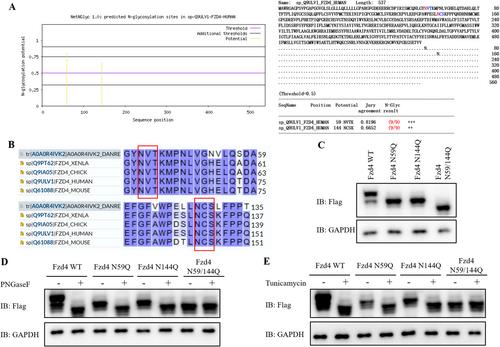 Fig. 1 Identification of N-glycosylation modification sites of Fzd4 protein.1
FZD4 is a class F GPCR that mediates Norrin and Wnt signaling:
Creative Biolabs provides FZD4 membrane protein products produced with optimized expression systems. These include full-length multi-pass transmembrane protein retaining the native seven-transmembrane architecture and N-terminal cysteine-rich domain, along with isolated extracellular domain variants. The seven-transmembrane region and cysteine-rich domain mediate Norrin and Wnt binding, making these proteins suitable for studies of class F GPCR signaling, Norrin/Wnt–receptor interactions, and downstream signal transduction. All FZD4 proteins are quality-controlled to ensure consistent performance.
Not finding the protein product you need? Contact us to start your one-stop custom service!
Creative Biolabs offers custom-engineered FZD4 stable cell lines, including overexpression and knockdown models. These cell lines support studies of FZD4 expression, ligand binding and receptor interactions; Norrin-dependent β-catenin signaling requires a suitable LRP5/6 co-receptor background, with TSPAN12 modulating Norrin responsiveness. Each line is validated for stable expression and consistent function in various experimental settings.
Not finding the stable cell line product you need? Contact us to start your one-stop custom service!
High-specificity recombinant antibodies targeting FZD4 are developed using antibody engineering technologies for research applications involving FZD4 expression and localization. These antibodies can be used in studies of FZD4 distribution in retinal and vascular tissues and may also support characterization of FZD4-containing receptor complexes in combination with appropriate detection reagents.
Not finding the recombinant antibody product you need? Contact us to start your one-stop custom service!
Beyond catalog products, Creative Biolabs offers specialized custom services for FZD4 research:
FZD4 is a class F GPCR that binds Norrin and Wnt ligands to activate Dishevelled-dependent signaling, playing a critical role in retinal angiogenesis and tissue homeostasis.
FZD4 is essential for retinal vascular development, and its mutations cause familial exudative vitreoretinopathy (FEVR). It is also the only FZD receptor known to recognize Norrin, making it important for studies of class F GPCR signaling and retinal disease mechanisms.
No, all FZD4 products and services are strictly for research use only, not intended for clinical diagnosis or treatment.
Offerings include full-length FZD4 membrane proteins, extracellular domain variants, specific detection antibodies, and custom stable cell lines for Norrin/Wnt signaling and retinal angiogenesis research.
FZD4 proteins may support studies of ligand binding and DVL interaction, depending on protein format and experimental context.









