Creative Biolabs is offering the most comprehensive services for antibody development projects. With strict regulation and effective execution, we are dedicated to providing the most valuable solutions to complete your projects.
HighlightsCreative Biolabs is offering the most comprehensive services for antibody development projects. With strict regulation and effective execution, we are dedicated to providing the most valuable solutions to complete your projects.
HighlightsCreative Biolabs has established a broad range of platforms for developing novel antibodies or equivalents. These cutting-edge technologies enable our scientists to meet your demands from different aspects and tailor the most appropriate solution that contributes to the success of your projects.
HighlightsWith deep understanding in antibody-related realms and extensive project experience, Creative Biolabs offers a variety of references to help you learn more about our capacities and achievements, including infographic, flyer, case study, peer-reviewed publications, and all kinds of knowledge that can assist your projects. You are also welcome to contact us directly for more specific solutions.
HighlightsGet a real taste of Creative Biolabs, one of the most professional custom service providers in the world. We are committed to providing highly customized comprehensive solutions with the best quality to advance your projects.
Highlights Loading...
All listed services and products are For Research Use Only. Do Not use in any diagnostic or therapeutic applications.
Gap junction protein alpha 1 (GJA1), also known as connexin 43 as recorded in all cell biology textbooks, is the most abundant member of the connexin family and the core material that builds direct intercellular communication pathways in mammalian tissues. This protein itself has four spiral structures that can penetrate the cell membrane; six such proteins assemble together to form a ring-shaped structure, which is called a connexon. A connexon on one cell docks with a connexon on its immediately adjacent neighboring cell, assembling into a complete gap junction channel — this channel connects the originally independent cytoplasms of the two cells, creating a shared space that can continuously conduct electrical signals and chemical substances. Small molecules such as ions, metabolites, and second messengers can shuttle directly between cells through these channels, moving from one cell directly into another without first entering the extracellular space and requiring no intermediary for transfer. Most intercellular signal transmission spreads to the surrounding area like a broadcast, where any cell may receive the signal. However, cell communication achieved through gap junctions is completely different: it is like a private dedicated line connected only for two specific users. It not only transmits signals at high speed, but also allows the channel to be opened or closed at any time; more importantly, it only establishes an exclusive pathway between the specified specific cells, and will not transmit signals to unrelated cells.
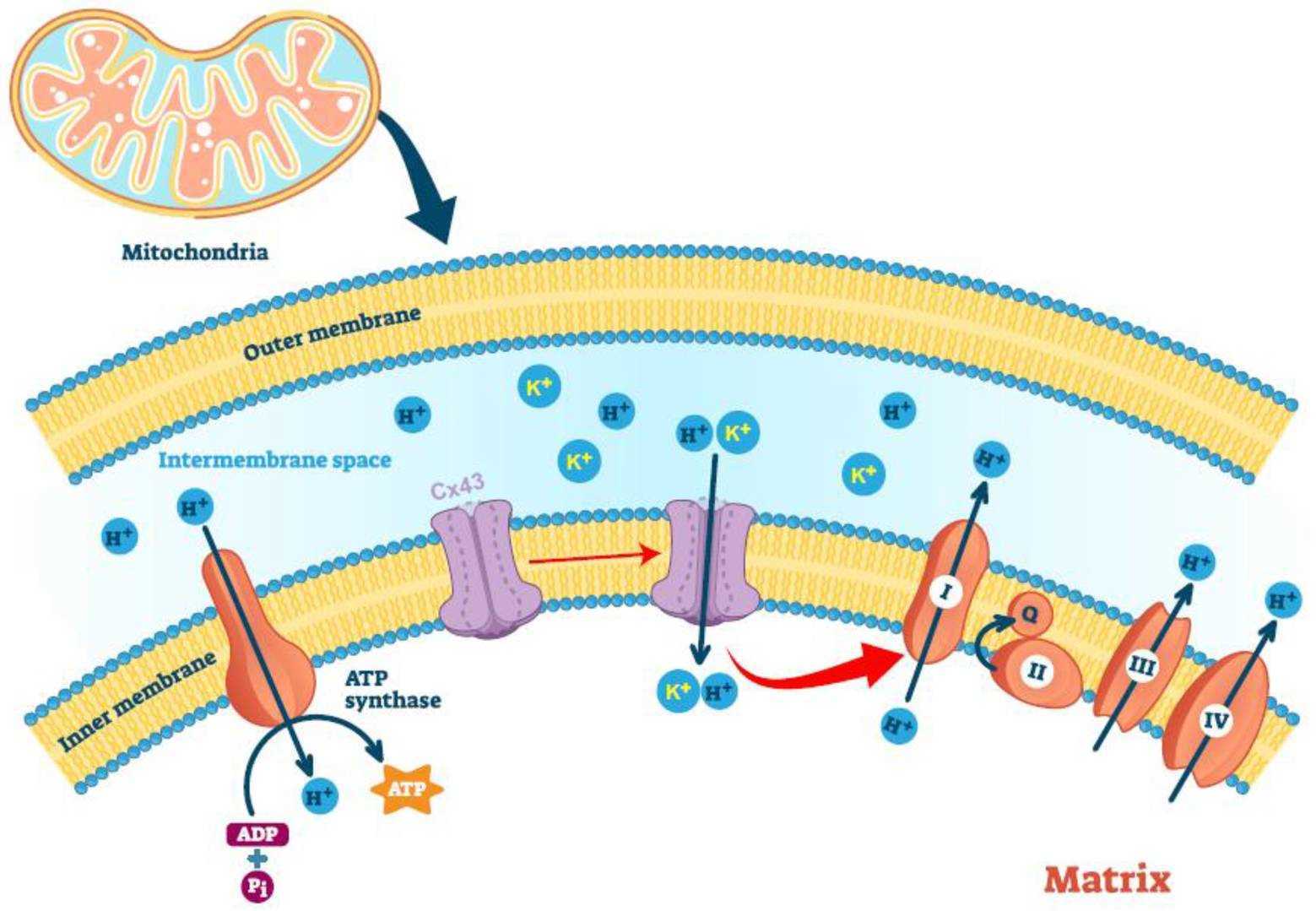 Fig.1 Mitochondria-localized Connexin43 forms a function hemichannel and may regulate potassium uptake, mitochondrial uncoupling, and ROS production.1
Several research currents keep converging on this connexin:
Producing GJA1 credibly means keeping assembly competence at the center of every format decision. A connexin that folds without hexamerizing is a subunit without a function. Full-length GJA1 comes from our optimized eukaryotic expression systems with folding support matched to the four-helix connexin architecture, and formats are chosen to preserve the assembly state that experiments need. If your study requires a defined assembly state, a specific phosphorylation background, or a presentation matched to a particular coupling assay, the format can be adjusted around your protocol—the preparation follows the experimental design.
Not finding the membrane protein product you need? Contact us to start your one-stop custom service!
Cellular models for GJA1 work turn on expression density and junctional assembly working together—a connexin only couples cells if it reaches the surface and forms docked channels. Wild-type overexpression lines and site variants let researchers probe how modification state shapes gating. Each clone is characterized before release, so the line's behavior is established before experiments begin. Should your program call for a particular variant background, a specific density tier, or an expression schedule built around your junction-formation timeline, the platform can be tailored to fit; the cell line is constructed to serve the experiment it will run in.
Not finding the stable cell line product you need? Contact us to start your one-stop custom service!
Antibody work on GJA1 faces the twenty-member family problem: the connexins share their four-helix scaffold, and their intracellular loop regions—the most accessible epitope territory—are similar enough that generic clones drift into cross-reactivity that corrupts quantitation. Our recombinant panel here is screened for genuine GJA1 discrimination. Sequence-defined production keeps lot-to-lot performance steady, and where a project needs a different conjugate, validation against a specific sample type, or an adjustment in clone format to fit a particular workflow, that can be arranged on request—the panel flexes to meet the experimental design it serves.
Not finding the recombinant antibody product you need? Contact us to start your one-stop custom service!
Extending well beyond our standard catalog, we deliver fully customizable discovery and manufacturing solutions meticulously tailored to the sophisticated demands of GJA1-targeted research and precompound development:
Channel gating is reshaped by phosphorylation at defined sites, so the modification state of the connexin population influences conductance behavior. Reagent formats are documented by state where experiments require the distinction.
The connexin family shares its transmembrane scaffold, so isoform discrimination is earned through clone screening rather than assumed. Off-target panel results accompany product documentation for transparency.
All GJA1 products and services are provided strictly for preclinical research. They are not designed, validated, or authorized for any use involving human subjects.
Channels assemble and degrade on a fast cycle, meaning the observed localization pattern reflects population age as well as steady-state distribution. Turnover kinetics is treated as a design variable in study planning.