
Creative Biolabs is offering the most comprehensive services for antibody development projects. With strict regulation and effective execution, we are dedicated to providing the most valuable solutions to complete your projects.
HighlightsCreative Biolabs is offering the most comprehensive services for antibody development projects. With strict regulation and effective execution, we are dedicated to providing the most valuable solutions to complete your projects.
HighlightsCreative Biolabs has established a broad range of platforms for developing novel antibodies or equivalents. These cutting-edge technologies enable our scientists to meet your demands from different aspects and tailor the most appropriate solution that contributes to the success of your projects.
HighlightsWith deep understanding in antibody-related realms and extensive project experience, Creative Biolabs offers a variety of references to help you learn more about our capacities and achievements, including infographic, flyer, case study, peer-reviewed publications, and all kinds of knowledge that can assist your projects. You are also welcome to contact us directly for more specific solutions.
HighlightsGet a real taste of Creative Biolabs, one of the most professional custom service providers in the world. We are committed to providing highly customized comprehensive solutions with the best quality to advance your projects.
Highlights Loading...
All listed services and products are For Research Use Only. Do Not use in any diagnostic or therapeutic applications.
Gonadotropin-releasing hormone receptor (GNRHR), also known as GnRHR, GRHR, or LHRHR, is encoded by the GNRHR gene on chromosome 4q13.2. The gene produces a 328-amino-acid protein of approximately 38 kDa that belongs to the class A (rhodopsin-like) family of G protein-coupled receptors (GPCRs). GNRHR contains seven transmembrane domains, an extracellular N-terminal domain, and, notably, lacks a cytoplasmic C-terminal tail—an unusual feature among mammalian GPCRs. This structural characteristic contributes to the receptor's slow internalization kinetics and sustained signaling. Cryo-electron microscopy structures of GNRHR in complex with GnRH and the Gq protein have been determined at resolutions of 2.67 Å and 3.18 Å, revealing that GnRH adopts a conserved inverted "U-shaped" conformation, inserting both its N- and C-termini deep into the receptor's orthosteric pocket. GNRHR is expressed predominantly in the gonadotrope membrane of the anterior pituitary and is also found in extrapituitary tissues including lymphocytes, breast, ovary, prostate, and cancer cell lines.
GNRHR functions as the receptor for gonadotropin-releasing hormone (GnRH), mediating the action of GnRH to stimulate the secretion of luteinizing hormone (LH) and follicle-stimulating hormone (FSH) from pituitary gonadotrophs. Upon GnRH binding, GNRHR couples primarily to Gq/11 proteins, activating phospholipase C (PLC) which hydrolyzes phosphatidylinositol 4,5-bisphosphate into diacylglycerol (DAG) and inositol 1,4,5-trisphosphate (IP3). DAG activates protein kinase C (PKC), while IP3 triggers the release of calcium from intracellular stores. Downstream signaling through PKC leads to transactivation of the epidermal growth factor receptor and activation of mitogen-activated protein kinases (MAPKs), including ERK, JNK, and p38 MAPK, which translocate to the nucleus and induce early gene transcription. Mutations in GNRHR cause hypogonadotropic hypogonadism 7 (HH7), a disorder of reproductive failure, and GNRHR mutations account for approximately 3.5% of all normosmic and 7%–11% of presumed autosomal recessive idiopathic hypogonadotropic hypogonadism (IHH). These features make GNRHR an important research target for studies of GPCR signaling, reproductive endocrinology, and the molecular mechanisms of hypogonadotropic hypogonadism.
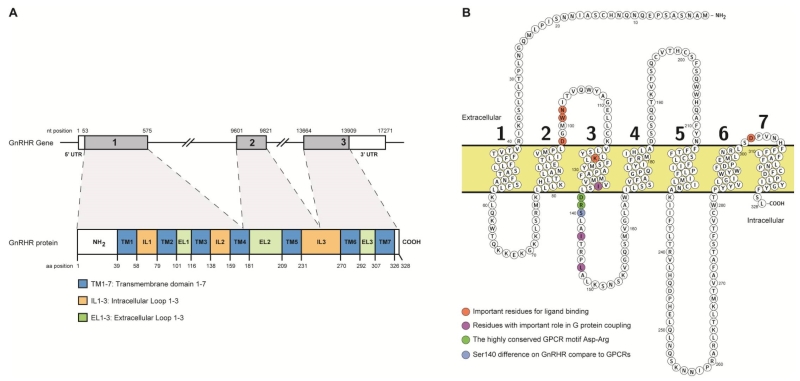 Fig. 1 Gene and protein structure of GnRHR.1
GNRHR, encoded by the GNRHR gene, functions as a Gq/11-coupled GPCR that mediates GnRH signaling in pituitary gonadotrophs:
Creative Biolabs offers high-quality GNRHR membrane protein products produced using optimized expression systems. These include full-length multi-pass transmembrane protein that retains the native seven-transmembrane architecture and orthosteric ligand-binding pocket, as well as isolated receptor domain variants. The seven-transmembrane architecture and intracellular loops mediate GnRH binding and Gq/11 protein coupling, making these proteins suitable for studies of GnRH receptor pharmacology, G protein coupling mechanisms, and ligand-receptor interaction characterization. All GNRHR proteins undergo strict quality control to support consistent performance across applicable research platforms.
Not finding the protein product you need? Contact us to start your one-stop custom service!
Creative Biolabs provides custom-engineered GNRHR stable cell lines, including overexpression and knockdown models. These cell lines are optimized for studies of GnRH signaling, Gq/11-mediated PLC activation, MAPK pathway regulation, and GNRHR-associated hypogonadotropic hypogonadism mechanisms. Each cell line undergoes stringent validation to ensure stable expression profiles and consistent functional performance in diverse experimental contexts.
Not finding the stable cell line product you need? Contact us to start your one-stop custom service!
High-specificity recombinant antibodies targeting GNRHR are developed using antibody engineering technologies for research applications involving GNRHR expression and localization. These antibodies can be used in studies of GNRHR distribution in pituitary and extrapituitary tissues and may also support characterization of GNRHR-containing receptor complexes in combination with appropriate detection reagents.
Not finding the recombinant antibody product you need? Contact us to start your one-stop custom service!
Beyond catalog products, Creative Biolabs offers specialized custom services for GNRHR research:
GNRHR is a Gq/11-coupled GPCR that binds GnRH to activate phospholipase C and MAPK signaling, stimulating the secretion of LH and FSH from pituitary gonadotrophs.
GNRHR is essential for reproductive function, and its mutations cause hypogonadotropic hypogonadism. It is also a key target for endocrine disorders and hormone-responsive cancers, making it important for studies of GPCR signaling and reproductive endocrinology.
No, all GNRHR products and services are strictly for research use only, not intended for clinical diagnosis or treatment.
Offerings include full-length GNRHR membrane proteins, receptor domain variants, specific detection antibodies, and custom stable cell lines for GnRH signaling and reproductive research.
GNRHR proteins may support studies of ligand binding and G protein coupling, depending on protein format and experimental context.









