Creative Biolabs is offering the most comprehensive services for antibody development projects. With strict regulation and effective execution, we are dedicated to providing the most valuable solutions to complete your projects.
HighlightsCreative Biolabs is offering the most comprehensive services for antibody development projects. With strict regulation and effective execution, we are dedicated to providing the most valuable solutions to complete your projects.
HighlightsCreative Biolabs has established a broad range of platforms for developing novel antibodies or equivalents. These cutting-edge technologies enable our scientists to meet your demands from different aspects and tailor the most appropriate solution that contributes to the success of your projects.
HighlightsWith deep understanding in antibody-related realms and extensive project experience, Creative Biolabs offers a variety of references to help you learn more about our capacities and achievements, including infographic, flyer, case study, peer-reviewed publications, and all kinds of knowledge that can assist your projects. You are also welcome to contact us directly for more specific solutions.
HighlightsGet a real taste of Creative Biolabs, one of the most professional custom service providers in the world. We are committed to providing highly customized comprehensive solutions with the best quality to advance your projects.
Highlights Loading...
All listed services and products are For Research Use Only. Do Not use in any diagnostic or therapeutic applications.
Glycophorin E (GYPE) is a short type I transmembrane sialoglycoprotein encoded by GYPE gene within the tandem glycophorin gene cluster on human chromosome 4, closely homologous to GYPA and GYPB MNS blood group carriers yet expressed at markedly lower copy numbers on mature erythrocyte plasma membranes. GYPE features a heavily O-sialylated extracellular ectodomain bearing minor MNS blood group antigen epitopes, a single transmembrane helix and short cytoplasmic tail that forms weak lateral interactions with spectrin-based erythrocyte cytoskeletal meshworks to stabilize red cell membrane lipid bilayer architecture. During erythroid progenitor differentiation, low-level GYPE transcription is activated alongside GYPA/GYPB to supplement total membrane sialoglycan content, contributing to erythrocyte surface negative charge that repels vascular endothelial adhesion and prevents premature red cell clearance within splenic sinusoids. Unlike highly abundant GYPA (carrier of M/N antigens) and GYPB (S/s antigens) that dominate MNS serology, GYPE generates rare low-prevalence blood group variants via limited extracellular amino acid polymorphisms and acts as a secondary stabilizer of red cell membrane flexibility without independent major antigenic function. Distinct from the two major glycophorin paralogs, GYPE exhibits minimal surface abundance and lacks direct high-avidity antibody binding epitopes for routine blood typing, while serving as a genetic reservoir for homologous recombination events that generate novel hybrid glycophorin variants underlying rare MNS blood group phenotypes. Complete loss of GYPE expression does not produce severe red cell pathological defects due to functional compensation by GYPA/GYPB, yet compound glycophorin gene deletions including GYPE amplify membrane fragility and alter blood group antigen profiles, establishing GYPE as a core research target for erythroid membrane glycoprotein biology and rare MNS blood group genetic mechanism exploration.
GYPE executes secondary erythrocyte membrane stabilizing function via negatively charged sialylated extracellular glycan chains that increase overall red cell surface electronegativity to reduce endothelial and macrophage adhesive interactions in peripheral circulation. Its short cytoplasmic domain mediates weak transient linkage to spectrin cytoskeletal filaments to support lateral membrane rigidity and deformability critical for red cell transit through narrow capillary vasculature. Conserved homologous exon architecture shared with GYPA and GYPB enables intergenic homologous recombination that reshapes glycophorin extracellular antigen epitope sequences to generate rare hybrid MNS blood group antigens across human populations. GYPE-dependent membrane sialoglycan enrichment sustains balanced erythrocyte circulatory homeostasis, covering maintained red cell deformability and reduced splenic clearance susceptibility under physiological hematological conditions. GYPE participates in a narrow spectrum of erythroid physiological processes including fetal erythroid membrane maturation, minor MNS antigen presentation and glycophorin gene cluster homologous recombination dynamics. Isolated GYPE deficiency exerts minimal impact on red cell function, while combined glycophorin paralog loss disrupts membrane integrity and modifies blood group serological reactivity. Therefore, GYPE represents a pivotal research target for minor erythroid sialoglycoprotein study and rare blood group genetics screening.
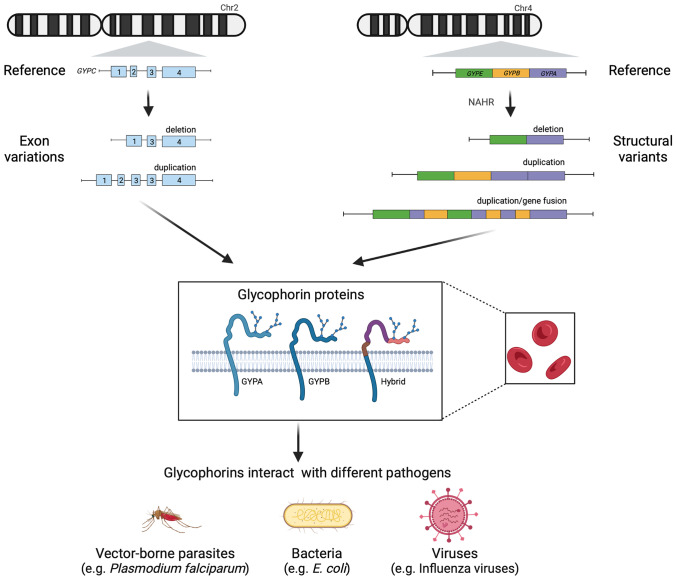 Fig. 1 Genomic structural variants reshape glycophorin isoforms, mediating red blood cell binding to diverse pathogens.1
The biological functions of GYPE are focused on low-abundance red cell sialoglycan presentation, mild cytoskeletal linkage and inter-paralog genetic recombination:
Creative Biolabs offers high-quality GYPE proteins through optimized expression systems, including full-length sialylated transmembrane glycoprotein and isolated extracellular antigenic domain variants. These products retain native conformational characteristics and erythrocyte cytoskeleton interaction biological activity, suitable for minor MNS blood group antigen interaction assays and erythroid membrane structural research. All GYPE proteins undergo strict quality control to ensure consistent performance and reliable application across diverse research platforms.
Not finding the membrane protein product you need? Contact us to start your one-stop custom service!
Creative Biolabs provides custom-engineered GYPE stable cell lines, including wild-type and blank control models. These cell lines are optimized for erythrocyte membrane glycoprotein profiling and rare blood group antigen functional analysis. Each cell line undergoes stringent validation to ensure stable expression profiles and consistent functional performance in diverse experimental contexts.
Not finding the stable cell line product you need? Contact us to start your one-stop custom service!
High-specificity recombinant antibodies targeting GYPE are developed via advanced antibody engineering technologies, with no cross-reactivity with GYPA and GYPB major glycophorin paralogs. These antibodies are validated for mature red blood cell membrane localization detection and rare MNS antigen tissue profiling, and can be paired with GYPA/GYPB detection reagents to analyze full glycophorin membrane complexes in hematology blood sample research models.
Not finding the recombinant antibody product you need? Contact us to start your one-stop custom service!
Beyond catalog products, Creative Biolabs offers specialized custom services for GYPE research:
GYPE is a low-abundance erythrocyte sialoglycoprotein that carries rare minor MNS blood group antigens, stabilizes red cell membrane structure and acts as a recombination template for glycophorin gene variants.
GYPE drives generation of rare MNS blood group phenotypes and modulates erythrocyte membrane mechanical properties, serving as a core minor glycophorin research marker in transfusion hematology.
No, all GYPE products and services are strictly for research use only, not intended for clinical diagnosis or treatment.
Offerings include glycosylated GYPE membrane proteins, isoform-specific detection antibodies and custom stable cell lines for erythroid membrane and rare blood group research.
GYPE proteins are validated via sialic acid-mediated membrane charge and cytoskeletal binding interaction testing.