Creative Biolabs is offering the most comprehensive services for antibody development projects. With strict regulation and effective execution, we are dedicated to providing the most valuable solutions to complete your projects.
HighlightsCreative Biolabs is offering the most comprehensive services for antibody development projects. With strict regulation and effective execution, we are dedicated to providing the most valuable solutions to complete your projects.
HighlightsCreative Biolabs has established a broad range of platforms for developing novel antibodies or equivalents. These cutting-edge technologies enable our scientists to meet your demands from different aspects and tailor the most appropriate solution that contributes to the success of your projects.
HighlightsWith deep understanding in antibody-related realms and extensive project experience, Creative Biolabs offers a variety of references to help you learn more about our capacities and achievements, including infographic, flyer, case study, peer-reviewed publications, and all kinds of knowledge that can assist your projects. You are also welcome to contact us directly for more specific solutions.
HighlightsGet a real taste of Creative Biolabs, one of the most professional custom service providers in the world. We are committed to providing highly customized comprehensive solutions with the best quality to advance your projects.
Highlights Loading...
All listed services and products are For Research Use Only. Do Not use in any diagnostic or therapeutic applications.
ITGB3 (or CD61) from the integrin family is a type I transmembrane glycoproteins of ~87 kDa theoretically which increases to 110-kDa after heavy N-linked-glycosylation and propeptide cleavage. ITGB3, as part of the integral adhesion receptor family, is coupled with designated alpha subunits – primarily represented by an alpha-IIb(ITGA2B), forming a platelet fibrinogen receptor; or an alpha-V( ITGAV), building up in its very own vitronectin adhesive particular complexes that parse exterior cellular matrix within the intracellular cytoskeleton. ITGB3 contributes a β-I domain to the extracellular ligand-binding head, where defined metal-ion-dependent sites, including the MIDAS, coordinate ligand recognition together with the alpha-subunit β-propeller; it also contains a single transmembrane helix and a short cytoplasmic tail that engages talin, kindlin, and other focal-adhesion components. Upon stimulation through inside-out signaling, ITGB3 undergoes an enormous conformational change from a bent inactive state to its extended open conformation revealing high-affinity ligand-binding sites for various ligands such as fibrinogen (392 amino acids), fibronectin 208 kDa protein part vitronectin; plasma prothrombin and von Willebrand factor. This is the activation cascade that drives platelet aggregation and clot retraction in hemostatic biology. ITGB3-mediated adhesion promotes both endothelial migration and angiogenic sprouting during vascular development, as well as supporting blood vessel wall remodeling in the matching context. In basic cancer biology, aberrant ITGB3 expression on circulating and disseminating cell populations enhances metastatic colonization (seeding), stroma invasion and anoikis resistance. Autosomal mutations in ITGB3 that either abolish heterodimer assembly or disable ligand binding cause high bleeding phenotypes, highlighting this subunit as an anchor for coagulation biology and vascular investigations; plus compound mechanism studies.
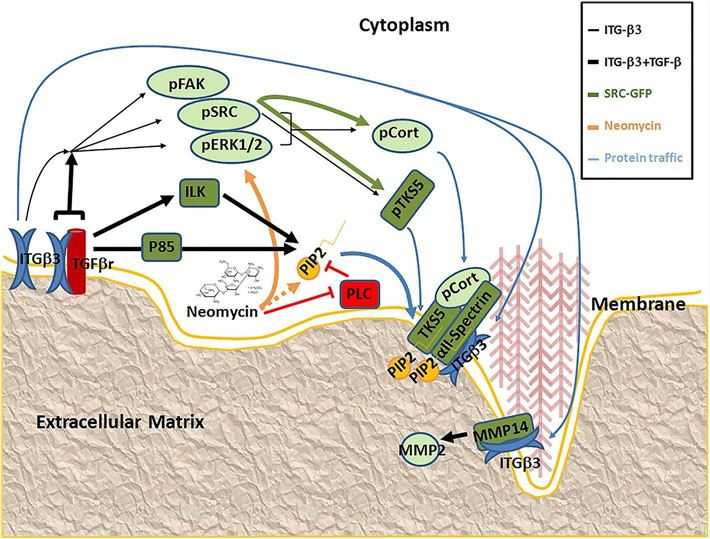 Fig.1 Schematic representation of signal pathways associated to invadopodia formation in H157 NSCLC.1
ITGB3 coordinates diverse cellular programs that extend considerably beyond its structural role as a simple membrane anchor:
We engineer an exceptional collection of full-length, conformationally authentic ITGB3 membrane proteins designed to address the inherent challenges of heterodimeric integrin biochemistry. Our manufacturing pipeline integrates advanced membrane protein expression technologies that furnish investigators with physiologically relevant receptor assemblies. Each preparation undergoes extensive quality control, stability assessments, and functional validation.
Not finding the membrane protein product you need? Contact us to start your one-stop custom service!
Establishing a eukaryotic cell platform that can faithfully reproduce the signal transduction of the natural ITGB3 heterodimer is of great significance for adhesion biology and pre-compound evaluation. Our cell lines not only include normal chromosome wild-type expression but also cover various mutants, meeting different research needs. To support the mechanism study of the adhesion process mediated by ITGB3, we constructed cell lines with fused fluorescent reporter genes, enabling real-time quantitative analysis of the activated state after ligand binding or compound exposure in research assays. Each cell line has been rigorously experimentally verified and quality-controlled, providing an indispensable substrate for mechanism research, angiogenesis research, and the optimization of research reagents targeting the ITGB3 axis.
Not finding the stable cell line product you need? Contact us to start your one-stop custom service!
Utilize our meticulously developed series of sequence-specific and high-affinity monoclonal antibodies to advance your ITGB3 research project. These antibodies have been meticulously designed to effectively identify the structural complexity of the ITGB3 subunit. All antibodies have undergone comprehensive pre-validation, including: quantitative Western blot analysis under reducing and non-reducing conditions, direct and sandwich ELISA assays. The versatility of this analysis enables researchers to characterize the expression of ITGB3 in various biological environments.
Not finding the recombinant antibody product you need? Contact us to start your one-stop custom service!
Extending well beyond our standard catalog, we deliver fully customizable discovery and manufacturing solutions meticulously tailored to the sophisticated demands of ITGB3-targeted research and compound development:
Sure. We can create various mutant forms and natural polymorphisms related to changes in ligand affinity, to meet your diverse needs.
No. All ITGB3-directed proteins, stable expression systems, and affinity reagents are designated exclusively for preclinical investigation. They have not been evaluated for application to biological specimens collected with the aim of assessing source functional status or adhesive competence.
Our integrated offering spans three principal material classes: recombinant ITGB3 proteins in diverse biochemical presentations, stable expression systems with validated surface heterodimer display, and sequence-defined antibodies mapping to distinct structural regions of the subunit.
The antibody panel is characterized for target recognition under intended assay conditions. Clone-specific selectivity and application data should be reviewed for the chosen format before use.