Creative Biolabs is offering the most comprehensive services for antibody development projects. With strict regulation and effective execution, we are dedicated to providing the most valuable solutions to complete your projects.
HighlightsCreative Biolabs is offering the most comprehensive services for antibody development projects. With strict regulation and effective execution, we are dedicated to providing the most valuable solutions to complete your projects.
HighlightsCreative Biolabs has established a broad range of platforms for developing novel antibodies or equivalents. These cutting-edge technologies enable our scientists to meet your demands from different aspects and tailor the most appropriate solution that contributes to the success of your projects.
HighlightsWith deep understanding in antibody-related realms and extensive project experience, Creative Biolabs offers a variety of references to help you learn more about our capacities and achievements, including infographic, flyer, case study, peer-reviewed publications, and all kinds of knowledge that can assist your projects. You are also welcome to contact us directly for more specific solutions.
HighlightsGet a real taste of Creative Biolabs, one of the most professional custom service providers in the world. We are committed to providing highly customized comprehensive solutions with the best quality to advance your projects.
Highlights Loading...
All listed services and products are For Research Use Only. Do Not use in any diagnostic or therapeutic applications.
The gene associated with this disorder is potassium voltage-gated channel subfamily H member 2 (KCNH2), also known as the human Ether-à-go-go-Related Gene (hERG) or Kv11. 1; KCNH) family of voltage-gated potassium channels, approximately 127 kDa. KCNH2 forms a homotetrameric structure, consisting of four KCNH2 subunits that constitute the functional channel, often in conjunction with auxiliary beta subunit KCNE2 (MiRP1) that modifies gating kinetics and pharmacological sensitivity. Cardiac electrophysiology establishes the physiological importance of KCNH2 most firmly. The CHANNEL is a key figure in the transitory phase of the delayed rectifier potassium current, a stream that is crucial for a suitable repolarization of the ventricular action potential. KCNH2 is unique among voltage-gated potassium channels in its gating kinetics: it activates slowly after depolarization, inactivates quickly and recovers from inactivation slowly. The unique properties therefore provide large outward potassium current during the repolarization phase of the cardiac cycle whilst velocity deactivation kinetics contribute to a net repolarising influence into early diastole protecting against premature depolarisations and harmful triggered activity. In addition to heart, KCNH2 is also expressed in hippocampal neurons, jejunal smooth muscle, pancreatic β-cells and some tumor cell lines where it controls neuronal excitability, gastrointestinal motility, insulin secretion and cancer cell proliferation.
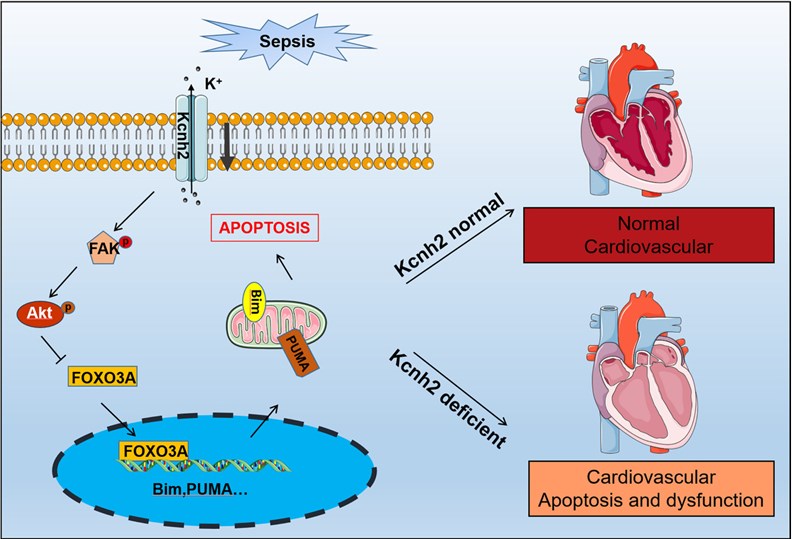 Fig.1 Schematic representation shows the mechanisms of Kcnh2-modulated cardiac dysfunction following sepsis stimulus.1
Electrophysiology, pharmacology and pathology of KCNH2 The functional portfolio of KCNH2:
Take your cardiac electrophysiology and drug safety programs to the next level with our high quality recombinant KCNH2 membrane protein catalog. We acknowledge that the transmembrane structure, high level of glycosylation, and obligate formation as a tetramer for KCNH2 pose significant production challenges. Overcoming these obstacles to success has entailed leveraging a battery of versatile expression systems—including mammalian HEK293 cells, insect cell systems, and lipid-based formulations—to obtain full-length KCNH2 constructs embedded in membranes that retain physiologically relevant voltage-dependent gating and pharmacological sensitivity. All full-length wild-type human and mouse KCNH2, as well as disease-related mutations such as LQT2-causing trafficking mutants and SQT1-associated gain-of-function mutants. Every preparation receives extensive biophysical characterization by SDS-PAGE, analytical SEC and ligand-binding assays to determine readiness for structural studies, patch-clamp electrophysiology, and hERG safety screening.
Not finding the membrane protein product you need? Contact us to start your one-stop custom service!
Reliable and reproducible cellular models are critical for dissecting KCNH2-dependent biology and evaluating channel responses. We offer customized KCNH2 stable cell lines designed to support studies of channel expression and function according to specific research requirements. These cellular models can be applied to KCNH2 electrophysiology, ion channel function studies, compound-response analysis, and related mechanistic research. Available cell models, construct configurations, and assay readouts should be determined based on the specific project requirements and supporting product or service information.
Not finding the stable cell line product you need? Contact us to start your one-stop custom service!
We will provide high-affinity recombinant antibodies targeting KCNH2 for use in research applications where application performance is of the utmost importance. These monoclonals are produced using state-of-the-art recombinant technologies, imparting superior specificity, sensitivity and batch-to-batch consistency compared to polyclonal antibodies. With specificity to KCNH2, our recombinant antibodies are validated for WB, ELISA, FCM, IF, ICC, IHC and IP; enabling accurate detection and quantification of this protein in cardiac myocyte lysates as well as neuronal tissue sections or transfected cell membranes.
Not finding the recombinant antibody product you need? Contact us to start your one-stop custom service!
n addition to our catalog products, we also provide custom membrane protein and antibody discovery and development services. Combining our experience in Biology of Ion channels and electrophysiology related to cardiac functions, we can help you doing:
KCNH2 products and services have been developed to be used for research use only, and not for clinical diagnosis, prevention, treatment or cure of any disease.
Yes. We have pricing tiers that are flexible for academic and industrial scale-up needs. Please submit your expected volume and timeline on our inquiry portal to receive a quote specific to you.
We have listed mouse and rat KCNH2 reagents in our catalog. Upon request, we can also provide custom production of additional orthologs or engineered mutants.
Absolutely. The cell engineering team routinely generates tetracycline-inducible systems and lines commonly co-expressing KCNH2 with KCNE2 (MiRP1) or calcium biosensor constructs used for comprehensive electrophysiology studies. We encourage discussions regarding your expression system of choice and phenotypic needs.