Creative Biolabs is offering the most comprehensive services for antibody development projects. With strict regulation and effective execution, we are dedicated to providing the most valuable solutions to complete your projects.
HighlightsCreative Biolabs is offering the most comprehensive services for antibody development projects. With strict regulation and effective execution, we are dedicated to providing the most valuable solutions to complete your projects.
HighlightsCreative Biolabs has established a broad range of platforms for developing novel antibodies or equivalents. These cutting-edge technologies enable our scientists to meet your demands from different aspects and tailor the most appropriate solution that contributes to the success of your projects.
HighlightsWith deep understanding in antibody-related realms and extensive project experience, Creative Biolabs offers a variety of references to help you learn more about our capacities and achievements, including infographic, flyer, case study, peer-reviewed publications, and all kinds of knowledge that can assist your projects. You are also welcome to contact us directly for more specific solutions.
HighlightsGet a real taste of Creative Biolabs, one of the most professional custom service providers in the world. We are committed to providing highly customized comprehensive solutions with the best quality to advance your projects.
Highlights Loading...
All listed services and products are For Research Use Only. Do Not use in any diagnostic or therapeutic applications.
Killer cell lectin like receptor B1 (KLRB1, also known as CD161 or NKR-P1A) is a type II transmembrane C-type lectin-like receptor encoded by the KLRB1 gene. It is expressed on natural killer (NK) cells and multiple T-cell populations and participates in the regulation of immune cell responses. Unlike receptors with intrinsic enzymatic activity, KLRB1 functions through ligand-dependent cell-surface interactions, with lectin-like transcript 1 (LLT1), encoded by CLEC2D, serving as a major human ligand. The interaction between KLRB1 and LLT1 may modulate NK-cell cytotoxicity, cytokine production, and T-cell responses in a cell type- and context-dependent manner. LLT1 expression on immune and other cell populations provides a mechanism through which KLRB1-expressing lymphocytes can respond to changes in their surrounding cellular environment. In NK cells, engagement of CD161 by LLT1 has been associated with inhibitory regulation of cytotoxic activity, whereas CD161 expression on T-cell subsets is linked to more diverse functional states and immune responses. These characteristics distinguish KLRB1 from broadly acting immune receptors and make its functional consequences dependent on both the responding cell population and ligand context. Changes in KLRB1 expression or ligand availability may therefore influence lymphocyte interaction patterns and immune responses observed in experimental systems, making KLRB1 a valuable research target for studying NK- and T-cell regulatory mechanisms.
KLRB1 contains an intracellular N-terminal region, a transmembrane segment, and an extracellular C-type lectin-like domain responsible for ligand recognition. Through its extracellular region, KLRB1 recognizes LLT1 and forms a receptor-ligand axis capable of regulating immune cell activity without functioning as a conventional catalytic receptor. The biological outcome of KLRB1 engagement varies among immune cell populations, reflecting differences in cellular signaling context and activation state. In NK cells, the KLRB1-LLT1 interaction can restrain cytotoxic responses and cytokine secretion, while studies of T-cell populations indicate that CD161 is associated with distinct activation, differentiation, and functional characteristics. KLRB1-mediated interactions can therefore connect extracellular ligand recognition with modulation of lymphocyte effector behavior. Its expression across NK cells and defined T-cell populations, together with its interaction with CLEC2D/LLT1, makes KLRB1 relevant to basic research on immune-cell recognition, lymphocyte regulation, and cell-cell communication.
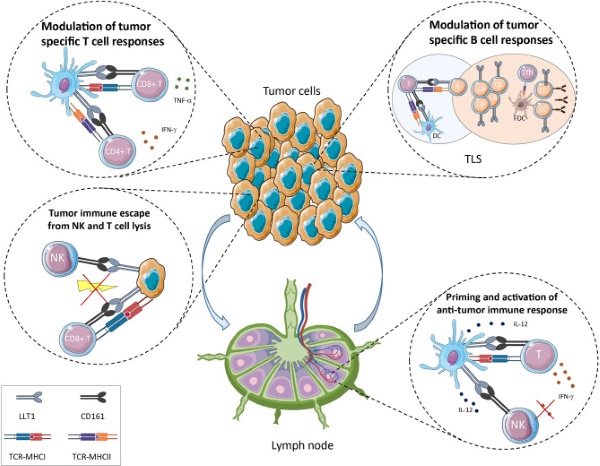 Fig. 1 Schematic diagram of LLT1-KLRB1 checkpoint regulating multi-lineage anti-tumor immune responses.1
The biological functions of KLRB1 are focused on C-type lectin receptor signaling, lymphocyte cytotoxicity modulation and immune homeostasis maintenance:
Relying on the optimized recombinant expression system, Creative Biolabs prepared high-quality KLRB1 series of scientific research proteins, including full-length KLRB1 protein and segmented functional domain variants and other product types. This series of proteins can stably maintain the natural spatial conformation and completely retain the receptor-specific ligand binding activity, which can meet the basic research needs of immunology, such as verification of receptor-ligand interaction, exploration of lymphocyte function mechanism, and screening of immunomodulatory small molecule drugs. All batches of KLRB1 protein have passed strict quality verification, and their performance is stable and uniform, which can realize reliable and repeatable experimental application in various immunological experimental systems.
Not finding the membrane protein product you need? Contact us to start your one-stop custom service!
Creative Biolabs provides custom-engineered KLRB1 stable cell strains, including overexpression and expression-interference models. These strains are optimized for immune receptor functional research, lymphocyte signal transduction and compound immunomodulatory activity assessment. Each cell strain undergoes strict functional validation to ensure steady target expression levels and uniform experimental performance across multiple research scenarios.
Not finding the stable cell line product you need? Contact us to start your one-stop custom service!
High-specificity recombinant antibodies targeting KLRB1 are developed via advanced antibody engineering technologies, with no cross-reactivity against other C-type lectin receptor family members. These antibodies are validated for multiple experimental applications, including target protein expression quantification, lymphocyte membrane localization detection, receptor-ligand binding assessment and translational immunology research, enabling accurate characterization of KLRB1 expression abundance, subcellular distribution and functional regulatory status under physiological and pathological contexts.
Not finding the recombinant antibody product you need? Contact us to start your one-stop custom service!
Beyond catalog products, Creative Biolabs offers specialized custom services for KLRB1 research:
KLRB1 is a core C-type lectin immune receptor that mediates inhibitory lymphocyte signaling, cytotoxicity regulation and systemic immune homeostasis maintenance.
KLRB1 undertakes irreplaceable regulatory roles in lymphocyte function and immune system balance; its functional aberration drives tumor and inflammatory immune disorders, establishing it as a vital immunology research target.
No, all KLRB1 products and customized research services are strictly limited to laboratory research applications, not applicable for clinical diagnosis or therapeutic intervention.
The product portfolio covers KLRB1 recombinant proteins, high-specificity recombinant antibodies and customizable stable cell strains for immune receptor and translational immunology research.
KLRB1 proteins undergo activity verification via ligand binding capacity testing, receptor structural integrity evaluation and lymphocyte signal response assessment.