
Creative Biolabs is offering the most comprehensive services for antibody development projects. With strict regulation and effective execution, we are dedicated to providing the most valuable solutions to complete your projects.
HighlightsCreative Biolabs is offering the most comprehensive services for antibody development projects. With strict regulation and effective execution, we are dedicated to providing the most valuable solutions to complete your projects.
HighlightsCreative Biolabs has established a broad range of platforms for developing novel antibodies or equivalents. These cutting-edge technologies enable our scientists to meet your demands from different aspects and tailor the most appropriate solution that contributes to the success of your projects.
HighlightsWith deep understanding in antibody-related realms and extensive project experience, Creative Biolabs offers a variety of references to help you learn more about our capacities and achievements, including infographic, flyer, case study, peer-reviewed publications, and all kinds of knowledge that can assist your projects. You are also welcome to contact us directly for more specific solutions.
HighlightsGet a real taste of Creative Biolabs, one of the most professional custom service providers in the world. We are committed to providing highly customized comprehensive solutions with the best quality to advance your projects.
Highlights Loading...
All listed services and products are For Research Use Only. Do Not use in any diagnostic or therapeutic applications.
Matrix metallopeptidase 14, which is MMP14, also has a more commonly used name: membrane type 1 matrix metalloproteinase MT1-MMP. It belongs to the matrix metalloproteinase family, with a molecular weight of 66kDa, and is a type I transmembrane endopeptidase that attaches to cell membranes and requires zinc ions to function. Simply put, it is a molecular scissors that can attach to the cell surface, relies on zinc ions to maintain the "sharpness" of the scissors, and is specifically responsible for cutting long protein peptide chains around cells into small segments. Its structure is clearly divided, with each part taking charge of its own functions, assembling into a complete protein that can work normally. The N-terminal at the very front carries a catalytic domain, in which the catalytic zinc ion is hidden in a highly conserved HEXXHXXGXXH sequence — this sequence rarely mutates during evolution, and is the core structure that maintains its cleavage capability. Following it is the hinge region, which flexibly connects the front and rear functional segments like a door hinge. Further back is the hemopexin-like domain, which is responsible for binding the substrate to be cleaved, as well as inhibitors that can suppress its activity. This is equivalent to helping the scissors locate the target to cut, while also being regulated by control mechanisms to prevent indiscriminate cutting. There is also a very short transmembrane helix that helps it anchor firmly to the cell membrane without drifting away. The cytoplasmic tail extending into the cell at the very end is responsible for its intracellular transport, and can also participate in intracellular signal transduction, serving as the built-in "positioner" and "signal interface" of these scissors. In basic research, MMP14 has been confirmed to be the core driving force that promotes three-dimensional cell invasion, new blood vessel sprouting, and wound healing. However, if its activity is out of control and it is overly active when it should not be, in controlled biological models, it is closely linked to abnormal tissue remodeling and cancer cell metastasis and spread. Cells that should have remained in their original location can, relying on the uncontrolled cleavage capability of MMP14, break through tissue barriers to travel to other parts of the body to take root, and will also remodel originally normal tissues beyond recognition.
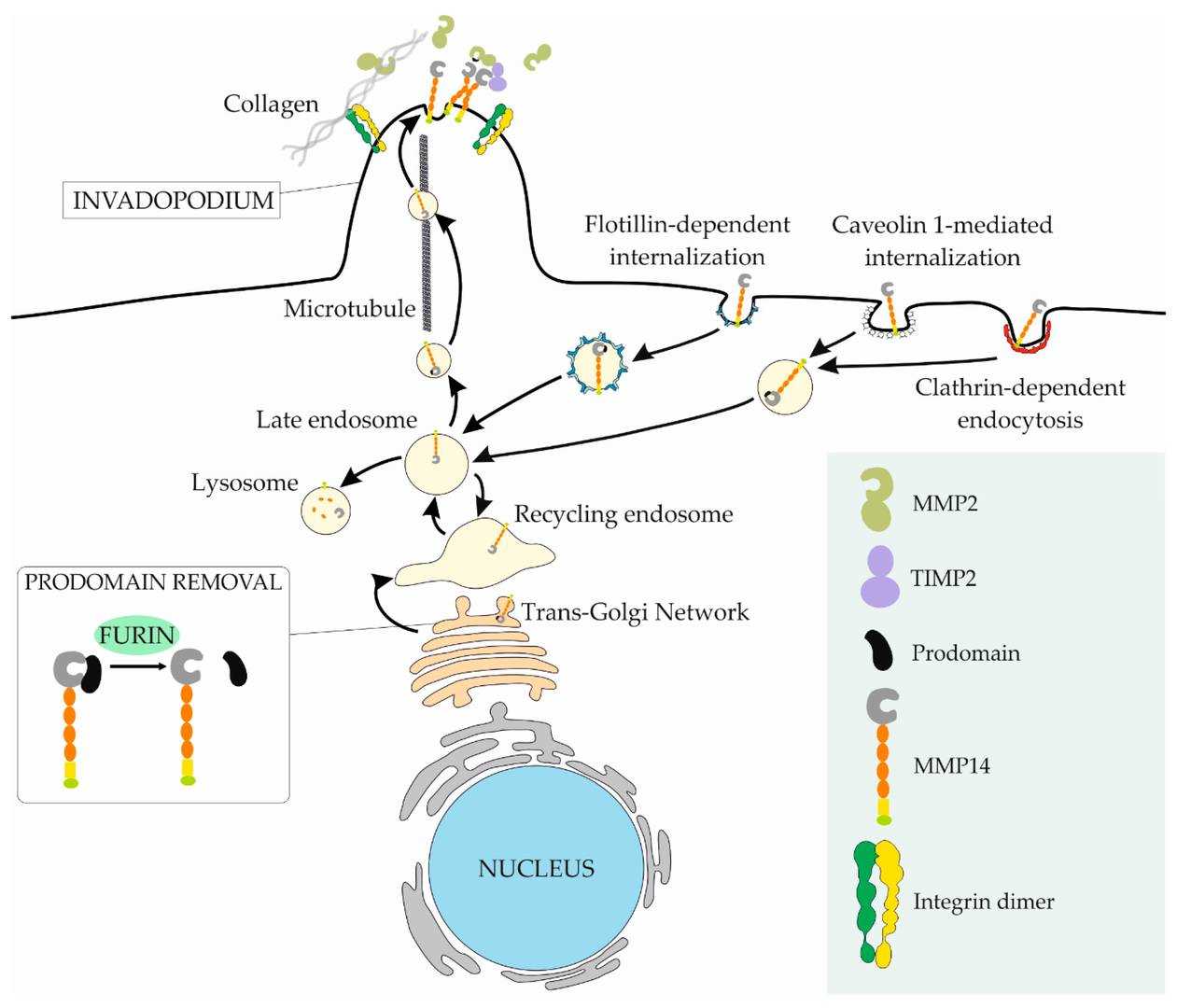 Fig.1 The plasma membrane expression of MMP14 is highly regulated.1
MMP14 coordinates diverse cellular programs that extend considerably beyond its nominal designation as a simple collagenase:
Our team has developed full-length MMP14 membrane protein preparations for research on membrane-anchored metalloprotease structure and activity. The production workflow is designed to preserve key structural and catalytic features relevant to MMP14 studies. Every batch of the produced preparation has passed strict quality inspection, and can meet various needs of different experiments. Whether it is low-throughput mechanism exploration or high-throughput compound screening, stable and reliable experimental results can be obtained.
Not finding the membrane protein product you need? Contact us to start your one-stop custom service!
Establishing a native cell platform that can truly reproduce the proteolytic degradation of the extracellular matrix proteins of natural MMP14 is of crucial importance for matrix biology and pre-compound evaluation. Through advanced multi-functional technologies, we provide stable MMP14 cell lines that can maintain the true localization and catalytic activity of MMP14 on the cell membrane. Our product range includes both commonly expressed wild-type cells and variant cells without catalytic activity. Each cell line has undergone strict validation, and these scalable cell resources provide an indispensable experimental foundation for matrix biology research and the optimization of research reagents targeting the MMP14 axis.
Not finding the stable cell line product you need? Contact us to start your one-stop custom service!
Utilize our meticulously developed series of sequence-specific and high-affinity monoclonal antibodies to advance your MMP14 research project. These antibodies have been precisely designed to effectively address the complexity of the membrane-bound metalloproteinase structure. The antibody panel is characterized for MMP14 recognition under intended assay conditions, with clone-specific validation used to guide application selection. The versatility of this analysis enables researchers to characterize the expression of MMP14 in various biological environments and design more precise research antibodies for basic matrix biology studies.
Not finding the recombinant antibody product you need? Contact us to start your one-stop custom service!
Extending well beyond our standard catalog, we deliver fully customizable discovery and manufacturing solutions meticulously tailored to the sophisticated demands of MMP14-targeted research and precompound development:
No. The complete range of MMP14-directed materials—recombinant protein preparations, stable expression systems, and affinity reagents—is reserved exclusively for preclinical investigation.
Yes. We provide engineered cellular models in which the protease is exteriorized with confirmed competence for mediating localized extracellular matrix component turnover at the membrane periphery.
Yes. Specific clones have been isolated for preferential recognition of the target when it resides within inhibitory complexes, wherein conformational masking of certain epitopes is compensated by exposure or stabilization of others.
Yes, we can customize according to your requirements to produce products with the corresponding functions.









