Creative Biolabs is offering the most comprehensive services for antibody development projects. With strict regulation and effective execution, we are dedicated to providing the most valuable solutions to complete your projects.
HighlightsCreative Biolabs is offering the most comprehensive services for antibody development projects. With strict regulation and effective execution, we are dedicated to providing the most valuable solutions to complete your projects.
HighlightsCreative Biolabs has established a broad range of platforms for developing novel antibodies or equivalents. These cutting-edge technologies enable our scientists to meet your demands from different aspects and tailor the most appropriate solution that contributes to the success of your projects.
HighlightsWith deep understanding in antibody-related realms and extensive project experience, Creative Biolabs offers a variety of references to help you learn more about our capacities and achievements, including infographic, flyer, case study, peer-reviewed publications, and all kinds of knowledge that can assist your projects. You are also welcome to contact us directly for more specific solutions.
HighlightsGet a real taste of Creative Biolabs, one of the most professional custom service providers in the world. We are committed to providing highly customized comprehensive solutions with the best quality to advance your projects.
Highlights Loading...
All listed services and products are For Research Use Only. Do Not use in any diagnostic or therapeutic applications.
Phosphatidylinositol glycan anchor biosynthesis class F (PIGF), otherwise called OORS and GPI11 homolog, is a constituent of the endoplasmic reticulum integral membrane protein that acts as an essential non-catalytic subunit within the GPI ethanolamine phosphate transferase complexes required for evolutionary conservation. This extraordinary protein assembles into functionally essential heterodimeric complexes with two different catalytic partners, PIGO and PIGG to catalyze the transfer of ethanolamine phosphate (EtNP) elements in the second and third mannose residues of substrate ontogenetic GPI anchor precursors. The GPI anchor per se is a highly elaborated glycolipid made up of phosphatidylinositol, glucosamine and 3-mannose residues as well as ethanolamine phosphate that acts like a universal membranal tether targeting more than 150 different human proteins to be anchored on the cell surface. These GPI-anchored proteins (GPI-APs) represent an exceptionally diverse functional array, including complement regulatory proteins (CD55, CD59), adhesion molecules (NCAM, Thy1); receptors such as the folate receptor and uPAR; enzymes; alkaline phosphatase acetylcholinesterase, and co-receptors in developmental signaling pathways CRIPTO, RECK; emphasizing that the PIGF-dependent biosynthetic machinery is of paramount biological importance. PIGF has a multi-pass transmembrane topology in which both N- and C-terminal domains extend into the cytoplasm, allowing PIGF to act as a scaffolding structures within ER membrane. This protein harbors a highly conserved functional motif that is necessary for the biological activity of SLC35A2, but is separate from these domains involved in heterodimerization with PIGO and PIGG. Furthermore, elegant biochemical studies showed that the C-terminal half of PIGF was sufficient for binding to both PIGO and PIGG yet this truncated construct could not rescue the defective phenotype of glioblastoma cells where expression of full length pIgf is abolished; therefore we concluded heterodimer formation alone cannot be assumed to confer function as recent work has shown a significant role for at least one conserved motif direct in catalysis or regulation EtNP transfer. PIGF is widely expressed in human tissues but shows the highest expression levels in adipose tissue, heart and brain, which correlates with the fact that GPI-anchored proteins are essential for virtually every cell type.
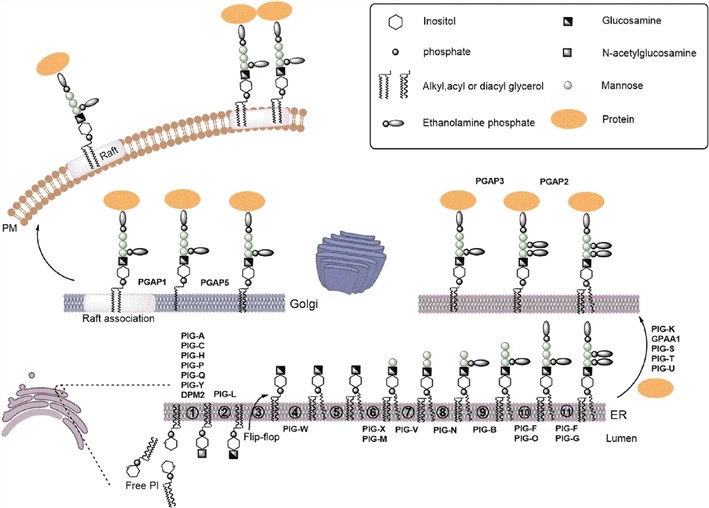 Fig.1 A scheme for the overall GPI-APs biosynthetic pathway, structural remodeling and transport.1
The functional repertoire of PIGF spans three axes: membrane protein biology, developmental physiology and disease pathogenesis:
We provide a range of PIGF membrane protein products designed to support structural and functional studies of this ER-resident component of the GPI-anchor biosynthesis pathway. PIGF functions as a stabilizing subunit associated with PIGO and PIGG during ethanolamine phosphate transfer steps in GPI-anchor assembly. Our portfolio may include full-length PIGF and engineered research constructs suitable for studying PIGF-related membrane organization, interactions with PIGO and PIGG, and mechanisms of GPI-anchor biosynthesis. Available construct formats, expression systems, tags, complex configurations, and characterization methods should be determined according to the corresponding product or project information.
Not finding the membrane protein product you need? Contact us to start your one-stop custom service!
Given the essentiality of PIGF to GPI anchor biosynthesis and its emerging importance in developmental biology as well as inherited disease, the development of robust cellular models for further studies into PIGF has been necessary. We're focused on generating custom-engineered PIGF stable cell lines that stably express target constructs at high levels — including wild-type PIGF along with conserved motif mutants and C-terminal truncation variants. These stable cell lines are suited for drug screening, GPI-AP surface expression assays and functional studies of EtNP transferase activity, ER stress monitoring as well as adapted for high-throughput screening campaigns. In multiple host backgrounds (HEK293, CHO-K1 and PIGF-deficient CHO cells with options for either an ectopic or constitutive expression system in class F complementation group cell lines). We have also generated doxycycline-inducible PIGF-expressing lines for controlled GPI biosynthesis, and stable depletion of endogenous PIGF, heterodimeric enzyme assays with cell lines expressing both various combinations of ectopic PIGF-PIGO or -PIGG complexes, but were still lacking in loss-of-function data. All stable cell lines are validated by flow cytometry (for GPI-AP surface markers like CD59), Western blot, immunofluorescence localization assays and functional complementation readouts to ensure that consistent homogeneous expression is maintained over passages.
Not finding the stable cell line product you need? Contact us to start your one-stop custom service!
We have developed high-affinity recombinant antibodies against PIGF, which are fit for purpose to be used in a wide range of research applications. Produced by innovative recombinant technologies, these antibodies give better specificity and sensitivity than traditional hybridoma-derived monoclonal antibodies along with batch-to-batch consistency. We raised our anti-PIGF antibodies against ell-selected epitopes with well-balanced composition through a variety of the N-terminal cytoplasmic region, transmembrane domains and C-terminal cytoplasmic tail encompassing the conserved functional motif that will also lead to the best odds in detection of this full-length ~25 kDa protein. Reverse-order antibody validation approaches include confirmed detection by Western blot in HEK293 and CHO cell lysates, immunohistochemistry (IHC) of placental and brain tissue sections, as well as flow cytometry; unverified applications consist of ELISA for antigen quantification. The formats—monoclonal and polyclonal, conjugated to fluorescent dyes (PE, FITC, Alexa Fluor), enzymes (HRP; AP) or biotin for workflow flexibility. Our pairs are validated not only for the sandwich ELISA, but also specifically for use in serum/plasma and in cell culture supernatants to facilitate biomarker discovery of GPI biosynthesis disorders with your PIGF antibodies.
Not finding the recombinant antibody product you need? Contact us to start your one-stop custom service!
In addition to our catalog products we provide tailored custom services and projects for membrane protein, antibody discovery & development. Drawing on our deep knowledge and advanced platforms, we can help you with:
No, all our PIGF products and services are strictly for research use only and are not intended for clinical diagnosis, prevention, treatment, or cure of any disease.
We can provide or develop antibodies for PIGF research according to specific experimental requirements. These reagents may support studies of PIGF expression, localization, and interactions with PIGO or PIGG in the GPI-anchor biosynthesis pathway. Any ability to preferentially recognize complex-associated PIGF should be determined based on clone-specific validation data.
PIGF-related research products can support studies of GPI-anchor biosynthesis, ER-associated PIGF function, and interactions of PIGF with PIGO and PIGG. Appropriate protein constructs, cellular models, antibodies, and experimental readouts can be selected according to the specific research objective.
Yes, we have generated stable lines constitutively expressing full-length PIGF together with both PIGO and GPAA1 from independent loci. Microtiter plate configuration for designed experimentIn this setup, the use of microtiter plates affords continual assessment of transamidase complex stability and delivery of GPI-anchor precursor processing intermediates (GPI-APIs) to cell surface receptors due to the absence in variability provided by continuous transient expression.