Creative Biolabs is offering the most comprehensive services for antibody development projects. With strict regulation and effective execution, we are dedicated to providing the most valuable solutions to complete your projects.
HighlightsCreative Biolabs is offering the most comprehensive services for antibody development projects. With strict regulation and effective execution, we are dedicated to providing the most valuable solutions to complete your projects.
HighlightsCreative Biolabs has established a broad range of platforms for developing novel antibodies or equivalents. These cutting-edge technologies enable our scientists to meet your demands from different aspects and tailor the most appropriate solution that contributes to the success of your projects.
HighlightsWith deep understanding in antibody-related realms and extensive project experience, Creative Biolabs offers a variety of references to help you learn more about our capacities and achievements, including infographic, flyer, case study, peer-reviewed publications, and all kinds of knowledge that can assist your projects. You are also welcome to contact us directly for more specific solutions.
HighlightsGet a real taste of Creative Biolabs, one of the most professional custom service providers in the world. We are committed to providing highly customized comprehensive solutions with the best quality to advance your projects.
Highlights Loading...
All listed services and products are For Research Use Only. Do Not use in any diagnostic or therapeutic applications.
Peripherin 2 (PRPH2) is a photoreceptor-specific tetraspanin membrane protein encoded by the PRPH2 gene, enriched at outer-segment disk rims. The polypeptide contains four transmembrane helices, two intradiscal loops (D1 and D2), and cytoplasmic N- and C-terminal regions. The large D2 loop contributes to intermolecular assembly, allowing PRPH2 to form homomeric complexes and heteromeric complexes with ROM1. These assemblies support disk rim morphogenesis, curvature, and structural stability within photoreceptor outer segments. Disordered PRPH2 complex assembly can disrupt outer-segment membrane organization and light-sensing architecture.
Sequence variants within PRPH2 coding regions might alter oligomeric complex assembly and destabilize photoreceptor membrane architecture. PRPH2 fully integrates within disk lipid bilayers as a four-pass tetraspanin, with intradiscal loops and cytoplasmic termini. Its membrane topology and assembly with PRPH2 or ROM1 partners support disk rim formation and structural stability. Reduced functional PRPH2 tends to disorder outer-segment architecture, making this membrane protein a suitable visual cell research target.
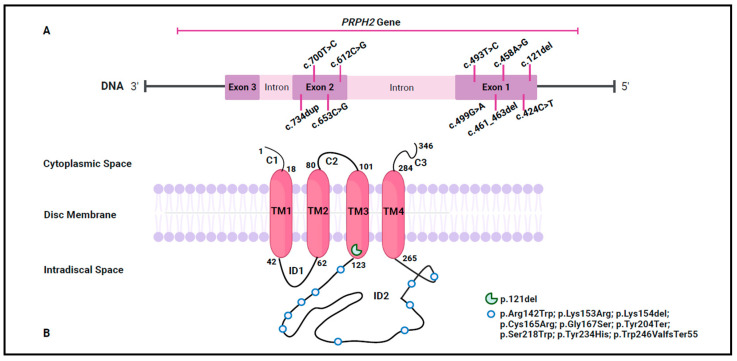 Fig. 1 Gene arrangement and membrane topology diagram of human PRPH2 protein. Panel B illustrates PRPH2 tetraspan transmembrane architecture with four transmembrane helices, two intradiscal extracellular loops ID1 and ID2, as well as cytoplasmic terminal segments.1
The biological functions of integral membrane PRPH2 structural protein are focused on D2-loop-mediated oligomeric assembly and photoreceptor outer-segment disk organization:
Creative Biolabs offers purified PRPH2 membrane protein samples produced under unified preparation workflows, including full-length PRPH2 constructs and isolated intradiscal D2-loop variants. Truncated fragments cannot support complete four-pass membrane topology or oligomeric assembly, while full-length constructs fit retinal structural protein research. All batches receive uniform quality screening. Functional assessments may only be performed under simulated lipid bilayer microenvironment setups. Intradiscal D2-loop and four-transmembrane structural features are preserved across batches for comparative complex-assembly testing. Full-length PRPH2 membrane samples retain intact contact residues post-purification, supporting reliable detection of transient PRPH2 or PRPH2-ROM1 oligomeric complexes in comparative analysis.
Not finding the Membrane Protein product you need? Contact us to start your one-stop custom service!
Creative Biolabs provides cell research models with adjustable PRPH2 expression levels, suitable for structural observation of photoreceptor membrane structural proteins and disk assembly research. Sample assessment covers sustained membrane detection and preliminary oligomeric-complex analysis, enabling side-by-side comparison of membrane organization under varying PRPH2 abundances. These cell models can be paired with membrane morphology observation schemes to track disk architecture shifts linked to PRPH2 dosage changes.
Not finding the stable cell line product you need? Contact us to start your one-stop custom service!
Anti-PRPH2 recombinant antibodies are generated via standardized protein preparation workflows, compatible with photoreceptor membrane localization mapping and PRPH2-associated oligomeric-complex identification. The antibody series supports multi-dimensional visualization of PRPH2 distribution within retinal sensory cell samples.
Not finding the recombinant antibody product you need? Contact us to start your one-stop custom service!
Beyond catalog products, Creative Biolabs offers specialized custom services for PRPH2 research:
PRPH2 is a photoreceptor-specific four-pass tetraspanin that forms PRPH2 and PRPH2-ROM1 complexes and supports outer-segment disk rim morphogenesis and stability.
PRPH2 expression status might alter light-sensing membrane organization, serving as a key mediator of retinal cell homeostasis biological processes.
No, all PRPH2 related products and services are strictly for research use only, and cannot be applied in clinical workflows. All material design and functional screening are optimized exclusively for basic laboratory research, without meeting clinical application criteria.
Offerings include full-length PRPH2 membrane protein, target-specific recombinant antibodies and tunable expression cell research models, supporting research on photoreceptor disk rim organization.
Laboratory analysis schemes may include PRPH2 self-association or ROM1 co-binding assays to assess complex formation under membrane-mimetic conditions.