Creative Biolabs is offering the most comprehensive services for antibody development projects. With strict regulation and effective execution, we are dedicated to providing the most valuable solutions to complete your projects.
HighlightsCreative Biolabs is offering the most comprehensive services for antibody development projects. With strict regulation and effective execution, we are dedicated to providing the most valuable solutions to complete your projects.
HighlightsCreative Biolabs has established a broad range of platforms for developing novel antibodies or equivalents. These cutting-edge technologies enable our scientists to meet your demands from different aspects and tailor the most appropriate solution that contributes to the success of your projects.
HighlightsWith deep understanding in antibody-related realms and extensive project experience, Creative Biolabs offers a variety of references to help you learn more about our capacities and achievements, including infographic, flyer, case study, peer-reviewed publications, and all kinds of knowledge that can assist your projects. You are also welcome to contact us directly for more specific solutions.
HighlightsGet a real taste of Creative Biolabs, one of the most professional custom service providers in the world. We are committed to providing highly customized comprehensive solutions with the best quality to advance your projects.
Highlights Loading...
All listed services and products are For Research Use Only. Do Not use in any diagnostic or therapeutic applications.
Proline-rich transmembrane protein 2 (PRRT2) is a membrane-associated neuronal protein with a long proline-rich N-terminal region and a C-terminal membrane-associated domain. PRRT2 is enriched at presynaptic terminals, where it participates in the regulation of synaptic vesicle release and interacts with components of the neurotransmitter release machinery, including SNARE proteins and synaptotagmins. These interactions contribute to the control of vesicle priming and Ca2+-dependent neurotransmitter release. PRRT2 is highly expressed in the central nervous system and is associated with neuronal circuits involved in motor control and synaptic transmission. Pathogenic PRRT2 variants are associated with paroxysmal neurological disorders, particularly paroxysmal kinesigenic dyskinesia and infantile seizure-related phenotypes, making PRRT2 an important target for research into presynaptic function and neuronal excitability.
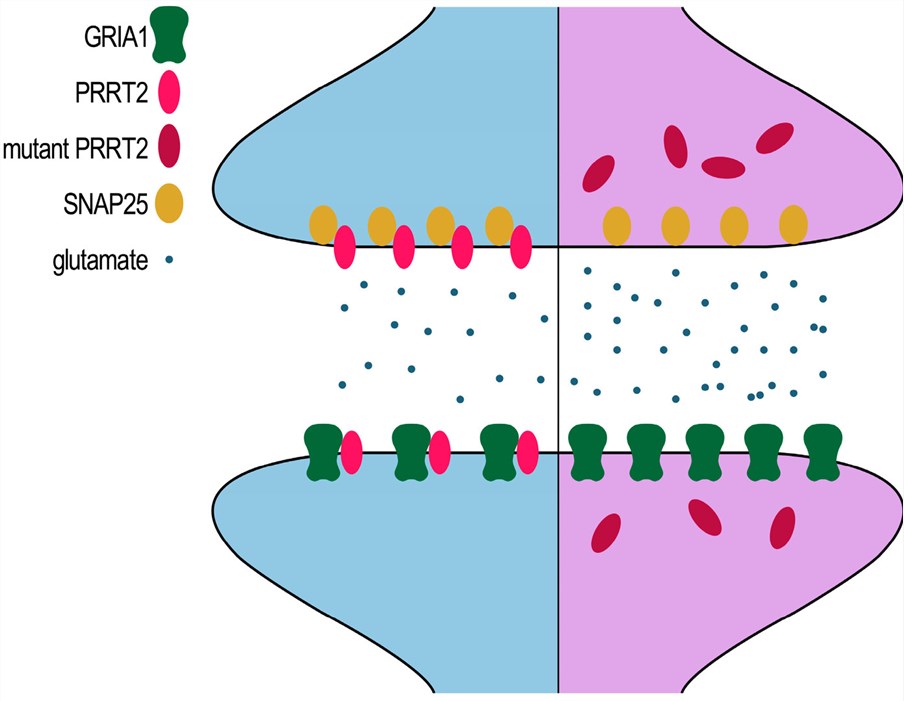 Fig.1 Schematic representation of mutant PRRT2 affecting the glutamate signaling pathway.1
The functional repertoire of PRRT2 spans multiple domains of synaptic physiology and neuropathology:
PRRT2 contains a largely disordered N-terminal region together with a C-terminal membrane-associated domain, making recombinant protein production and structural characterization technically challenging. Creative Biolabs provides full-length and engineered PRRT2 membrane protein constructs designed to support structural studies, protein-interaction research, antibody development and characterization, and investigations of PRRT2 membrane-associated function. Construct design, expression format, membrane-mimetic preparation, and functional characterization can be selected according to specific research requirements and available project data.
Not finding the membrane protein product you need? Contact us to start your one-stop custom service!
Robust cellular models able to express functional PRRT2 at the presynaptic membrane, while retaining SNARE-regulatory activity are critical for studies on neurotransmitter release assays/inhibitor screening and also disease-mechanism analyses. The engineered stable cell lines of Creative Biolabs, where they have established an optimized transduction and selection protocol to derive highly homogeneous stably expressing protein with minimal gene copy variation ensure sustainable protein expression levels over time. Lentiviral delivery, transposon-mediated integration and targeted knock-in methodologies provide precise genetic control of our cell engineering platform. After rigorous monoclonal selection for clonal purity, each line is extensively phenotypically validated to not only show surface and synaptic localization but also functional modulation of SNARE assembly and neurotransmitter release.
Not finding the stable cell line product you need? Contact us to start your one-stop custom service!
Sequence-defined antibodies can provide useful tools for studying PRRT2 expression, localization, and protein interactions in experimental model systems. Creative Biolabs provides recombinant antibody discovery and development services targeting PRRT2 for research applications. Antibody design and selection strategies can be tailored to relevant PRRT2 regions according to project requirements, with downstream characterization supporting applications such as ELISA, immunodetection, and other research assays. Specific epitope recognition, affinity, selectivity against related PRRT family proteins, and application suitability should be determined from antibody-specific characterization data. All antibodies and related services are intended for research use only.
Not finding the recombinant antibody product you need? Contact us to start your one-stop custom service!
Creative Biolabs provides advanced discovery services that go beyond standard catalogue offerings to address the entire PRRT2 research needs:
No, they are for research use only and not intended diagnostic or therapeutic purposes.
Yes we do offer conformation selective antibodies that recognize an epitope contained within the proline-rich domain now exposed by SNAP25 binding. These reagents allow for the direct visualization of synaptically-localized PRRT2 in fixed neuronal cultures or tissue sections, separating active-zone populations from unassembled cytoplasmic species.
We did (and have derived multi-stable lines that stably express PRRT2 together with SNAP25 and synaptotagmin-1 from independent loci in a constitutive manner). For each batch, this comes with data on depolarization-evoked exocytosis kinetics that helps you perform all your mechanistic studies without repeated transient transfection between experiments.
Yes, our immunogen is to a region that (to the best of my knowledge) has been very well conserved in mammalian species so you should be able to use any mouse/rat neuronal preparation without having multiple reagents for the same application.