
Creative Biolabs is offering the most comprehensive services for antibody development projects. With strict regulation and effective execution, we are dedicated to providing the most valuable solutions to complete your projects.
HighlightsCreative Biolabs is offering the most comprehensive services for antibody development projects. With strict regulation and effective execution, we are dedicated to providing the most valuable solutions to complete your projects.
HighlightsCreative Biolabs has established a broad range of platforms for developing novel antibodies or equivalents. These cutting-edge technologies enable our scientists to meet your demands from different aspects and tailor the most appropriate solution that contributes to the success of your projects.
HighlightsWith deep understanding in antibody-related realms and extensive project experience, Creative Biolabs offers a variety of references to help you learn more about our capacities and achievements, including infographic, flyer, case study, peer-reviewed publications, and all kinds of knowledge that can assist your projects. You are also welcome to contact us directly for more specific solutions.
HighlightsGet a real taste of Creative Biolabs, one of the most professional custom service providers in the world. We are committed to providing highly customized comprehensive solutions with the best quality to advance your projects.
Highlights Loading...
All listed services and products are For Research Use Only. Do Not use in any diagnostic or therapeutic applications.
Receptor Activity-Modifying Protein 1 (RAMP1) serves as a perfect example—within receptor biology, the size of a molecule never determines the magnitude of its function. This protein has fewer than 150 amino acids, with only one transmembrane helical structure that spans the cell membrane. Yet this tiny auxiliary protein governs a receptor system that is critically important to the field of pharmaceutical research in the human body: the calcitonin gene-related peptide axis. It never functions independently; all its roles are realized through collaboration with other proteins. Its first core binding partner is the calcitonin receptor-like receptor, commonly referred to as CLR. This protein is itself a signal-transducing protein with seven transmembrane helices. Without assistance, it cannot efficiently reach the surface of the cell membrane to interface with external signals, nor can it independently select its binding ligands, leaving it unable to even identify which signals it is meant to receive. RAMP1 accompanies it all the way from its intracellular synthesis site to the cell membrane; throughout this journey, it not only facilitates the protein's trafficking, but also completely rewrites the properties of this receptor. The final RAMP1–CLR complex formed is the CGRP receptor—a structure explicitly defined in pharmaceutical research that binds to the neuropeptide with high affinity. This neuropeptide regulates vasodilation, neurogenic inflammation, and pain signal transduction, making it a core target in neurovascular research. This small RAMP1 can take on entirely distinct functions when paired with a different partner. In addition to binding with CLR, it can also associate with another core protein, the calcitonin receptor, at which point it assembles into a complex that preferentially binds amylin. This demonstrates that RAMP proteins are never fixed auxiliary components dedicated to a single protein; rather, they are universal modules that can flexibly switch partners, and their specific function is entirely determined by the partner they are paired with at a given time. To date, a total of Three RAMPs have been identified. Each RAMP influences the CLR or calcitonin receptor it binds to, endowing these core receptors with completely distinct ligand preferences and unique intracellular trafficking destinations. Specifically, RAMP1 drives its partner to preferentially bind CGRP; RAMP2 and RAMP3, by contrast, direct that same core signal receptor to bind other peptide ligands. One GPCR, when paired with three different auxiliary proteins, can transform into three receptors with entirely separate functions. This modular combinatorial design has established the RAMP system as a classic case study in textbooks, used to explain how auxiliary subunits can enrich the pharmacological properties of receptors without modifying the primary sequence of the signal protein itself.
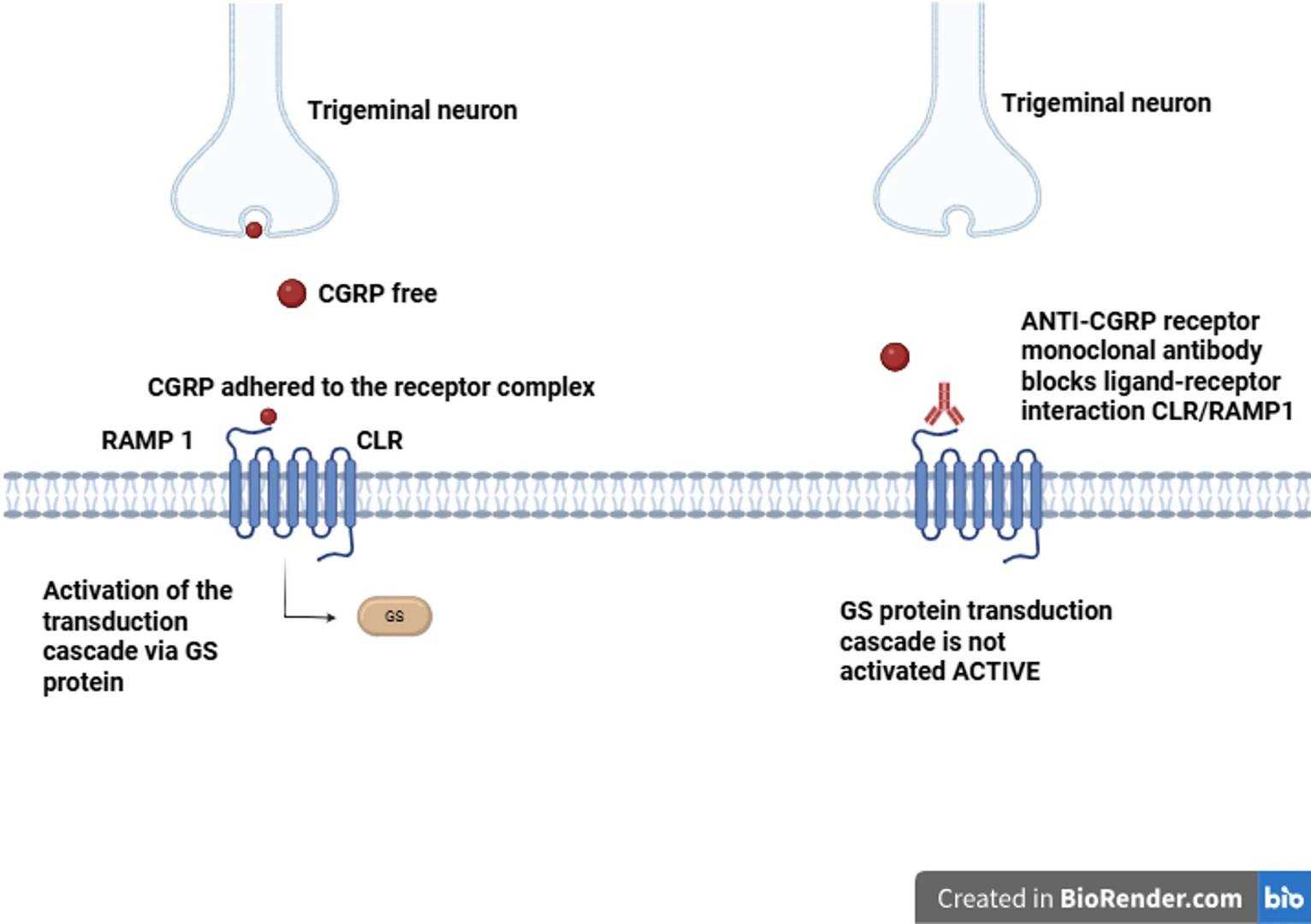 Fig.1 The figure illustrates the mechanism of action of CGRP and the effect of pharmacological blockade of its receptor by monoclonal antibody in the peripheral trigeminovascular system.1
Several research currents keep pulling on this small protein:
To reliably produce a functional RAMP1, its inherent biological property of relying on partner collaboration must be placed at the core of the protein structure design process from the very start; one cannot simply produce an isolated RAMP1 for use. An isolated single-helix RAMP1 is simple to generate, but it cannot be used for any functional experiments—for binding assays and signal transduction assays, the fully assembled RAMP1–CLR complex is required to replicate its true physiological state. Our full-length RAMP1 is all sourced from an optimized eukaryotic expression platform, which preserves the protein's native processing workflow. If experiments require complete, functionally active receptor units, we also produce specialized pre-assembled complex preparations. All final products undergo rigorous quality testing before release. Testing items include: verifying purity via SDS-PAGE to confirm the absence of extraneous contaminant proteins; confirming monodispersity via analytical size-exclusion chromatography to ensure a uniform, stable protein state; and assessing aggregation status via light scattering analysis to prevent protein clumping that could compromise experimental results. If your research requires specific partner pairing schemes, predefined ligand competition assay conditions, or protein preparations tailored to a particular pharmaceutical experiment, we can adjust our production protocols to fully align with your experimental workflow—our protein production adapts to your experimental design, and we will deliver the exact format you require.
Not finding the membrane protein product you need? Contact us to start your one-stop custom service!
Cellular models for RAMP1 work turn on a double variable: accessory-protein abundance and partner availability must be controlled together, because the surface behavior of the CGRP receptor depends on both. Wild-type overexpression lines supply defined RAMP1 densities; partner-co-expression lines reproduce native complex display for ligand-binding and signaling studies. Each clone is characterized before release: RAMP1 expression quantified against calibrated standards, complex formation with the partner receptor documented, and surface delivery verified—so the line's behavior is established before experiments begin. Should your program call for a particular partner combination, a specific expression tier, or a configuration built around your assay design, the platform can be tailored to fit; the cell line is constructed to serve the experiment it will run in.
Not finding the stable cell line product you need? Contact us to start your one-stop custom service!
Antibody work on RAMP1 faces the small-protein problem in its sharpest form: a single transmembrane helix and short terminal regions leave very little epitope real estate, and the three-RAMP family shares enough sequence that generic clones drift into cross-reactivity that quietly corrupts quantitation. The recombinant panel here is screened for genuine RAMP1 discrimination, then validated across lysate quantitation, surface staining of complex-expressing cells, fixed-tissue distribution mapping, and live-cell imaging of trafficking dynamics. Complex-recognition formats that see the RAMP1–CLR assembly as a unit are available alongside subunit-selective clones, so detection can match whichever experimental question is being asked. Sequence-defined production keeps lot-to-lot performance steady, and where a project needs a different conjugate, a custom validation against a specific sample type, or a clone format adjustment to suit a particular workflow, that can be arranged on request—the panel flexes to meet the experimental design it serves.
Not finding the recombinant antibody product you need? Contact us to start your one-stop custom service!
Extending well beyond our standard catalog, we deliver fully customizable discovery and manufacturing solutions meticulously tailored to the sophisticated demands of RAMP1-targeted research and precompound development:
Catalog items work well for standard detection or complex-assembly workflows. Custom production makes sense when constructs, formats, or quality attributes step beyond routine specifications. A short consultation is usually enough to decide.
A brief description of the application, the format envisioned, and any acceptance criteria already in mind is sufficient. Technical details can be refined together from there.
Yes. Custom formats and integrated multi-component engagements are routine, with unified quality frameworks keeping specifications aligned across components.
All RAMP1 products and services are provided strictly for preclinical research. They are not designed, validated, or authorized for any use involving human subjects.









