Creative Biolabs is offering the most comprehensive services for antibody development projects. With strict regulation and effective execution, we are dedicated to providing the most valuable solutions to complete your projects.
HighlightsCreative Biolabs is offering the most comprehensive services for antibody development projects. With strict regulation and effective execution, we are dedicated to providing the most valuable solutions to complete your projects.
HighlightsCreative Biolabs has established a broad range of platforms for developing novel antibodies or equivalents. These cutting-edge technologies enable our scientists to meet your demands from different aspects and tailor the most appropriate solution that contributes to the success of your projects.
HighlightsWith deep understanding in antibody-related realms and extensive project experience, Creative Biolabs offers a variety of references to help you learn more about our capacities and achievements, including infographic, flyer, case study, peer-reviewed publications, and all kinds of knowledge that can assist your projects. You are also welcome to contact us directly for more specific solutions.
HighlightsGet a real taste of Creative Biolabs, one of the most professional custom service providers in the world. We are committed to providing highly customized comprehensive solutions with the best quality to advance your projects.
Highlights Loading...
All listed services and products are For Research Use Only. Do Not use in any diagnostic or therapeutic applications.
Transmembrane serine protease matriptase (ST14) composed of 855 amino acids, also known as membrane-type serine protease 1 (MTSP1), prostamin, PRSS14, TADG-15 or epithin is a type II transmembrane serine protease. ST14 functions as an epithelial membrane activator, which triggers proteolytic cascades by cleavage and activation of latent growth factors and other proteases. Sphingosine 1–phosphate (S1P) further activates the protease, integrating lipid signaling with epithelial proteolysis. The diversity of this substrate repertoire allows matriptase to serve as a hub in these processes involved in epithelial homeostasis, wound healing, and malignant transformation. ST14 expression is mainly epithelial, and highest levels detected in skin, gut, prostate, mammary gland and ovary. It has been found to be overexpressed in several types of cancer, including breast, colon, prostate and ovarian carcinomas where the expression correlates with tumor invasion, metastasis and poor prognosis. Interestingly, other studies indicate that expression of matriptase is higher in early-stage ovarian tumors and decreases with tumor progression, demonstrating complex context-dependent roles for this serine protease in tumor biology.
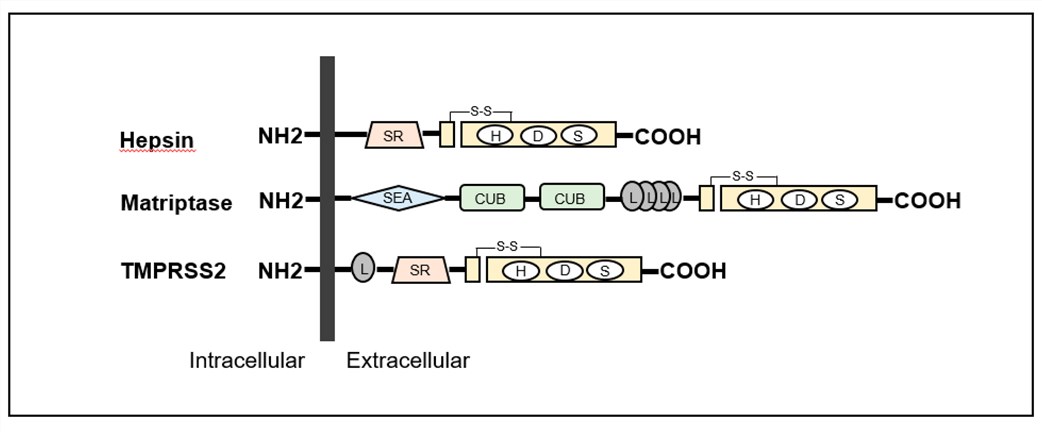 Fig. 1 Structures of hepsin, matriptase and transmembrane protease serine (TMPRSS) 2 are shown.1
ST14 has functional breadth across a multitude of physiological and pathological domains:
Features complicating structural and pharmacological investigation of ST14 include the protease's propensity for autoactivation, HAI-1–dependent regulation, multi-domain extracellular architecture, and sensitivity to autoproteolysis during heterologous expression. To meet these challenges, Creative Biolabs has developed a custom ST14 protein design platform that provides full-length and domain-based ST14 constructs for structural, protease, and interaction research. Using domain structural insights and codon-optimized gene synthesis, our engineering team develops constructs tailored to specific experimental requirements while considering key structural and functional regions of ST14. Our engagements start with a consultative technical assessment focused on matching the target protein architecture to your application requirements. Specific construct designs, preparation formats, and structural or functional validation strategies are determined according to individual project needs.
Not finding the membrane protein product you need? Contact us to start your one-stop custom service!
Reliable cellular models expressing ST14 can support protease activation assays, HAI-1 interaction studies, inhibitor screening, and broader protease-signaling research. Using optimized transduction and selection protocols, Creative Biolabs engineers custom ST14 stable cell lines with sustained protease expression. Lentiviral delivery, transposon-mediated integration, and targeted knock-in methods can be applied through our cell engineering platform depending on project requirements. Generated stable ST14 models may support studies of protease activity, protein interactions, and associated signaling mechanisms. Specific expression characteristics, phenotypic characterization, and functional validation strategies are determined according to the individual cell line and project requirements.
Not finding the stable cell line product you need? Contact us to start your one-stop custom service!
Reagents, such as robust high-affinity, sequence-defined anti-ST14 monoclonal antibodies (mAbs) specifically developed to detect the protease in epithelial tissue and map its surface localization during activation, that could ideally block HGF/uPA activation in therapeutic applications and differentiate between active matriptase and its zymogen precursor are required. Creative Biolabs have multi-epitope directed end to end recombinant antibody discovery programs against extracellular, catalytic and conformational ST14 epitopes. We integrate immunogen design, multi-platform selection and downstream engineering into a unique antibody development pipeline to deliver binders with the specificity, affinity and developability profiles needed for research use. Our strategy avoids the batch-to-batch variation associated with conventional polyclonal sera through recombinant expression and clonal sequencing, providing a fully characterized, renewable reagent.
Not finding the recombinant antibody product you need? Contact us to start your one-stop custom service!
Not limited to catalog-based products, Creative Biolabs provides enhanced discovery services for the complete range of ST14 research needs:
No, all reagents and services are for research use only (RUO) and not for diagnostic or therapeutic use.
Yes, we did generate stable lines which express sufficient ST14 as assessed by flow cytometry and autocatalytic processing assays.
Yes, we do provide recombinant proteins and stable cell lines expressing validated pathogenic mutations in the serine protease domain or transmembrane anchor.
Yes, the immunogen corresponds to a highly conserved epitope for a mammalian protein that has very consistent expression within mouse and rat epithelial preparations and cell lysates without the need for multiple species-specific reagents.