
Creative Biolabs is offering the most comprehensive services for antibody development projects. With strict regulation and effective execution, we are dedicated to providing the most valuable solutions to complete your projects.
HighlightsCreative Biolabs is offering the most comprehensive services for antibody development projects. With strict regulation and effective execution, we are dedicated to providing the most valuable solutions to complete your projects.
HighlightsCreative Biolabs has established a broad range of platforms for developing novel antibodies or equivalents. These cutting-edge technologies enable our scientists to meet your demands from different aspects and tailor the most appropriate solution that contributes to the success of your projects.
HighlightsWith deep understanding in antibody-related realms and extensive project experience, Creative Biolabs offers a variety of references to help you learn more about our capacities and achievements, including infographic, flyer, case study, peer-reviewed publications, and all kinds of knowledge that can assist your projects. You are also welcome to contact us directly for more specific solutions.
HighlightsGet a real taste of Creative Biolabs, one of the most professional custom service providers in the world. We are committed to providing highly customized comprehensive solutions with the best quality to advance your projects.
Highlights Loading...
All listed services and products are For Research Use Only. Do Not use in any diagnostic or therapeutic applications.
SURF1 (surfeit locus protein 1), encoded by the SURF1 gene on chromosome 9q34.2 and also known as surfeit 1, is a multi-pass transmembrane protein localized to the mitochondrial inner membrane. The gene is located within the surfeit gene cluster and shares a bidirectional promoter with SURF2 on the opposite strand. The SURF1 gene contains 9 exons and encodes a protein of 300 amino acids with a calculated molecular mass of approximately 30–35 kDa. The mature protein contains two transmembrane domains with a central loop region facing the intermembrane space; both transmembrane domains and the central loop are required for proper insertion of the protein into the inner membrane. SURF1 belongs to the SURF1 family, which includes the yeast ortholog SHY1 and the rickettsial protein RP733. SURF1 is expressed in multiple tissues, with highest levels in tissues with high metabolic demand including skeletal muscle, heart, and brain.
SURF1 functions as a component of the mitochondrial translation regulation assembly intermediate of cytochrome c oxidase (MITRAC) complex, which regulates cytochrome c oxidase (COX) assembly. COX (complex IV) is the terminal enzyme of the mitochondrial respiratory chain, catalyzing the transfer of electrons from reduced cytochrome c to molecular oxygen. The enzyme is composed of 13 protein subunits, three of which are encoded by mitochondrial DNA and the remaining ten by nuclear DNA, and its assembly requires a large number of nuclear-encoded assembly factors. SURF1 acts in the early steps of COX assembly, most likely before the incorporation of subunit II into nascent intermediates composed of subunit I alone or subunit I plus subunits 4 and 5a. Human cells lacking SURF1 accumulate COX subcomplexes composed of merely COX1, COX4, and COX5a, indicating that assembly is stalled at a rather early stage. Studies in bacterial systems have implicated Surf1 in the insertion and/or stabilization of heme a/a3 into COX subunit I, and P. denitrificans Surf1 isoforms have been shown to bind heme a in a 1:1 stoichiometry. In yeast, Shy1 has been proposed to facilitate the release of Mss51 from the Mss51-Cox14-Cox1 ternary complex, making Mss51 available for Cox1 translation. Mutations in SURF1 are the most prevalent cause of Leigh syndrome with cytochrome c oxidase deficiency, a severe mitochondrial encephalomyopathy characterized by bilateral symmetrical necrotic lesions in the basal ganglia and brainstem. More than sixty different SURF1 mutations have been identified, most of which are nonsense or frameshift mutations predicted to lead to prematurely truncated or aberrant proteins. These properties make SURF1 an important research target for studies of mitochondrial respiratory chain assembly, COX biogenesis, heme insertion, mitochondrial translation regulation, and the molecular mechanisms underlying SURF1-associated Leigh syndrome.
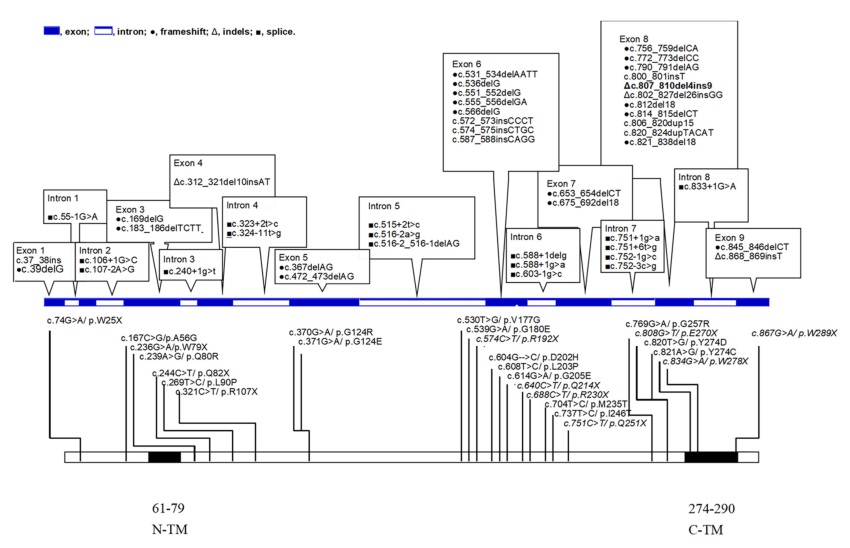 Fig. 1 Distribution of SURF1 mutations based on published literature.1
SURF1, encoded by the SURF1 gene, functions as a mitochondrial inner membrane assembly factor that regulates cytochrome c oxidase biogenesis:
Creative Biolabs offers high-quality SURF1 membrane protein products produced using optimized expression systems. These include full-length multi-pass transmembrane protein that retains the native mitochondrial inner membrane topology, as well as isolated domain variants containing the central loop and transmembrane domains. The transmembrane domains and central loop mediate inner membrane integration and interaction with COX assembly intermediates, making these proteins suitable for studies of mitochondrial membrane protein function, COX assembly regulation, and protein-protein interaction characterization. All SURF1 proteins undergo strict quality control to support consistent performance across applicable research platforms.
Not finding the protein product you need? Contact us to start your one-stop custom service!
Creative Biolabs provides custom-engineered SURF1 stable cell lines, including overexpression and knockdown models. These cell lines are optimized for studies of COX assembly, mitochondrial respiratory chain biogenesis, mitochondrial translation regulation, and SURF1-associated mitochondrial dysfunction. Each cell line undergoes stringent validation to ensure stable expression profiles and consistent functional performance in diverse experimental contexts.
Not finding the stable cell line product you need? Contact us to start your one-stop custom service!
High-specificity recombinant antibodies targeting SURF1 are developed using antibody engineering technologies for research applications involving SURF1 expression and localization. These antibodies can be used in studies of SURF1 distribution in mitochondrial inner membrane fractions and may also support characterization of SURF1-containing MITRAC complexes in combination with appropriate detection reagents.
Not finding the recombinant antibody product you need? Contact us to start your one-stop custom service!
Beyond catalog products, Creative Biolabs offers specialized custom services for SURF1 research:
SURF1 is a mitochondrial inner membrane protein that functions as a component of the MITRAC complex, regulating cytochrome c oxidase assembly in early steps. Evidence from model systems suggests that Surf1 proteins may also facilitate heme a insertion into COX subunit I.
SURF1 is essential for cytochrome c oxidase biogenesis, and its mutations are the most prevalent cause of Leigh syndrome with COX deficiency, making it important for mitochondrial respiratory chain assembly and OXPHOS research.
No, all SURF1 products and services are strictly for research use only, not intended for clinical diagnosis or treatment.
Offerings include full-length SURF1 membrane proteins, domain variants, specific detection antibodies, and custom stable cell lines for mitochondrial biogenesis and COX assembly research.
SURF1 proteins are validated via protein-protein interaction assays, mitochondrial membrane integration assays, and relevant functional characterization in applicable research platforms.









