
Creative Biolabs is offering the most comprehensive services for antibody development projects. With strict regulation and effective execution, we are dedicated to providing the most valuable solutions to complete your projects.
HighlightsCreative Biolabs is offering the most comprehensive services for antibody development projects. With strict regulation and effective execution, we are dedicated to providing the most valuable solutions to complete your projects.
HighlightsCreative Biolabs has established a broad range of platforms for developing novel antibodies or equivalents. These cutting-edge technologies enable our scientists to meet your demands from different aspects and tailor the most appropriate solution that contributes to the success of your projects.
HighlightsWith deep understanding in antibody-related realms and extensive project experience, Creative Biolabs offers a variety of references to help you learn more about our capacities and achievements, including infographic, flyer, case study, peer-reviewed publications, and all kinds of knowledge that can assist your projects. You are also welcome to contact us directly for more specific solutions.
HighlightsGet a real taste of Creative Biolabs, one of the most professional custom service providers in the world. We are committed to providing highly customized comprehensive solutions with the best quality to advance your projects.
Highlights Loading...
All listed services and products are For Research Use Only. Do Not use in any diagnostic or therapeutic applications.
Vesicle associated membrane protein 2 (VAMP2), also called synaptobrevin-2, is a relatively small protein; however, its importance is far greater than its size. VAMP2 can be found at the exact site where each synaptic vesicle attaches to the presynaptic membrane. Although it contains only about 100 amino acids, VAMP2 is a tail-anchored membrane protein. It has one hydrophobic helix that anchors itself to the vesicle membrane and a larger N-terminal section that projects outward from the vesicle membrane into the cytosol. This is the portion of the protein that is involved in the fusion process. When VAMP2 binds to syntaxin and a SNAP family protein on the plasma membrane, they form the four-helix SNARE bundle. The closing of this bundle provides the energy required to bring the two membranes together for fusion. The crystal structure of the SNARE bundle, determined to near atomic resolution, has become one of the fundamental pictures in modern membrane biology. This structure shows a parallel four-helix coil that continually goes through a cycle of forming and breaking down at every synapse throughout the nervous system. The fusion pore then opens, allowing neurotransmitters to leave the terminal and allowing signals to pass on to the next cell. Loss of VAMP2 markedly impairs fast, calcium-triggered synaptic vesicle fusion and evoked neurotransmitter release. Residual or spontaneous release may nevertheless persist in some experimental models. VAMP2's importance is matched by its vulnerability. Clostridial neurotoxins, some of the most deadly toxins in existence, target VAMP2's cytosolic section and cut it at specific points. By cutting VAMP2's cytosolic section, the neurotoxins separate the fusion apparatus from VAMP2. Researchers can use these neurotoxins as a research tool to investigate VAMP2's function, as well as as an indicator of how essential VAMP2 is to the synaptic vesicle fusion process.
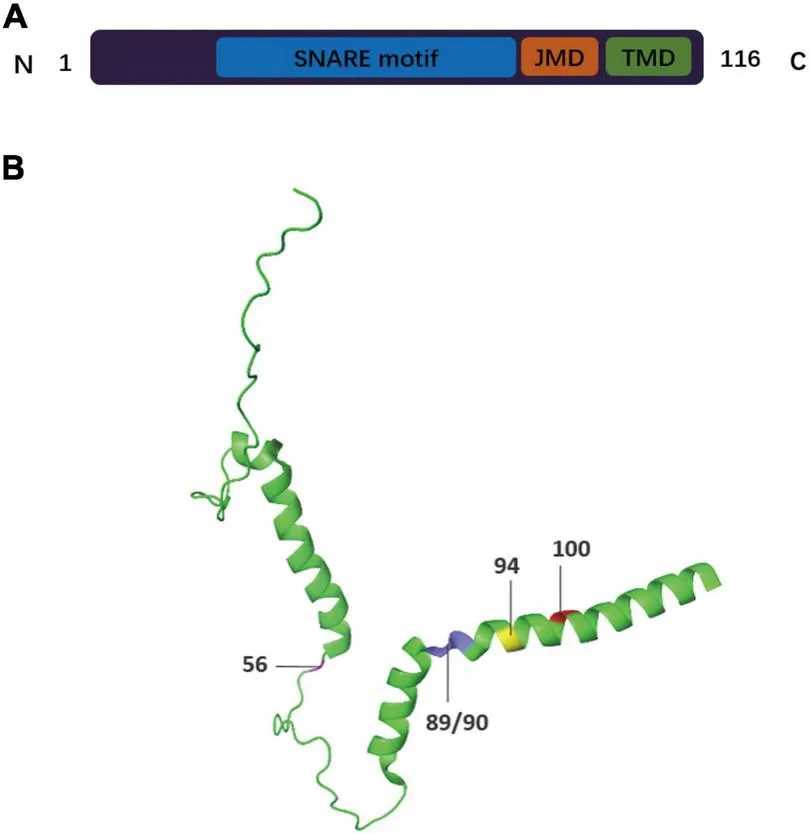 Fig.1 Schematic drawing of the domain arrangement and 3-D structure of VAMP2.1
Several research currents keep converging on this small protein:
VAMP2 must be produced in a credible manner that respects its tail-anchored architecture. While there are instances where a soluble fragment may provide answers to certain questions, the working protein will be membrane-inserted. Therefore, any form of fusion-competent VAMP2 must be presented in a way that allows for the preservation of this context. Our optimal expression systems produce full-length VAMP2 with the membrane anchor intact. We release-test for purity using SDS-PAGE. If your study requires a specific cleavage site, a certain type of membrane composition, or a format designed to mimic a particular fusion or assembly assay, we can alter the format based upon your experimental protocol; the preparation will follow the experimental design.
Not finding the membrane protein product you need? Contact us to start your one-stop custom service!
Cells used to study the function of VAMP2 have an added dimension of complexity — the protein is necessary for fusion, therefore any changes in expression levels need to be done carefully and analyzed accurately. Researchers can utilize wild type overexpressers and various site-specific mutants to determine if there is a relationship between sensitivity to proteases and ability to promote membrane fusion. All clones are fully characterized prior to being released to researchers. This allows researchers to understand what to expect from each line during their experiments. If you need a specific variant background, a particular density level, or an expression protocol that works best with your fusion assay timeline, the platform can be adapted to meet those needs; each cell line is developed to support the specific experiment that it will be used for.
Not finding the stable cell line product you need? Contact us to start your one-stop custom service!
Antibody studies with respect to VAMP2 are plagued by the "family problem" in its most compact form: the VAMP family has the coiled-coil SNARE motif, and general clones will drift towards cross-reactivity that makes quantitation difficult when there are other VAMP family members contributing to fusion. Here we have developed a panel of recombinant antibodies that have been screened for their ability to discriminate among the various VAMP2 variants. Both cytosolic and juxtamembrane formats of these recombinant antibodies are available; therefore, detection may occur at either end of the small VAMP2 protein depending upon which area of the protein is being interrogated in the study. Additionally, the sequence defined production of our antibodies ensures consistency in performance from lot-to-lot, and if a research team requires a different conjugate, validation against a certain type of sample, or modification of the clone format to accommodate a specific experimental workflow, then we can provide those services as well - our antibody panel can adapt to accommodate the experimental design used in each study.
Not finding the recombinant antibody product you need? Contact us to start your one-stop custom service!
Extending well beyond our standard catalog, we deliver fully customizable discovery and manufacturing solutions meticulously tailored to the sophisticated demands of VAMP2-targeted research and precompound development:
The membrane anchor is part of the protein's identity, and fusion-competent behavior depends on it. Formats are characterized with membrane insertion as a defined quality attribute, not an assumed one.
Reconstitution rebuilds the fusion reaction from purified components in controlled liposome formats. VAMP2 serves as the vesicle-side anchor around which these reductionist systems are organized.
The VAMP family shares the coiled-coil motif but differs in localization, partner preference, and trafficking routes. Comparative work uses these differences to map how one architecture serves distinct fusion contexts.
All VAMP2 products and services are provided strictly for preclinical research. They are not designed, validated, or authorized for any use involving human subjects.









