Creative Biolabs is offering the most comprehensive services for antibody development projects. With strict regulation and effective execution, we are dedicated to providing the most valuable solutions to complete your projects.
HighlightsCreative Biolabs is offering the most comprehensive services for antibody development projects. With strict regulation and effective execution, we are dedicated to providing the most valuable solutions to complete your projects.
HighlightsCreative Biolabs has established a broad range of platforms for developing novel antibodies or equivalents. These cutting-edge technologies enable our scientists to meet your demands from different aspects and tailor the most appropriate solution that contributes to the success of your projects.
HighlightsWith deep understanding in antibody-related realms and extensive project experience, Creative Biolabs offers a variety of references to help you learn more about our capacities and achievements, including infographic, flyer, case study, peer-reviewed publications, and all kinds of knowledge that can assist your projects. You are also welcome to contact us directly for more specific solutions.
HighlightsGet a real taste of Creative Biolabs, one of the most professional custom service providers in the world. We are committed to providing highly customized comprehensive solutions with the best quality to advance your projects.
HighlightsProtein-protein interactions (PPIs) form the bedrock of virtually every cellular process, from signal transduction and DNA replication to metabolic regulation and immune responses. It is fundamental to unraveling disease mechanisms, identifying novel therapeutic targets, and designing next-generation biologics and small molecule drugs. For over two decades, Creative Biolabs has been at the forefront of protein science, providing the global research community with sophisticated, reliable, and highly customized PPI assay services. As a trusted partner, we combine a deep-seated biological expertise with a state-of-the-art technological arsenal to help you validate, characterize, and quantify protein interactions with unparalleled accuracy. Our services are tailored for research applications, empowering you to push the boundaries of discovery.
No single method can capture the full complexity of protein interactions. Creative Biolabs has established a versatile portfolio of cutting-edge platforms to investigate PPIs in vitro, in situ, and in vivo. Our experts will guide you in selecting the optimal assay or combination of assays to achieve your specific scientific goals, considering factors like affinity, cellular context, and throughput requirements.
Recommended Technologies: Yeast Two-Hybrid (Y2H), Mammalian Protein-Protein Interaction Trap (MAPPIT), Co-IP coupled with Mass Spectrometry (Co-IP/MS), etc.
Recommended Technologies: Surface Plasmon Resonance (SPR), Bio-Layer Interferometry (BLI), MicroScale Thermophoresis (MST), Isothermal Titration Calorimetry (ITC), etc.
Recommended Technologies: Förster Resonance Energy Transfer (FRET), Bioluminescence Resonance Energy Transfer (BRET), Bimolecular Fluorescence Complementation (BiFC), etc.
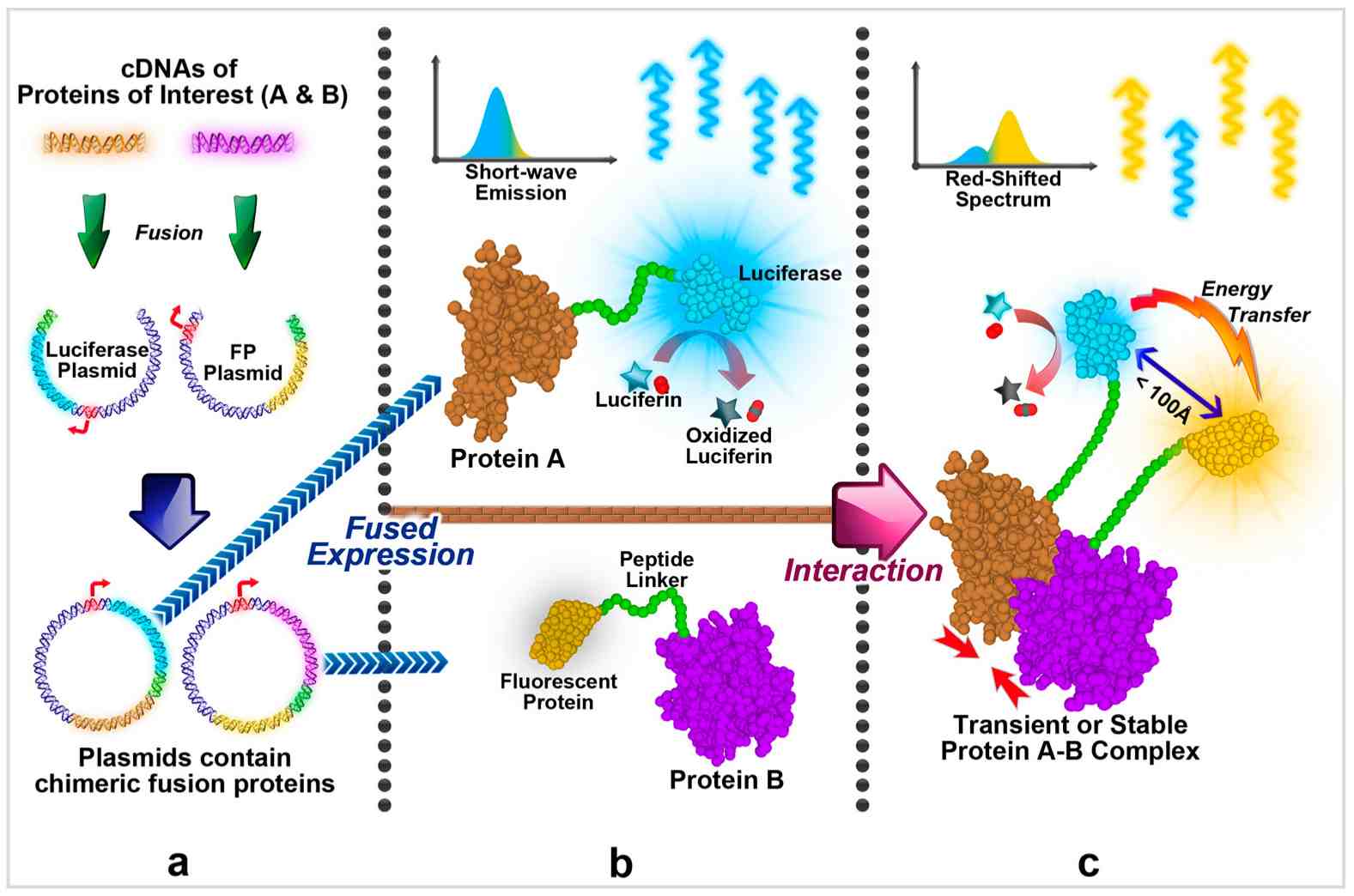 Fig. 1 Principles of BRET assay.1
Ideal for quantitative characterization of binding kinetics and affinity. These methods are essential for lead optimization, antibody characterization, and mechanistic studies.
Uncover interaction networks on a proteome-wide scale. Our state-of-the-art MS platforms, combined with powerful bioinformatics, deliver comprehensive maps of protein complexes.
Validate interactions and screen for novel partners within a biological context.
Table 1. Protein-protein interaction services.
| Experimental Methods | ||
| In vivo | Yeast two-hybrid (Y2H) | Bacterial two-hybrid (B2H) system |
| Y2H-based Drug-Target Interaction Identification | Fluorescence resonance energy transfer (FRET) | |
| Bioluminescence resonance energy transfer (BRET) | Proximity-dependent Biotin Identification (BioID) | |
| Bimolecular fluorescence complementation (BiFC) | TurboID | |
| Synthetic lethality | Yeast Three-Hybrid (Y3H) for Protein Interaction Identification | |
| In vitro | Tandem affinity purification (TAP) | Affinity chromatography |
| Co-immunoprecipitation (Co-IP) | Pull-down assay | |
| Protein arrays | Protein-fragment complementation assay (PCA) | |
| Phage display | X-ray crystallography | |
| Surface plasmon resonance (SPR) | Nuclear magnetic resonance spectroscopy (NMR spectroscopy) | |
| In silico | Gene fusion | Sequence-based approaches |
| Chromosome proximity | Structure-based approaches | |
| In silico two hybrid | Mirror tree | |
| Phylogenetic tree | Gene expression-based approaches | |
We believe in a consultative approach, ensuring your project is designed for success from the very beginning.
Our PPI services provide critical data for a multitude of research and development areas.
Leverage our full suite of interaction analysis platforms to build a complete picture of your biological system. Explore our full range of PPI services:
Ready to illuminate your protein interaction network? Contact us today to discuss your project with one of our experts.
Q: Which PPI assay is the best for my project?
A: The "best" assay depends entirely on your research goal. Our collaborative approach begins with a detailed consultation to determine the ideal method.
Q: Can you study weak or transient protein interactions?
A: Yes, absolutely. Capturing transient interactions is a common challenge that we are well-equipped to handle. For these types of interactions, we highly recommend in vivo methods like Proximity-Dependent Biotinylation (BioID/TurboID) or Cross-Linking Mass Spectrometry (XL-MS). These techniques are specifically designed to "trap" fleeting interactions within their native cellular context, providing a more accurate snapshot of the dynamic interactome than traditional methods like Co-IP.
Q: How do you handle membrane protein interactions?
A: Membrane proteins present unique challenges due to their hydrophobic nature and requirement for a lipid environment. Creative Biolabs has developed specialized platforms to address this. We can express membrane proteins in appropriate systems (e.g., mammalian cells, insect cells) and utilize detergents or nanodiscs to solubilize and stabilize them for analysis using techniques like SPR or cell-based assays. Our expertise ensures that the structural integrity and functionality of the membrane protein are maintained during the analysis.
All listed services and products are For Research Use Only. Do Not use in any diagnostic or therapeutic applications.