Creative Biolabs is offering the most comprehensive services for antibody development projects. With strict regulation and effective execution, we are dedicated to providing the most valuable solutions to complete your projects.
HighlightsCreative Biolabs is offering the most comprehensive services for antibody development projects. With strict regulation and effective execution, we are dedicated to providing the most valuable solutions to complete your projects.
HighlightsCreative Biolabs has established a broad range of platforms for developing novel antibodies or equivalents. These cutting-edge technologies enable our scientists to meet your demands from different aspects and tailor the most appropriate solution that contributes to the success of your projects.
HighlightsWith deep understanding in antibody-related realms and extensive project experience, Creative Biolabs offers a variety of references to help you learn more about our capacities and achievements, including infographic, flyer, case study, peer-reviewed publications, and all kinds of knowledge that can assist your projects. You are also welcome to contact us directly for more specific solutions.
HighlightsGet a real taste of Creative Biolabs, one of the most professional custom service providers in the world. We are committed to providing highly customized comprehensive solutions with the best quality to advance your projects.
HighlightsThe adaptive immune system's remarkable ability to recognize a vast array of pathogens and malignancies is rooted in the diversity of the T-cell receptor (TCR) repertoire. As a cornerstone of cellular immunity, the T-cell receptor (TCR) is responsible for identifying specific antigens presented by the Major Histocompatibility Complex (MHC). At Creative Biolabs, we provide a world-class TCR Repertoire Analysis Service, leveraging the latest NGS sequencing technologies and proprietary bioinformatics pipelines. With over two decades of expertise in biotechnology, our platform offers unprecedented depth and sensitivity to map the T-cell receptor (TCR) repertoire in various physiological and pathological states. Our services are designed to support researchers in drug discovery, vaccine development, and basic immunology, focusing strictly on research applications (not for clinical diagnosis).
The TCR repertoire refers to the collection of all unique TCRs within an individual's immune system. This diversity is generated through a complex process known as V(D)J recombination.
The most hypervariable part of the TCR is the Complementarity-Determining Region 3 (CDR3). Sequencing CDR regions of TCR is essential because these regions directly interact with the antigen peptide.
| Feature | Description | Importance in Analysis |
| V(D)J Segments | Variable, Diversity, and Joining gene segments. | Defines the basic structure of the TCR chain. |
| CDR3 Region | The junctional region between V, D, and J. | The primary determinant of antigen specificity. |
| Clonality | The expansion of specific T-cell clones. | Indicates a targeted immune response to a specific stimulus. |
| Diversity Indices | Mathematical measures like Shannon Entropy. | Reflects the overall health and breadth of the immune system. |
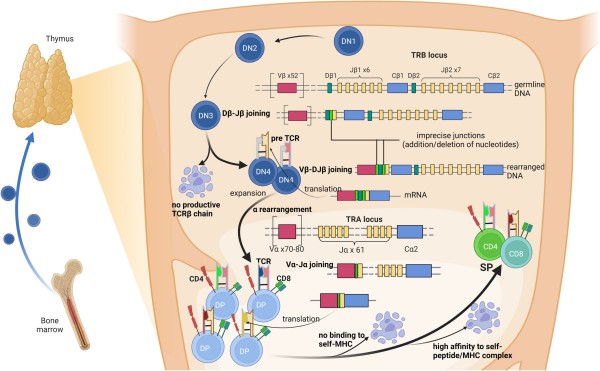 Fig. 1 αβT cell development.1
Creative Biolabs utilizes a multi-tiered approach to T-cell receptor (TCR) repertoire analysis. By moving beyond traditional methodologies, we offer high-resolution insights into the immune system's state.
Our "Gold Standard" bulk analysis is optimized for researchers who require the highest level of sensitivity. This platform is ideal for detecting "needle-in-a-haystack" clones.
For researchers requiring the pairing information of α/β or γ/δ chains, we offer a specialized Paired-Chain Resolution Platform. This technology utilizes physical partitioning and emulsion-based library preparation to ensure that the genetic information from a single biological unit is preserved during NGS sequencing.
Our TCR Repertoire Analysis follows a rigorous, optimized workflow to ensure reproducibility and accuracy.
We accept a wide range of sample types, including:
We employ advanced enrichment strategies to minimize bias:
Libraries are sequenced to the desired depth. We typically recommend 1-2 million reads for standard bulk samples and up to 10 million reads for deep repertoire exploration.
Our proprietary MemDX™ bioinformatics pipeline transforms raw FASTQ files into actionable insights.
The utility of T-cell receptor (TCR) repertoire analysis spans across multiple domains of biomedical research.
With over 20 years in the industry, Creative Biolabs stands out as a leader in TCR Repertoire NGS sequencing.
Besides regular sequencing analysis of the TCR repertoire, we also provide a series of custom analysis options including but not limit to:
By utilizing our TCR Repertoire Analysis Service, you gain a powerful tool to observe and understand immune dynamics with unprecedented clarity. Whether you are investigating the mechanisms of a new immunotherapy or tracking the evolution of a viral response, Creative Biolabs provides the expertise, technology, and dedication to drive your research forward.
Contact our experts today to discuss your T-cell receptor (TCR) repertoire project and receive a customized quote.
Reference
All listed services and products are For Research Use Only. Do Not use in any diagnostic or therapeutic applications.