Creative Biolabs is offering the most comprehensive services for antibody development projects. With strict regulation and effective execution, we are dedicated to providing the most valuable solutions to complete your projects.
HighlightsCreative Biolabs is offering the most comprehensive services for antibody development projects. With strict regulation and effective execution, we are dedicated to providing the most valuable solutions to complete your projects.
HighlightsCreative Biolabs has established a broad range of platforms for developing novel antibodies or equivalents. These cutting-edge technologies enable our scientists to meet your demands from different aspects and tailor the most appropriate solution that contributes to the success of your projects.
HighlightsWith deep understanding in antibody-related realms and extensive project experience, Creative Biolabs offers a variety of references to help you learn more about our capacities and achievements, including infographic, flyer, case study, peer-reviewed publications, and all kinds of knowledge that can assist your projects. You are also welcome to contact us directly for more specific solutions.
HighlightsGet a real taste of Creative Biolabs, one of the most professional custom service providers in the world. We are committed to providing highly customized comprehensive solutions with the best quality to advance your projects.
HighlightsIn the landscape of therapeutic drug development, a deep understanding of molecular interactions is paramount. The affinity of an antibody for its antigen is a critical quality attribute (CQA) that dictates its potency, specificity, and overall therapeutic efficacy. At Creative Biolabs, we provide a comprehensive suite of affinity measurement services, leveraging state-of-the-art technologies to deliver high-precision, reliable, and insightful data for your research, preclinical, and clinical programs. Our two decades of experience are built on a foundation of scientific excellence and a commitment to helping our clients accelerate their discovery and development pipelines. We specialize in label-free, real-time analysis of biomolecular interactions, providing you with the critical kinetic data (ka, kd) and affinity constants (KD) needed to make informed decisions, de-risk candidates, and satisfy regulatory requirements.
Binding affinity, quantified by the equilibrium dissociation constant (KD), is the measure of the strength of the non-covalent interaction between a single binding site of a molecule (e.g., an antibody) and its ligand (e.g., an antigen).
Creative Biolabs has invested in a diverse range of cutting-edge platforms to offer you unparalleled flexibility and accuracy. Our core technologies, Surface Plasmon Resonance (SPR) and Bio-Layer Interferometry (BLI), are the gold standards for label-free interaction analysis.
SPR is a powerful optical technique that measures changes in the refractive index at the surface of a sensor chip. It provides real-time, high-quality kinetic and affinity data, making it the preferred method for a wide range of applications, from early-stage screening to in-depth characterization.
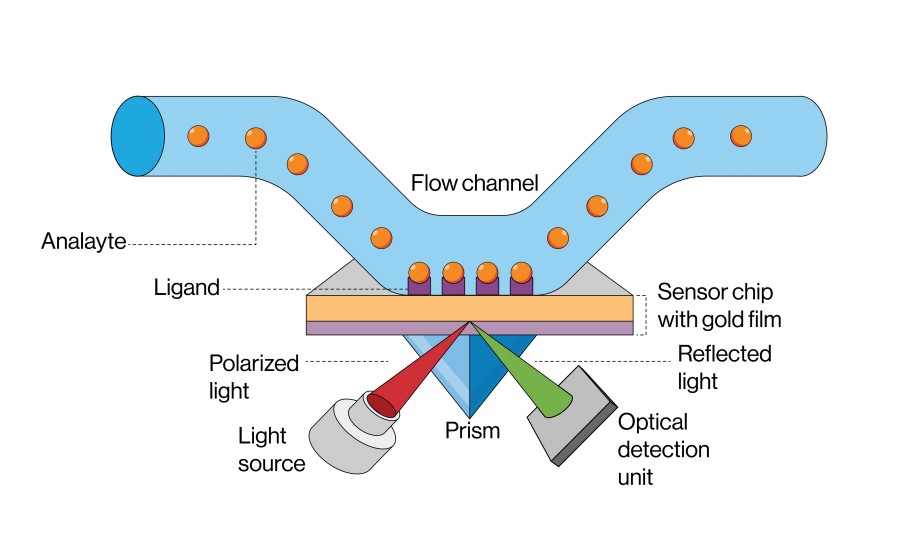 Fig. 1 Principle and Instrumentation of Surface Plasmon Resonance.
| Application | Description |
| Full Kinetic Profiling | Precise determination of ka, kd, and KD for in-depth candidate characterization. |
| High-Throughput Screening | Rapid screening of antibody libraries or hybridoma supernatants to rank candidates by off-rate. |
| Small Molecule Analysis | High-sensitivity detection of interactions between proteins and small molecules or fragments. |
| Epitope Binning & Mapping | Comprehensive analysis to group antibodies based on their binding epitopes. |
| Thermodynamic Analysis | Measuring binding at different temperatures to understand the thermodynamic drivers of the interaction. |
| Concentration Analysis | Accurate, label-free quantification of active protein concentration. |
BLI is an optical analytical technique that measures the interference pattern of white light reflected from two surfaces: a layer of immobilized protein on the biosensor tip and an internal reference layer. Binding of analyte to the biosensor tip causes a wavelength shift in the interference pattern, which is monitored in real-time.
| Application | Description |
| Rapid Affinity Screening | Ideal for early-stage discovery, enabling high-throughput ranking of hundreds of clones. |
| Quantitation | Fast and accurate measurement of protein concentration (e.g., IgG titer) from crude samples. |
| Fc Receptor Binding | Characterizing the interaction of antibodies with Fc receptors (FcγR, FcRn) to predict effector function and half-life. |
| Batch Release & QC | A quick and reliable method for ensuring the binding activity of manufactured lots. |
| Yes/No Binding Analysis | Quickly confirming the presence or absence of a specific binding interaction. |
The choice between SPR and BLI depends on your specific application, sample type, and stage of research. Our experts will work closely with you to select the most appropriate technology for your project.
| Feature | Surface Plasmon Resonance (SPR) | Bio-Layer Interferometry (BLI) |
| Principle | Refractive index change | Interference pattern shift |
| Sensitivity | Very High (ideal for small molecules) | High (better for larger molecules) |
| Throughput | Medium to High | High to Very High |
| Fluidics | Microfluidics-based | Fluidics-free (dip-and-read) |
| Sample Type | Requires purified samples | Tolerant of crude/complex samples |
| Sample Recovery | Not possible | Yes |
| Primary Use Cases | Detailed kinetics, small molecules, thermodynamics | High-throughput screening, quantitation, QC |
At Creative Biolabs, we follow a rigorous and transparent process to ensure the highest quality data and client satisfaction.
Creative Biolabs offers a range of specialized services to address more complex biological questions:
Leverage our integrated service portfolio to support every stage of your antibody development program.
Other optional Affinity Measurement Services:
Q: What is the typical sample requirement for an affinity measurement project?
A: Sample requirements vary depending on the platform and the nature of the molecules. As a general guideline:
We will provide you with specific recommendations during the project design phase.
Q: Can you measure the affinity of unpurified samples?
A: Yes. Our BLI (Octet) platform is exceptionally well-suited for analyzing crude samples. Its fluidics-free, dip-and-read format is tolerant of complex matrices, allowing us to directly measure protein concentration or binding kinetics from hybridoma supernatants, cell lysates, or periplasmic extracts. This saves you valuable time and resources by eliminating the need for upfront purification, especially during early-stage screening.
Q: How do you choose the right immobilization strategy for my ligand?
A: The choice of immobilization strategy is critical for obtaining high-quality data. Our scientists consider several factors, including the nature of your ligand (e.g., protein, antibody, peptide), available functional groups, and the need to maintain its native conformation. Common strategies include:
We will always select the strategy that ensures the highest activity and stability of your immobilized molecule.
Q: What is the difference between affinity (KD) and avidity?
A: Affinity (KD) refers to the strength of a single, monovalent interaction between one binding site on a molecule and its partner (e.g., a single Fab arm of an IgG binding to its epitope).
Avidity describes the overall, combined strength of multiple, simultaneous interactions (e.g., a bivalent IgG binding with both of its Fab arms to two antigens on a cell surface). Avidity is often much stronger than the intrinsic affinity of the individual interactions.
Our platforms can be configured to measure both. Standard assays typically measure affinity, but we can design specific assays to characterize the avidity of multivalent interactions.
Q: Why is off-rate (kd) considered so important in drug development?
A: The off-rate (kd, or dissociation rate) measures how quickly a drug dissociates from its target. A slow off-rate indicates a long residence time of the drug on its target, which often correlates with prolonged pharmacological effects and higher in vivo potency. For many therapeutic antibodies, a slow off-rate is a key selection criterion, as it can lead to more durable target engagement and potentially less frequent dosing. Our affinity measurement services provide precise off-rate data to help you rank and select the most promising candidates.
All listed services and products are For Research Use Only. Do Not use in any diagnostic or therapeutic applications.