Amino Acid Sequencing Challenges: A Deep Dive
Introduction Sample Preparation Edman Degradation Mass Spectrometry Modified Amino Acids Data Analysis
Introduction: The Importance and Complexity of Amino Acid Sequencing
Overview of Amino Acid Sequencing
Amino acid sequencing which identifies the exact sequence of residues in proteins and peptides serves as the essential method of understanding a protein's primary structure. The protein's linear amino acid arrangement guides its transformation into complex three-dimensional structures that define its biological activity. The field has transitioned from Edman degradation to advanced mass spectrometry (MS) methods to acquire sequence data which continues to serve as a fundamental element of proteomics and biochemical research.
Significance in Biology and Biotechnology
Amino acid sequencing serves as a foundational tool across every sector of contemporary life sciences and biotechnology. It is indispensable for:
-
Understanding Protein Function: This sequence outlines functional mechanisms by specifying active sites and binding domains along with regulatory motifs.
-
Drug Discovery and Development: Understanding therapeutic proteins such as monoclonal antibodies and hormones requires characterization for batch consistency and identification of immunogenic epitopes alongside drug-target interaction studies.
-
Biopharmaceutical Quality Control: The identity and integrity of recombinant protein products must be verified to meet regulatory standards.
-
Antibody Engineering: The creation of antibodies with superior binding properties and durability or lower immune response depends on accurate comprehension and alterations of molecular sequences.
-
Basic Research: Research into biological pathways and disease mechanisms as well as comparative genomics studies depend extensively on protein sequence data.
-
Synthetic Biology: The creation of new functional proteins or peptides depends on precise sequencing to confirm their identity.
Highlighting the Inherent Challenges
Researchers must overcome multiple possible errors during sample acquisition through data interpretation to acquire complete and accurate sequence data for complex, modified, or low-abundance proteins. The need for advanced methodologies and expert optimization skills is critical in these scenarios which Creative Biolabs consistently develops expertise and resources to conquer.
Challenges Related to Sample Preparation
The quality and nature of the starting material profoundly impact the success and reliability of downstream analysis after amino acid sequencing.
Protein Purification and Isolation
Purity Requirement: High purity protein samples stand as essential requirements for successful Edman degradation and mass spectrometry processes. The presence of contaminating proteins creates disruptive signals which make data analysis very difficult and can result in incorrect sequence assignments.
Methodological Hurdles: Multiple chromatography stages including affinity, ion-exchange, and size-exclusion techniques often result in sample loss at each step making the purification of low-abundance proteins especially difficult. The choice of purification tags and their subsequent removal also adds complexity.
Sample Complexity and Heterogeneity
Protein Mixtures: Direct analysis of proteins from intricate biological samples such as cell lysates requires extensive separation methods because of the vast diversity of proteins found in these complex matrices.
Isoforms and Variants: Multiple protein isoforms result from genes utilizing alternative splicing or genetic polymorphism. Researchers often struggle to differentiate closely related protein sequences when they co-purify.
Inherent Heterogeneity: Even a "single" purified protein preparation can be heterogeneous due to N- or C-terminal truncations, post-translational modifications, or incomplete processing.
Solubility and Degradation Issues
Solubility: Many proteins, particularly membrane proteins or large complexes, exhibit poor solubility in buffers compatible with sequencing workflows. Aggregation can hinder enzymatic digestion for MS and reactions for Edman. Finding appropriate solubilizing agents (e.g., detergents) that do not interfere with downstream analysis is critical.
Degradation: Proteases present endogenously in the sample source or introduced adventitiously can degrade the target protein during purification and handling. This leads to sample loss and the generation of artifactual peptides/truncations. The use of protease inhibitors is standard practice, but their effectiveness can be variable, and they must be removed before analysis. Sample instability, such as deamidation or oxidation, can also occur during storage or processing.
Table 1. Common Sample Preparation Challenges and Mitigation Strategies
|
Challenge
|
Description
|
Common Mitigation Strategies
|
|
Low Purity
|
Presence of contaminating proteins interfering with analysis.
|
Multi-dimensional chromatography (HPLC/FPLC), affinity purification, gel electrophoresis (SDS-PAGE) followed by excision.
|
|
Sample Complexity
|
High number of distinct proteins/peptides (e.g., cell lysate).
|
Extensive fractionation (e.g., SCX, OFFGEL), enrichment strategies for target proteins/peptides.
|
|
Isoforms/Variants
|
Co-purification of highly similar protein sequences.
|
High-resolution separation techniques, deep sequencing coverage (MS), targeted analysis of unique peptides.
|
|
Poor Solubility
|
Protein aggregation or inability to dissolve in compatible buffers.
|
Buffer optimization, use of detergents (SDS, NP-40, Triton X-100 - MS compatibility varies), chaotropes (Urea, Guanidine-HCl).
|
|
Proteolytic Degradation
|
Sample breakdown by endogenous or exogenous proteases.
|
Use of broad-spectrum protease inhibitor cocktails, rapid processing at low temperatures, denaturation.
|
|
Chemical Instability
|
Non-enzymatic modifications (e.g., oxidation, deamidation) during handling.
|
Control of pH, temperature, redox environment; use of antioxidants; prompt analysis.
|
|
Low Abundance
|
Insufficient sample quantity for detection/analysis.
|
Sensitive detection methods (nanoLC-MS), sample enrichment, pooling of material, scaling up purification.
|
Edman Degradation-Related Challenges
Edman degradation has been mostly replaced by MS for sequencing tasks but continues to serve important functions in N-terminal sequencing and MS result validation. However, it has inherent limitations.
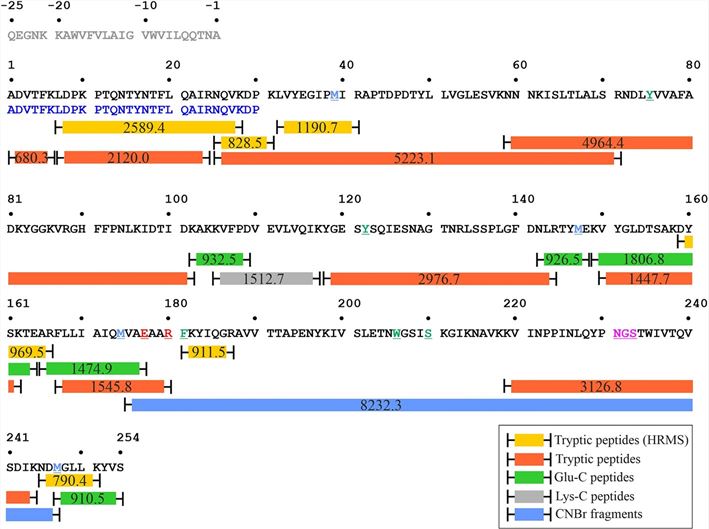 Fig. 1 Amino acid sequence of hortensin 4 obtained using as a reference the ribosome inactivating protein (A.C. ABJ90432.1) retrieved in the genome of Atriplex patens L. Coloured bars show the overlapping peptides and chemical fragments used for assembling the amino acid sequence of purified protein.1
N-terminal Blockage
-
The Problem: The Edman chemistry process depends on phenyl isothiocyanate (PITC) reacting with the exposed α-amino group found at the N-terminal amino acid. The reaction stops and Edman sequencing fails when the N-terminal amino group undergoes chemical modification that blocks it.
-
Common Blocking Groups: Natural N-terminal modifications like acetylation (Ac-) or formylation (fMet), or the formation of pyroglutamic acid (pGlu) from N-terminal glutamine, are common culprits. Artificial blockage can also occur during sample handling (e.g., carbamylation from urea buffers).
-
Mitigation: Enzymatic (e.g., pyroglutamate aminopeptidase) or chemical deblocking methods exist but are not universally effective and can introduce other complications. Often, blocked proteins require alternative strategies, such as internal sequencing after proteolytic digestion.
Incomplete Reactions and Yield Reduction
-
Stepwise Chemistry: Edman degradation involves sequential cycles of coupling (PITC reaction), cleavage (releasing the N-terminal residue as an ATZ derivative), and conversion (to a stable PTH-amino acid for identification).
-
Efficiency Loss: None of these steps are 100% efficient. Incomplete coupling leaves some chains unreacted in a given cycle, while incomplete cleavage leaves the N-terminal residue attached. This leads to a progressive decrease in the signal intensity of the correct PTH-amino acid and an increase in background noise and "preview" sequences (signal from cycle n+1 appearing in cycle n) with each cycle.
-
Impact: The cumulative effect of yield loss severely limits the practical read length.
Length Limitations
-
Signal Decay: Due to the cycle efficiency issues described above, the signal-to-noise ratio progressively deteriorates.
-
Practical Limit: Typically, reliable Edman sequencing is limited to ~30-60 amino acid residues from the N-terminus under optimal conditions. Beyond this, the signal becomes too weak and the background too high for unambiguous residue identification. For full protein sequencing, Edman requires fragmentation (chemical or enzymatic) and sequencing of multiple overlapping peptides, a laborious process.
Mass Spectrometry Challenges
Mass spectrometry, particularly when coupled with liquid chromatography (LC-MS/MS), is the dominant technology for protein sequencing today. It offers high sensitivity and throughput but presents its own set of challenges.
Peptide Fragmentation and Complexity
-
Tandem MS (MS/MS): Normal protein digestion breaks it down into peptides followed by LC peptide separation, peptide ion selection and fragmentation to identify peptide sequences through mass analysis.
-
Fragmentation Methods: Each dissociation method cleaves peptide bonds at various positions and does so with variable efficiencies which leads to complex fragment ion spectra.
-
Spectral Complexity: Interpreting these complex fragmentation patterns to reliably deduce the peptide sequence requires sophisticated algorithms. Incomplete fragmentation or ambiguous fragment assignments can hinder accurate sequencing. Certain peptide sequences or specific amino acid compositions can yield poor fragmentation or spectra dominated by uninformative ions.
Difficulty in Sequencing Certain Amino Acids
-
Isobaric Residues: Leucine and Isoleucine have identical nominal and average masses (m/z ~113.08 Da). Standard CID/HCD fragmentation primarily breaks the peptide backbone and often cannot distinguish between them, as the key differentiating side-chain fragmentation is low efficiency. While specific fragmentation techniques or analysis of immonium ions can sometimes help, ambiguity often remains.
-
Near-Isobaric Residues: The similar mass of Lysine and Glutamine demands high-resolution mass analyzers to separate them during peptide analysis. The resolution of the instrument and the chosen fragmentation method can make small fragment differentiation difficult.
Data Interpretation and De Novo Sequencing Complexities
-
Database Searching: The most common MS data interpretation method involves matching experimental MS/MS spectra against theoretical spectra generated from protein sequence databases. This is powerful but relies on the correct protein sequence being present in the database. It struggles with unexpected variants, novel proteins, or organisms with unsequenced genomes. Defining appropriate score thresholds and controlling the False Discovery Rate (FDR) is crucial.
-
De Novo Sequencing: This approach derives the peptide sequence directly from the MS/MS spectrum without relying on a database. It is essential for unknown sequences but is computationally intensive and more prone to errors. Ambiguities arise from noisy spectra, incomplete fragmentation ladders, isobaric/near-isobaric residues, and the difficulty of determining the correct order of fragments. Hybrid approaches combining database and de novo strategies are often employed.
Table 2. Edman Degradation vs. Mass Spectrometry - Selected Challenges
|
Feature
|
Edman Degradation
|
Mass Spectrometry (LC-MS/MS)
|
|
Starting Point
|
Requires free N-terminus
|
Does not require free N-terminus (uses internal peptides)
|
|
N-terminal Block
|
Major obstacle
|
Not an issue for internal sequencing; N-term peptide may be missed
|
|
Read Length
|
Limited (~30-60 residues)
|
Potentially full protein coverage (via peptide assembly)
|
|
PTM Handling
|
Can detect shifts if stable; often problematic
|
Powerful for PTM detection & localization (mass shifts, specific fragmentation)
|
|
Isobaric Residues
|
Not applicable (identifies PTH-AA)
|
Major challenge (Leu/Ile ambiguity)
|
|
Sensitivity
|
Picomole to high femtomole range
|
Femtomole to attomole range
|
|
Throughput
|
Low (sequential cycles)
|
High (parallel analysis of many peptides)
|
|
Mixture Analysis
|
Very difficult
|
Well-suited, especially with LC separation
|
|
Data Analysis
|
Relatively straightforward (chromatogram peaks)
|
Complex (spectral interpretation, database search, de novo)
|
Difficulties in Analyzing Modified Amino Acids
Protein sequencing becomes more complex because proteins usually undergo modifications after translation.
Post-Translational Modifications (PTMs)
-
Ubiquity and Diversity: Proteins undergo PTMs through the covalent attachment of chemical groups or proteolytic cleavage events which significantly increase the proteome's functional potential. Hundreds of different PTM types are known.
-
Functional Importance: Through their influence on protein activity, localization, interaction partners, and degradation PTMs operate as vital regulators. The process of pinpointing PTMs holds equal significance to identifying the base sequence.
Impact of PTMs on Sequencing Accuracy
-
Mass Shifts: PTMs add mass to specific residues. This complicates database searching, requiring algorithms to consider potential variable modifications, which significantly increases search space and computational time. Unknown or unexpected modifications can lead to peptide misidentification.
-
Altered Fragmentation: A PTM changes how a peptide fragments during MS/MS analysis which may cause it to cleave the modification first instead of the peptide backbone thereby complicating sequence analysis.
-
Edman Interference: PTMs at the N-terminus can prevent Edman degradation from occurring. Internal PTMs cause a cycle "dropout" or unidentifiable residue at the modified position.
Detection and Characterization Challenges
-
Substoichiometry: PTMs usually exist in just a small portion of total proteins which results in modified peptides being scarce and hard to distinguish from unmodified peptides.
-
Enrichment Strategies: The identification of low-abundance PTMs necessitates the use of specific enrichment techniques before performing LC-MS/MS analysis. These techniques might introduce biases and fail to achieve full coverage.
-
Localization: Identifying specific amino acid residue(s) that carry PTMs within peptides proves difficult when multiple potential modification sites cluster together. Specific fragmentation methods and specialized algorithms are needed.
-
Complex PTMs: Characterizing large, heterogeneous modifications like glycosylation is particularly difficult due to the variety of glycan structures that can be attached.
Data Analysis and Interpretation Bottlenecks
Generating sequencing data, especially via MS, is often faster than analyzing and interpreting it thoroughly.
Large Volume of Data from Sequencing
-
Data Explosion: Modern high-resolution mass spectrometers coupled with high-performance LC systems generate vast amounts of raw data in a single run. Managing, storing, and processing this data requires significant computational infrastructure and efficient data handling strategies.
-
Processing Time: Converting raw instrument data into searchable peak lists and performing database searches or de novo analysis on large datasets can be time-consuming, creating a bottleneck in the workflow.
Computational Challenges in Sequence Assembly
-
Peptide-to-Protein Inference: After identifying potentially thousands of peptides via MS/MS, assembling them correctly to reconstruct the sequence(s) of the protein(s) originally present in the sample is non-trivial.
-
Ambiguity: Challenges include dealing with shared peptides, gaps in sequence coverage, repetitive sequence regions, and integrating information from overlapping peptides, especially in the context of PTMs and variants. Sophisticated bioinformatics algorithms are required to achieve the most parsimonious and accurate protein sequence reconstruction.
Error Correction and Validation
-
False Positives: Database search algorithms produce scores indicating the likelihood of a peptide-spectrum match (PSM). Setting appropriate thresholds to minimize false positives while maximizing true identifications (controlling the FDR) is critical but complex.
-
De Novo Errors: De novo sequencing inherently contains more potential errors (e.g., swapped adjacent residues, incorrect isobaric assignments, wrong sequence stretches). Results often require manual validation or confirmation using orthogonal methods.
-
Lack of Orthogonal Validation: Cross-validating MS results with an independent method like N-terminal Edman sequencing can increase confidence but is not always feasible or sufficient for full sequence validation. Ensuring the final reported sequence is accurate requires careful data scrutiny, awareness of potential pitfalls, and robust quality control measures.
The transition from biological samples to verified protein sequences faces substantial obstacles. Creative Biolabs combines its deep experience with top-tier instrumentation and specialized bioinformatics capabilities to uniquely tackle these fundamental sequencing challenges. At Creative Biolabs, we offer de novo antibody sequencing and de novo protein sequencing services, powered by our propriety DASS (Database Assisted Shotgun Sequencing) technology to meet the diverse protein research needs of our clients, driving innovation and advancement in the field of biomedical science.
Learn more about Creative Biolabs' de novo antibody sequencing services:
Reference
-
Ragucci, Sara, et al. "Hortensin 4, main type 1 ribosome inactivating protein from red mountain spinach seeds: Structural characterization and biological action." International Journal of Biological Macromolecules 307 (2025): 142085. Distributed under Open Access license CC BY 4.0, without modification. https://doi.org/10.1016/j.ijbiomac.2025.142085
All listed services and products are For Research Use Only. Do Not use in any diagnostic or therapeutic applications.









