
Creative Biolabs is offering the most comprehensive services for antibody development projects. With strict regulation and effective execution, we are dedicated to providing the most valuable solutions to complete your projects.
HighlightsCreative Biolabs is offering the most comprehensive services for antibody development projects. With strict regulation and effective execution, we are dedicated to providing the most valuable solutions to complete your projects.
HighlightsCreative Biolabs has established a broad range of platforms for developing novel antibodies or equivalents. These cutting-edge technologies enable our scientists to meet your demands from different aspects and tailor the most appropriate solution that contributes to the success of your projects.
HighlightsWith deep understanding in antibody-related realms and extensive project experience, Creative Biolabs offers a variety of references to help you learn more about our capacities and achievements, including infographic, flyer, case study, peer-reviewed publications, and all kinds of knowledge that can assist your projects. You are also welcome to contact us directly for more specific solutions.
HighlightsGet a real taste of Creative Biolabs, one of the most professional custom service providers in the world. We are committed to providing highly customized comprehensive solutions with the best quality to advance your projects.
HighlightsIn the rapidly evolving landscape of biotechnology, the quest for highly stable, small, and efficacious binding molecules has led to the emergence of Engineered Protein Scaffolds. While monoclonal antibodies (mAbs) have dominated the market for decades, protein scaffolds offer unique advantages in terms of tissue penetration, stability, and manufacturing costs. At Creative Biolabs, with over two decades of industry-leading experience, we provide a comprehensive, end-to-end Engineered Protein Scaffold Discovery Service tailored to meet the most rigorous demands of global researchers.
Protein scaffolds are non-antibody proteins that can be engineered to bind specifically to a target molecule with high affinity. Unlike the complex Y-shaped structure of antibodies, these scaffolds are typically small, single-domain proteins with high thermal and chemical stability.
Why Choose Protein Scaffolds over Traditional Antibodies?
The limitations of traditional antibodies—such as their large size (~150 kDa), complex disulfide bond requirements, and potential for immunogenicity—have paved the way for "antibody mimetics." Engineered scaffolds typically range from 5 to 20 kDa, allowing for:
The foundation of a successful discovery program lies in Scaffold Sequence Design. Creative Biolabs utilizes a "Structure-Guided and AI-Driven" approach.
AI and Computational Modeling
We leverage the latest advancements in structural biology, including:
Rational Design Strategies
The success of Engineered Protein Scaffold Discovery is fundamentally tied to the quality of the initial library. At Creative Biolabs, we believe that "diversity is not just about numbers; it is about the right numbers." A library with 1012 poorly designed clones is less valuable than one with 109 strategically designed variants. Our Scaffold Library Construction platform is built on this philosophy of "Precision Diversity."
Strategic Design Philosophies
We employ three primary strategies for library generation, depending on the structural constraints of the Scaffold Protein:
Trimer Codon Technology: The Gold Standard
Traditional degenerate codons often introduce unwanted stop codons or redundant amino acids (e.g., three different codons for Leucine). Creative Biolabs utilizes Trimer Codon Synthesis to overcome these limitations.
Once the library is constructed, the challenge shifts to Scaffold Library Screening. Creative Biolabs offers the industry's most versatile selection toolkit, ensuring that we can find the "needle in the haystack" regardless of target complexity.
Phage Display: The Versatile Workhorse
Our Phage Display system is optimized for Scaffold Library Screening against a variety of targets, including recombinant proteins, haptens, and even whole cells.
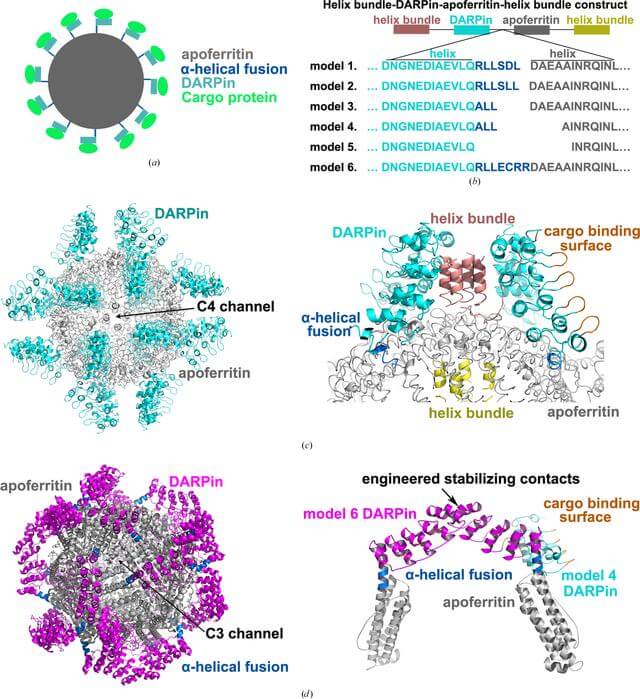 Fig. 1 Design of the helix bundle–DARPin–apoferritin–helix bundle scaffold.1
Yeast Surface Display: Real-time Characterization
For projects requiring eukaryotic post-translational considerations or precise affinity discrimination, yeast display is the platform of choice.
mRNA and Ribosome Display: Breaking the Diversity Barrier
For de novo Engineered Protein Scaffold Discovery, we often utilize cell-free display systems.
NGS-Integrated Selection: The "Big Data" Advantage
We don't just pick colonies; we sequence the entire selection pool. By applying Next-Generation Sequencing (NGS) to multiple rounds of screening, we can:
Our integrated workflow is designed to minimize risk and maximize the "developability" of your lead Scaffold Protein.
The future of biotherapeutics lies beyond the antibody. Engineered Protein Scaffolds represent a paradigm shift, offering flexibility and performance that antibodies cannot match. Partner with Creative Biolabs to leverage our world-class expertise in Scaffold Sequence Design, Library Construction, and High-Throughput Screening. Together, we can transform your therapeutic vision into reality.
Contact us today to discuss your next Engineered Protein Scaffold Discovery project.
References
All listed services and products are For Research Use Only. Do Not use in any diagnostic or therapeutic applications.








