Creative Biolabs is offering the most comprehensive services for antibody development projects. With strict regulation and effective execution, we are dedicated to providing the most valuable solutions to complete your projects.
HighlightsCreative Biolabs is offering the most comprehensive services for antibody development projects. With strict regulation and effective execution, we are dedicated to providing the most valuable solutions to complete your projects.
HighlightsCreative Biolabs has established a broad range of platforms for developing novel antibodies or equivalents. These cutting-edge technologies enable our scientists to meet your demands from different aspects and tailor the most appropriate solution that contributes to the success of your projects.
HighlightsWith deep understanding in antibody-related realms and extensive project experience, Creative Biolabs offers a variety of references to help you learn more about our capacities and achievements, including infographic, flyer, case study, peer-reviewed publications, and all kinds of knowledge that can assist your projects. You are also welcome to contact us directly for more specific solutions.
HighlightsGet a real taste of Creative Biolabs, one of the most professional custom service providers in the world. We are committed to providing highly customized comprehensive solutions with the best quality to advance your projects.
HighlightsDrug discovery targeting cIAP proteins is often hindered by long development cycles, significant background interference in screening, and the difficulty of identifying high-affinity binders to the BIR3 domain. Creative Biolabs' In vitro cIAP Fluorescence Polarization Assays directly address these challenges by providing a robust, high-throughput platform to obtain high-resolution binding affinity data. Leveraging advanced ratiometric detection and validated protocols, our service delivers precise and reliable identification of potent IAP inhibitors. This allows you to bypass complex, time-consuming assay optimization and focus directly on advancing your lead candidates.
cIAP proteins serve as critical checkpoint regulators within the death receptor-mediated apoptotic pathway, where their E3 ubiquitin ligase activity suppresses caspase activation and promotes cell survival through NF-κB signaling. Quantifying ligand engagement with the cIAP BIR3 domain via fluorescence polarization assays provides essential mechanistic insights into Smac mimetic functionality, enabling researchers to validate target engagement and optimize compounds that selectively relieve this apoptotic blockade.
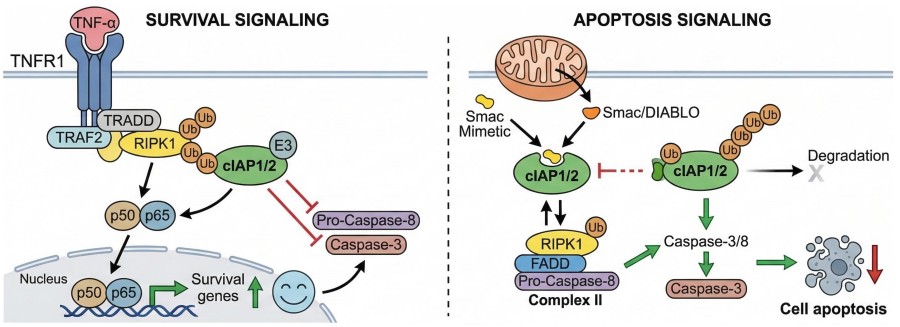 Fig.1 cIAP fluorescent polarization binding assays.
To support precise drug discovery, Creative Biolabs offers a sophisticated, homogeneous biochemical assay platform for characterizing small molecule interactions with the BIR3 domains of cIAP-1 and cIAP-2. This system yields accurate Kd and IC50 measurements, facilitating high-confidence affinity ranking of compound libraries. Whether advancing Smac mimetic programs to restore apoptotic sensitivity or engineering E3 ligase recruiters for targeted protein degradation, researchers gain the quantitative validation necessary for regulatory documentation and subsequent structure-activity refinement.
The FP assay is typically performed in a competitive format, involving the co-incubation of the cIAP protein, a fluorescently labeled known ligand (tracer), and serially diluted test compounds.
When the tracer alone is bound to cIAP, its molecular rotation is slowed, resulting in a high fluorescence polarization value. Upon displacement of the tracer by a test compound, the now-free tracer rotates rapidly, leading to a low fluorescence polarization signal.
By monitoring the changes in fluorescence polarization, a competitive binding curve can be generated. This allows for the calculation of the half-maximal inhibitory concentration (IC50) or the inhibition constant (Ki), providing a quantitative measure of the binding affinity between the test compound and cIAP.
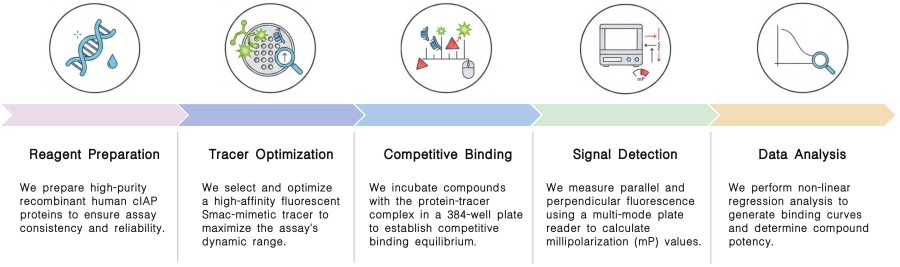
Final Deliverables:
Partnering with Creative Biolabs provides immediate entry to a fully optimized FP screening platform, bypassing the complexities of in-house assay development. Engineered for exceptional sensitivity, our system reliably resolves sub-nanomolar binding events that often evade conventional intensity-based detection methods.
Customer Reviews
"Creative Biolabs' cIAP FP assays delivered exceptional data quality with minimal background noise and a robust Z' factor, enabling rapid prioritization of our Smac mimetic library and accelerating downstream cellular validation." Dr. A**n.
"This homogeneous FP platform proved essential for characterizing our fast-dissociating peptide leads. The ability to capture real-time binding kinetics without wash steps significantly advanced our E3 ligase recruitment studies for targeted degradation." Prof. L**s.
"Consistent protein quality across multiple lots eliminated previous variability in our SAR studies. Creative Biolabs' rigorously validated cIAP preparations ensured stable IC50 measurements, providing reliable structure-activity data batch after batch." Sarah K**.
How to contact us?
Ready to advance your apoptosis research with precision cIAP data?
Contact our team today to discuss your project needs and request a customized quote. From assay design to final reports, we deliver the speed, accuracy, and expertise your program deserves. Let's accelerate your drug discovery together.
All listed services and products are For Research Use Only. Do Not use in any diagnostic or therapeutic applications.