Creative Biolabs is offering the most comprehensive services for antibody development projects. With strict regulation and effective execution, we are dedicated to providing the most valuable solutions to complete your projects.
HighlightsCreative Biolabs is offering the most comprehensive services for antibody development projects. With strict regulation and effective execution, we are dedicated to providing the most valuable solutions to complete your projects.
HighlightsCreative Biolabs has established a broad range of platforms for developing novel antibodies or equivalents. These cutting-edge technologies enable our scientists to meet your demands from different aspects and tailor the most appropriate solution that contributes to the success of your projects.
HighlightsWith deep understanding in antibody-related realms and extensive project experience, Creative Biolabs offers a variety of references to help you learn more about our capacities and achievements, including infographic, flyer, case study, peer-reviewed publications, and all kinds of knowledge that can assist your projects. You are also welcome to contact us directly for more specific solutions.
HighlightsGet a real taste of Creative Biolabs, one of the most professional custom service providers in the world. We are committed to providing highly customized comprehensive solutions with the best quality to advance your projects.
HighlightsHarnessing the power of advanced biophysical analysis, Creative Biolabs offers a comprehensive suite of ligand and analyte affinity measurement services. With over two decades of expertise, we provide precise, high-throughput characterization of molecular interactions, empowering researchers to accelerate their drug discovery and development pipelines. Our state-of-the-art platforms deliver critical data on binding kinetics, affinity, and thermodynamics for a vast range of ligands and analytes, ensuring the selection of candidates with optimal performance and efficacy.
In the highly competitive landscape of pharmaceutical and biotechnological research, the demand for high-quality binding data has never been greater. Early and accurate assessment of a drug candidate's affinity and kinetics can significantly impact its developmental trajectory.
Creative Biolabs has invested in a diverse portfolio of industry-leading technologies to offer unparalleled flexibility and precision. Our multi-platform approach ensures that we can select the optimal method for any given ligand-analyte pair, from small molecules to large biologics, in various sample matrices.
SPR is a powerful optical technique that allows for the real-time monitoring of molecular interactions without the need for labels. One molecule (the ligand) is immobilized on a sensor chip, and the other (the analyte) is flowed over the surface. The binding event causes a change in the refractive index at the sensor surface, which is detected and measured in Resonance Units (RU).
BLI is another robust optical, label-free technology that measures changes in the interference pattern of white light reflected from the tip of a biosensor. The ligand is immobilized on the biosensor tip, which is then dipped into a 96- or 384-well plate containing the analyte. This fluidics-free design makes it exceptionally well-suited for high-throughput applications and compatible with crude or complex samples.
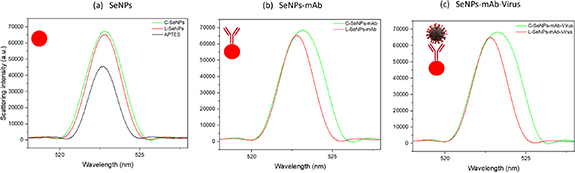 Fig. 1 Comparison of the scattering intensities of APTES (negative control) to laser-ablated and chemical synthesized (a) SeNPs, (b) SeNPs-mAb conjugate, and (c) SeNPs-mAb-virus conjugate.1
ITC is a powerful technique that directly measures the heat released or absorbed during a binding event. It is considered the gold standard for thermodynamic characterization, as it provides a complete thermodynamic profile of the interaction in a single experiment. The measurements are performed in-solution, without immobilization, providing a true representation of the binding event in its native state.
MST is a cutting-edge, in-solution technique that measures the motion of molecules along a microscopic temperature gradient. A change in the hydration shell, charge, or size of a molecule upon binding to a partner will alter its movement, which is detected via fluorescence.
At Creative Biolabs, we operate as an extension of your team. Our process is collaborative, transparent, and designed for success.
Our services support a vast array of research and development applications across multiple domains:
To further support your research, Creative Biolabs offers a suite of Affinity Measurement related services:
Propel your research forward with the confidence that comes from precise and reliable affinity data. Contact us today to discuss your project with one of our experts and discover how Creative Biolabs can be your trusted partner in ligand and analyte affinity measurement.
Q: What is the difference between affinity and avidity?
A: Affinity refers to the strength of a single binding interaction between one binding site on a molecule (e.g., an antibody's Fab region) and its partner (e.g., an epitope on an antigen). It is quantified by the equilibrium dissociation constant (KD). Avidity, on the other hand, describes the overall combined strength of multiple simultaneous binding interactions, such as an IgG antibody binding to a cell surface with both of its arms. Avidity is influenced by both the affinity of each individual interaction and the valency (number of binding sites) of the molecules involved.
Q: How do I choose the right technology (SPR, BLI, ITC, MST) for my project?
A: The best technology depends on several factors, including your research goals, the nature of your molecules, and sample availability.
Our team of experts will consult with you to recommend the optimal platform for your specific needs.
Q: What are the typical sample requirements for an affinity measurement project?
A: Sample requirements vary by technology. Generally, we require purified ligand and analyte. For SPR and BLI, the ligand to be immobilized should have high purity (>95%). The analyte's purity is less critical but recommended to be >90% for clean data. ITC requires higher concentrations and volumes of both molecules. MST is the most frugal, requiring only microliter volumes at nanomolar concentrations. We will provide detailed sample requirement guidelines specific to your project during the initial consultation.
Q: Can you measure the affinity of very weak or very strong interactions?
A: Yes. Our diverse technology platforms allow us to accurately measure a very broad range of affinities. For weak interactions (millimolar to micromolar range, common in fragment-based screening), techniques like SPR and ITC are highly effective. For very strong, tight-binding interactions (picomolar to femtomolar range), we employ specialized assay designs, such as long-dissociation-rate experiments on our SPR platforms, to ensure accurate measurement of the slow off-rate.
All listed services and products are For Research Use Only. Do Not use in any diagnostic or therapeutic applications.