Creative Biolabs is offering the most comprehensive services for antibody development projects. With strict regulation and effective execution, we are dedicated to providing the most valuable solutions to complete your projects.
HighlightsCreative Biolabs is offering the most comprehensive services for antibody development projects. With strict regulation and effective execution, we are dedicated to providing the most valuable solutions to complete your projects.
HighlightsCreative Biolabs has established a broad range of platforms for developing novel antibodies or equivalents. These cutting-edge technologies enable our scientists to meet your demands from different aspects and tailor the most appropriate solution that contributes to the success of your projects.
HighlightsWith deep understanding in antibody-related realms and extensive project experience, Creative Biolabs offers a variety of references to help you learn more about our capacities and achievements, including infographic, flyer, case study, peer-reviewed publications, and all kinds of knowledge that can assist your projects. You are also welcome to contact us directly for more specific solutions.
HighlightsGet a real taste of Creative Biolabs, one of the most professional custom service providers in the world. We are committed to providing highly customized comprehensive solutions with the best quality to advance your projects.
HighlightsFor over two decades, Creative Biolabs has been at the forefront of biotechnological innovation. We are proud to introduce our state-of-the-art MemDX™ Conversable Mammalian Library (CML) based Biomolecular Interaction Identification Service, a revolutionary platform designed to discover novel protein-protein, protein-ligand, and receptor-ligand interactions with unparalleled accuracy and physiological relevance. Our MemDX™ platform moves beyond the limitations of traditional methods like yeast two-hybrid (Y2H) systems. By leveraging a uniquely engineered mammalian expression library, we provide definitive interaction data for even the most challenging targets, including membrane proteins, in their correctly folded and post-translationally modified states.
Identifying biomolecular interactions is fundamental to understanding protein function, signaling pathways, and disease mechanisms. However, conventional methods often fall short, particularly when dealing with complex mammalian proteins.
| Method | Limitations | How MemDX™ Overcomes This |
| Yeast Two-Hybrid (Y2H) | High rate of false positives/negatives. Non-mammalian system lacks correct PTMs and protein folding. Unsuitable for most membrane proteins. | Screening is performed in mammalian cells, ensuring high biological relevance and reducing artifacts. |
| Bacterial Two-Hybrid (B2H) | Lacks eukaryotic cellular machinery for protein processing. Not suitable for secreted or membrane proteins. | Eukaryotic (mammalian) host ensures proper protein trafficking, processing, and modification. |
| In Vitro Assays (e.g., SPR, Co-IP) | Often require purified proteins, which can be difficult to produce, especially for membrane proteins. May miss transient or weak interactions. Can present non-native conformations. | Interactions are studied in situ on the cell surface or with natively secreted proteins, preserving their true conformation and activity. |
| Standard Mammalian Assays | Typically limited to one-on-one interaction validation, not high-throughput library screening. | MemDX™ is a true library-on-library screening platform, capable of testing millions of potential interactions in a high-throughput manner. |
Our MemDX™ Conversable Mammalian Library (CML) was specifically developed to address these gaps, providing a robust and reliable solution for genuine biomolecular interaction identification.
The power of the MemDX™ service lies in its core technology: the Conversable Mammalian Library. This is not a simple expression library. It is an ingeniously designed system that combines the advantages of both cell-surface display and soluble protein screening within a single framework.
Each "prey" protein within our comprehensive human cDNA library is constructed as a fusion protein with two key components:
This dual-format capability is the cornerstone of the MemDX™ platform, enabling a versatile and multi-faceted screening strategy that drastically reduces false positives and ensures the highest confidence in your results.
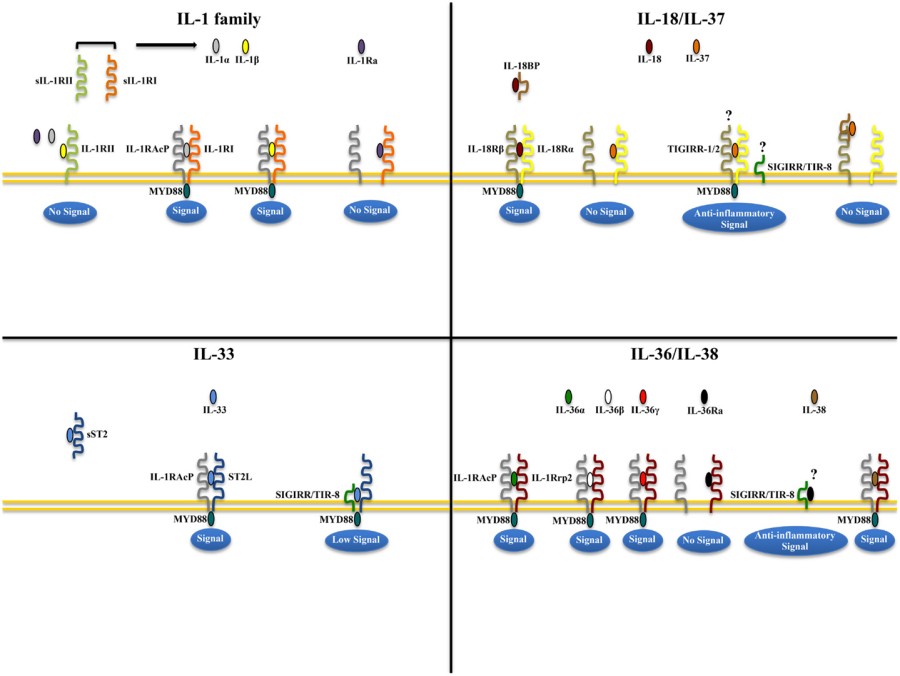 Fig. 1 Receptor-ligand pairing of IL-1 family members.1
Our biomolecular interaction identification process is a meticulously designed workflow, optimized for efficiency and success.
Step 1: Bait Preparation & Cell Line Generation
Your "bait" protein—the molecule for which you want to find interaction partners—is cloned into an appropriate mammalian expression vector. We then generate a stable mammalian cell line that expresses your bait protein on its surface.
Step 2: High-Throughput CML Screening
The bait-expressing cell line is co-cultured with our MemDX™ Conversable Mammalian Library cells, which express millions of different "prey" proteins on their surface. Cells that exhibit a positive binding interaction are identified and isolated using high-throughput flow cytometry (FACS).
Step 3: Hit Identification & Sequencing
The genetic material from the "hit" prey cells is recovered, and the identity of the interacting prey protein is determined through next-generation sequencing (NGS).
Step 4: Orthogonal Validation & Confirmation
This is where the "conversable" nature of our library shines. The identified prey proteins are produced in their soluble format. We then perform a battery of binding assays (e.g., ELISA, SPR) using the soluble prey and the bait-expressing cells to confirm the interaction, providing a secondary, independent validation of the primary screen.
Step 5: Comprehensive Data Analysis & Reporting
You receive a detailed report containing the identity of all validated interaction partners, raw screening data, validation assay results, and expert interpretation to guide your next research steps.
The versatility of the MemDX™ platform makes it an invaluable tool for a wide array of research and therapeutic development applications.
A significant portion of the human receptome consists of "orphan" receptors whose endogenous ligands are unknown. MemDX™ is the premier solution for this challenge.
Identify novel cell-surface antigens for therapeutic antibody development.
Elucidate complex signaling cascades and functional protein networks.
Discover the cellular protein targets of bioactive small molecules.
Unravel the interactions that drive your research forward. Partner with Creative Biolabs and leverage the power of the MemDX™ Conversable Mammalian Library (CML) based Biomolecular Interaction Identification Service.
To complement our MemDX™ service and support your entire research pipeline, Creative Biolabs offers a comprehensive suite of related services. Explore our full range of PPI services here: Protein-Protein Interaction (PPI) Assay Services
Let Creative Biolabs empower your drug discovery program with definitive Y2H based drug-target interaction identification.
Q: What types of "bait" proteins can be used with the MemDX™ platform?
A: Our platform is exceptionally versatile and can accommodate a wide range of bait proteins. The ideal candidates are cell-surface proteins, including:
We can also adapt the system for other bait types on a case-by-case basis. Please contact our technical team to discuss your specific target of interest.
Q: What is the primary advantage of MemDX™ CML over traditional yeast two-hybrid (Y2H) systems?
A: The primary advantage is physiological relevance. MemDX™ screens for interactions within a mammalian cell environment. This means that proteins are correctly folded, trafficked, and undergo essential post-translational modifications (like glycosylation and phosphorylation) that are absent or incorrect in yeast. This is particularly crucial for mammalian proteins, especially membrane proteins, leading to a drastically lower rate of false positives and the discovery of biologically meaningful interactions that Y2H systems would miss.
Q: What is the source of the "prey" library?
A: Our standard MemDX™ Conversable Mammalian Library is constructed from a comprehensive collection of human cDNAs, representing a vast diversity of secreted and cell-surface proteins. This provides broad coverage for discovering novel interactions. We also have the capability to build custom libraries from specific tissues, cell types, or even synthetic constructs to meet unique project goals.
Q: How do you handle technically challenging bait proteins, such as GPCRs that require specific conformations?
A: With over two decades of experience, we have developed proprietary strategies for expressing and presenting even the most difficult membrane proteins. For targets like GPCRs, we can generate cell lines that express the receptor in its native conformation. We can also perform screening in the presence of an agonist to stabilize a specific active conformation, allowing for the discovery of state-dependent interaction partners.
Q: Can this service be used to screen for interactions other than protein-protein interactions?
A: While the core MemDX™ platform is optimized for discovering protein-protein interactions (including peptide-protein and antibody-protein), the fundamental principle can be adapted. For instance, it can be used to identify protein receptors for non-proteinaceous ligands such as carbohydrates or lipids if the bait can be appropriately presented. Please consult with our scientists to explore custom solutions for non-protein interaction discovery.
All listed services and products are For Research Use Only. Do Not use in any diagnostic or therapeutic applications.