
Creative Biolabs is offering the most comprehensive services for antibody development projects. With strict regulation and effective execution, we are dedicated to providing the most valuable solutions to complete your projects.
HighlightsCreative Biolabs is offering the most comprehensive services for antibody development projects. With strict regulation and effective execution, we are dedicated to providing the most valuable solutions to complete your projects.
HighlightsCreative Biolabs has established a broad range of platforms for developing novel antibodies or equivalents. These cutting-edge technologies enable our scientists to meet your demands from different aspects and tailor the most appropriate solution that contributes to the success of your projects.
HighlightsWith deep understanding in antibody-related realms and extensive project experience, Creative Biolabs offers a variety of references to help you learn more about our capacities and achievements, including infographic, flyer, case study, peer-reviewed publications, and all kinds of knowledge that can assist your projects. You are also welcome to contact us directly for more specific solutions.
HighlightsGet a real taste of Creative Biolabs, one of the most professional custom service providers in the world. We are committed to providing highly customized comprehensive solutions with the best quality to advance your projects.
HighlightsMuscarinic receptors are GPCRs that play a role in the parasympathetic nervous system. They consist of M1, M2, M3, M4, and M5 receptor subtypes, which are implicated in several physiological processes like peristalsis, micturition, and others. Several widespread illnesses, such as chronic obstructive pulmonary disease and asthma, are closely linked with dysfunctional muscarinic receptors. Targeting muscarinic receptors in the affected area is meaningful for the treatment of a variety of associated diseases. Accordingly, identifying muscarinic receptors may aid in the drug development of diseases.
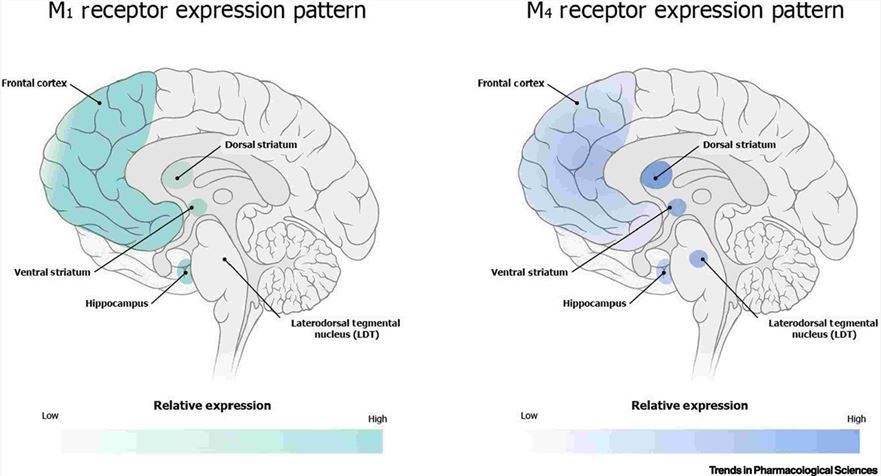 Fig.1 M1 and M4 muscarinic acetylcholine receptors (mAChRs) expression in brain areas associated with psychosis.1
Surprisingly, Creative Biolabs has innovatively developed a cost-effective Hi-Affi™ in vitro cell-based muscarinic receptor functional assay service and welcomes global customers to inquire and order.
Our Hi-Affi™ in vitro cell-based muscarinic receptor functional assay service incorporates a straightforward and efficient cell-based assay with muscarinic receptors functional assay that has the potential to be utilized to evaluate candidate samples and their capability to modulate muscarinic receptors. The principle of this assay is to examine the diacyl flux and calcium flux in response to G protein activation triggered by muscarinic receptors binding to ligands. During every stage of this procedure, our comprehensive, customized, and exceptional services will enable the diverse demands of global customers to be met.
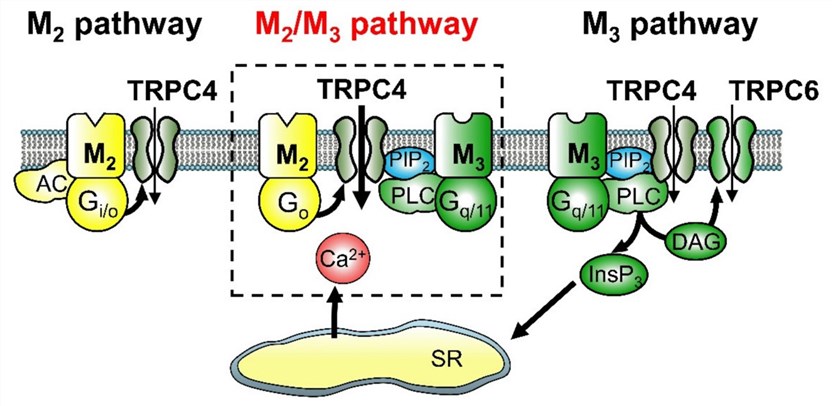 Fig.2 Three distinct muscarinic signaling pathways leading to transient receptor potential (TRP)-like cationic channel opening in ileal myocytes.2
Stage 1: Cell-Based Assay Setup
Stage 2: Candidate Sample Evaluation
Stage 3: Measurement of Calcium Flux or cAMP
Stage 4: Analysis of Muscarinic Receptor Modulation
Our service is designed to analyze four subtypes of muscarinic acetylcholine receptors (mAChRs):
Our integrated Hi-Affi™ in vitro cell-based muscarinic receptor functional assay service overcomes the limits of traditional muscarinic receptor functional assays and has succeeded in achieving innovative developments in technology, applications, and other aspects. Our integrated Hi-Affi™ in vitro cell-based muscarinic receptor functional assay service can deliver significant benefits to global customers:

Representative Data 1: The cellular signaling and roles of two categories of muscarinic receptors, M1 (flag epitope-tagged) and hM3Dq (HA epitope-tagged), in Jurkat leukemic T cells may be activated by carbachol or clozapine, respectively. The results show that muscarinic receptor stimulation caused substantial calcium responses in Jurkat cells. When either muscarinic receptor was retrovirally transduced into primary mouse T cells, it was seen that both receptors were sensitive to stimulation, at least in terms of calcium increases, with carbachol or clozapine, respectively. In addition, transduction of PLCβ1, a vital mediator of response to superantigens in Jurkat cells, could strongly improve responses to stimulated muscarinic receptors in mouse T cells. Consequently, they demonstrated that co-expression of PLCβ1 and stimulation of M1 and synthetic hM3Dq receptors may activate primary murine T cells.
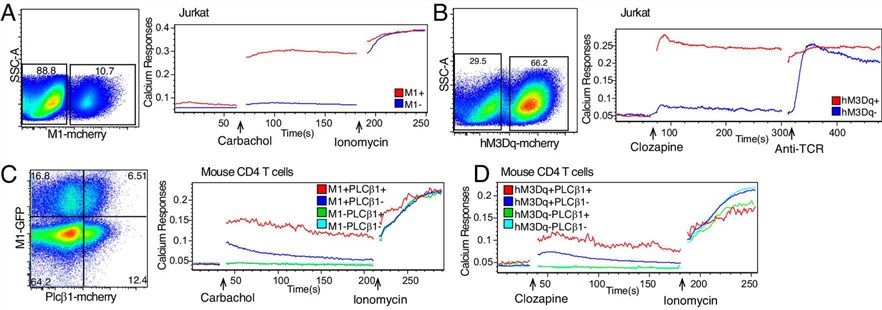 Fig.3 PLCβ1 significantly improves calcium responses in primary T cells with active muscarinic receptors.3
A1: The most common readouts for muscarinic receptor functional assays include:
A2: We can test a wide range of compounds, including: small molecule libraries; known agonists, antagonists, and allosteric modulators; peptides; and natural product extracts.
A3: To ensure a smooth and efficient service, please provide the following information:
A4: Yes, we offer flexible and customizable assay solutions. We can optimize assay conditions, develop specific cell lines, or adapt readouts to meet your unique research objectives. Please discuss your specific requirements with our scientific team.
Constantly, in response to customers' feedback, Creative Biolabs endeavors the develop and improve technological innovations. For more details about our Hi-Affi™ in vitro cell-based muscarinic receptor functional assay service, please don't hesitate to contact us. We are eagerly anticipating forging long-term partnerships with customers all across the world.
References
All listed services and products are For Research Use Only. Do Not use in any diagnostic or therapeutic applications.








