Creative Biolabs is offering the most comprehensive services for antibody development projects. With strict regulation and effective execution, we are dedicated to providing the most valuable solutions to complete your projects.
HighlightsCreative Biolabs is offering the most comprehensive services for antibody development projects. With strict regulation and effective execution, we are dedicated to providing the most valuable solutions to complete your projects.
HighlightsCreative Biolabs has established a broad range of platforms for developing novel antibodies or equivalents. These cutting-edge technologies enable our scientists to meet your demands from different aspects and tailor the most appropriate solution that contributes to the success of your projects.
HighlightsWith deep understanding in antibody-related realms and extensive project experience, Creative Biolabs offers a variety of references to help you learn more about our capacities and achievements, including infographic, flyer, case study, peer-reviewed publications, and all kinds of knowledge that can assist your projects. You are also welcome to contact us directly for more specific solutions.
HighlightsGet a real taste of Creative Biolabs, one of the most professional custom service providers in the world. We are committed to providing highly customized comprehensive solutions with the best quality to advance your projects.
Highlights Loading...
All listed services and products are For Research Use Only. Do Not use in any diagnostic or therapeutic applications.
Claudin 6 (CLDN6) is a tetraspan tight junction integral membrane protein encoded by the CLDN6 gene and a member of the claudin family. It contributes to the regulation of paracellular ion permeability, epithelial barrier integrity, and tissue compartmentalization. CLDN6 is prominently expressed in embryonic epithelial tissues and is largely absent or expressed at low levels in most normal adult tissues. Re-expression has been reported in subsets of epithelial tumors, although the frequency and level of expression vary across tumor types, individual samples, and detection platforms. Its evolutionarily conserved extracellular loop domains participate in homotypic interactions between neighboring cells, supporting tight junction strand organization and the regulation of transepithelial solute flux. Through these intercellular interactions, CLDN6 contributes to the sealing of epithelial cell-cell interfaces and the maintenance of compartmental solute gradients during development. CLDN6 has also been implicated in epithelial differentiation programs associated with tissue polarity and barrier formation during organogenesis. This oncofetal expression pattern, together with its membrane localization in selected tumor contexts, makes CLDN6 a relevant target for developmental biology, tumor surface-expression studies, and oncology biomarker research.
CLDN6 exerts its biological functions primarily through homotypic interactions between extracellular domains on adjacent epithelial cells, contributing to the formation and organization of continuous tight junction strands. These interactions help restrict uncontrolled paracellular movement of ions and small solutes and thereby support epithelial barrier function and compartmental homeostasis. Conserved transmembrane and extracellular regions of CLDN6 contribute to stable cell-cell association and the regulation of barrier permeability. CLDN6 is involved in embryonic epithelial differentiation, transepithelial transport regulation, and tissue-specific membrane expression. Changes in CLDN6 expression may affect epithelial barrier organization during development, while re-expression in subsets of tumors can generate a measurable cell-surface feature for molecular characterization. Because CLDN6 expression is heterogeneous across tumor types and specimens, its biological and research significance should be evaluated in a context-dependent manner. Accordingly, CLDN6 represents a useful target for studies of epithelial development, tumor surface-expression profiling, target-engagement research, and oncology biomarker characterization.
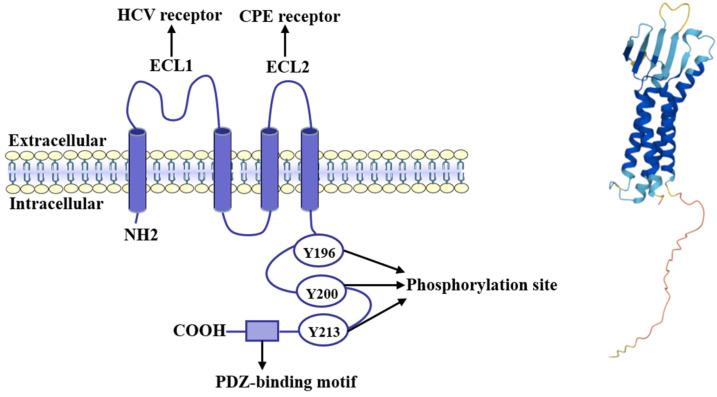 Fig. 1 Tetraspan transmembrane topology of CLDN6; extracellular loops mediate HCV and CPE toxin binding, cytoplasmic tyrosine residues undergo phosphorylation, and C-terminal PDZ motif interacts with tight junction scaffold proteins.1
The biological functions of CLDN6 are focused on intercellular homotypic adhesion and paracellular permeability restriction:
Creative Biolabs offers high-quality CLDN6 proteins via optimized expression systems, covering full-length CLDN6 and extracellular loop domain variants. These products retain native tetraspan membrane topology and homotypic binding activity, suitable for tight junction assembly and tumor antigen interaction research. All CLDN6 proteins undergo rigorous quality control to guarantee consistent functional performance and reliable application across diverse research platforms.
Not finding the membrane protein product you need? Contact us to start your one-stop custom service!
Creative Biolabs provides custom engineered CLDN6 stable cell lines, including overexpression and gene silencing models. These cell lines are optimized for tight junction physiology and tumor antigen research. Each cell line undergoes strict validation procedures to ensure steady target expression levels and uniform functional performance across multiple experimental scenarios.
Not finding the stable cell line product you need? Contact us to start your one-stop custom service!
High-specificity recombinant antibodies targeting CLDN6 are developed with advanced antibody engineering workflows, without cross-reactivity against other claudin family members. These antibodies receive multi-scenario functional validation, applicable to epithelial membrane localization and tumor biomarker detection.
Not finding the recombinant antibody product you need? Contact us to start your one-stop custom service!
Beyond catalog products, Creative Biolabs offers specialized custom services for CLDN6 research:
CLDN6 is a tight junction protein that mediates intercellular homotypic adhesion to assemble epithelial barrier strands and control paracellular solute flux.
CLDN6 regulates developmental epithelial barriers and acts as a tumor-restricted surface marker for therapeutic exploration, establishing it as a vital research target.
No, all CLDN6 products and services are strictly for research use only, not intended for clinical diagnosis or treatment.
Offerings include CLDN6 proteins, high-specificity recombinant antibodies and custom stable cell lines for epithelial barrier and tumor research.
CLDN6 proteins undergo functional verification via homotypic cell binding and tight junction assembly capacity evaluation.