Creative Biolabs is offering the most comprehensive services for antibody development projects. With strict regulation and effective execution, we are dedicated to providing the most valuable solutions to complete your projects.
HighlightsCreative Biolabs is offering the most comprehensive services for antibody development projects. With strict regulation and effective execution, we are dedicated to providing the most valuable solutions to complete your projects.
HighlightsCreative Biolabs has established a broad range of platforms for developing novel antibodies or equivalents. These cutting-edge technologies enable our scientists to meet your demands from different aspects and tailor the most appropriate solution that contributes to the success of your projects.
HighlightsWith deep understanding in antibody-related realms and extensive project experience, Creative Biolabs offers a variety of references to help you learn more about our capacities and achievements, including infographic, flyer, case study, peer-reviewed publications, and all kinds of knowledge that can assist your projects. You are also welcome to contact us directly for more specific solutions.
HighlightsGet a real taste of Creative Biolabs, one of the most professional custom service providers in the world. We are committed to providing highly customized comprehensive solutions with the best quality to advance your projects.
Highlights Loading...
All listed services and products are For Research Use Only. Do Not use in any diagnostic or therapeutic applications.
C-X-C motif chemokine receptor 1 (CXCR1) is a class A rhodopsin-like G protein-coupled receptor (GPCR), which is predominantly couples with heterotrimeric Gi proteins upon agonist engagement, leading to phospholipase C activation, intracellular calcium mobilization, and downstream activation of mitogen-activated protein kinase (MAPK) pathway and phosphoinositide 3–kinase (PI3K)/AKT pathways. In homeostatic environments, CXCR1-mediated trafficking is required to rapidly contain pathogens and repair damaged tissues. However, in chronic disease, dysregulated CXCR1 signalling promotes tissue destruction in acute respiratory distress syndrome and neutrophil extracellular trap formation in autoimmune vasculitis, driving the recruitment of protumoural neutrophils and myeloid-derived suppressor cells into the breast, pancreatic, and colorectal carcinoma tumour microenvironment. The clinical validation of CXCR1 as a pharmacologically tractable target, bolstered by preclinical efficacy of receptor antagonists in inflammatory and oncological models, has created greater need for structurally authentic ligand-free receptor preparations, pharmacologically faithful cell lines and conformation-specific antibodies to inform modern drug discovery.
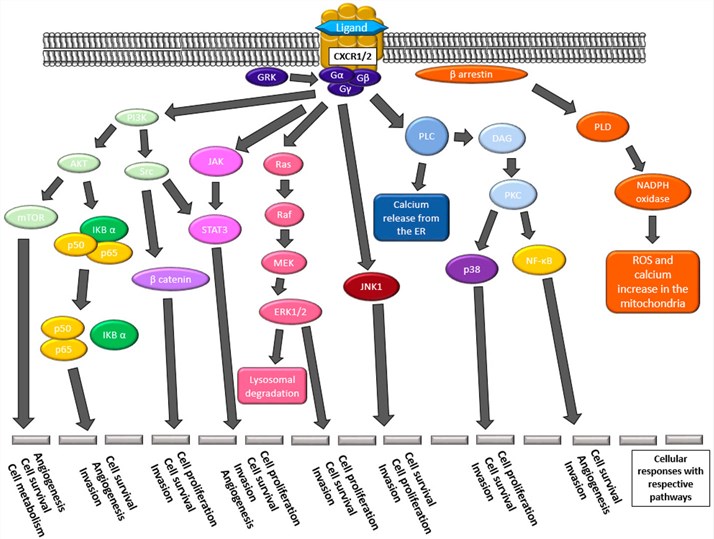 Fig.1 The downstream effectors of pathways elicited by the activation of CXCR1/2 by their respective ligands.1
CXCR1 has a functional reach across multiple interrelated physiological and pathological landscapes:
Drive your research on GPCRs and inflammation with our thoroughly characterized recombinant CXCR1 membrane protein product line. We acknowledge that the challenges of producing CXCR1 are considerable due to its seven-transmembrane structure, ligand-dependent conformational flexibility and low natural abundance. We express in multi-platform the well-folded membrane integrated CXCR1 and provide both full-length wild type human CXCR1 exhibitCXCR1 variants from mouse origin; as well N-terminal domain mutants and signaling-deficient CXCR1mutants. Over the last few years, we have validated all preparations biophysically using SDS-PAGE, analytical size-exclusion chromatography and ligand-binding assays to make sure they are suitable for structural biology, antibody screening and drug discovery.
Not finding the membrane protein product you need? Contact us to start your one-stop custom service!
We offer stable cell lines expressing either wild-type or modulated levels of human, mouse and rat CXCR1, using both endogenous receptor expression systems for loss-of-function studies. These platforms optimize conditions to achieve the high-throughput calcium mobilization assays, chemotaxis quantification, NET formation studies and cancer stem cell sphere formation assays that support the experimental consistency necessary for multi-phase research initiatives.
Not finding the stable cell line product you need? Contact us to start your one-stop custom service!
We offer a broad range of high-affinity recombinant antibodies against CXCR1 for an array of research applications. Using cutting-edge recombinant technologies, these antibodies provide greater specificity, sensitivity, and batch-to-batch consistency than polyclonal antibodies. Our CXCR1 recombinant antibodies are validated for a range of applications, including WB, ELISA, FCM, IHC and IP on various samples from neutrophil cell lysate to tumor biopsy to transfected cell membranes.
Not finding the recombinant antibody product you need? Contact us to start your one-stop custom service!
In addition to our catalog products, we provide custom services for membrane protein and antibody discovery and development. Drawing on our deep expertise in GPCR biology and chemokine receptor pharmacology, we can provide you with:
We can provide various products, such as recombinant full-length CXCR1; N-terminal domain fragments of CXCR1; stable cell lines with expression of CXCR1 or the downstream signaling components.
Our catalog includes mouse, and rat CXCR1 reagents. Additional orthologs or engineered mutants, including GRK2-uncoupled variants and constitutively active mutants, can be made available upon request.
Absolutely. Our cell engineering team regularly engineers tetracycline-inducible systems and lines that co-express CXCR1 together with CXCR2, Gαi or calcium biosensors for global pathway analysis and examination of receptor selectivity. We welcome in detail discussions on your expression architecture and phenotypic needs.
No, all CXCR1 products and services are for research use only and not for clinical diagnosis, prevention, treatment or cure of any disease.