
Creative Biolabs is offering the most comprehensive services for antibody development projects. With strict regulation and effective execution, we are dedicated to providing the most valuable solutions to complete your projects.
HighlightsCreative Biolabs is offering the most comprehensive services for antibody development projects. With strict regulation and effective execution, we are dedicated to providing the most valuable solutions to complete your projects.
HighlightsCreative Biolabs has established a broad range of platforms for developing novel antibodies or equivalents. These cutting-edge technologies enable our scientists to meet your demands from different aspects and tailor the most appropriate solution that contributes to the success of your projects.
HighlightsWith deep understanding in antibody-related realms and extensive project experience, Creative Biolabs offers a variety of references to help you learn more about our capacities and achievements, including infographic, flyer, case study, peer-reviewed publications, and all kinds of knowledge that can assist your projects. You are also welcome to contact us directly for more specific solutions.
HighlightsGet a real taste of Creative Biolabs, one of the most professional custom service providers in the world. We are committed to providing highly customized comprehensive solutions with the best quality to advance your projects.
Highlights Loading...
All listed services and products are For Research Use Only. Do Not use in any diagnostic or therapeutic applications.
Dopamine D1 receptor, also known as DRD1 and D1R, is the first discovered member of the D1-like dopamine receptor subfamily. The entire dopamine receptor family consists of G protein-coupled receptors with seven-transmembrane structures. Simply put, the function of these receptors is to convert the signals carried by dopamine into specific actions that cells can execute. There are five subtypes of dopamine receptors in total. Compared with several other subtypes, DRD1 has prominent unique features: it is not only abundant in quantity, but also distributed at key nodes. It is highly expressed in the neural circuits of the brain that control movement, to put it plainly, it grows in large quantities on the surface of the neurons in this circuit that are mainly responsible for transmitting signals outward. It mostly binds to G proteins that exert excitatory effects. These G proteins activate a substance called adenylate cyclase, which increases the content of intracellular cyclic AMP, and then initiates a series of cascade reactions of protein kinases. Ultimately, it can change the excitability of neurons and regulate gene expression within cells. A synapse is the site where neurons transmit signals to each other. If a large amount of dopamine suddenly floods into this site, DRD1 takes on the main work of signal conversion. It translates this sudden burst of dopamine signals into a series of programs that cells can understand and execute. These programs are the foundation that supports core physiological processes such as the generation of goal-directed behaviors, the initiation of limb movements, and the completion of reinforcement learning.
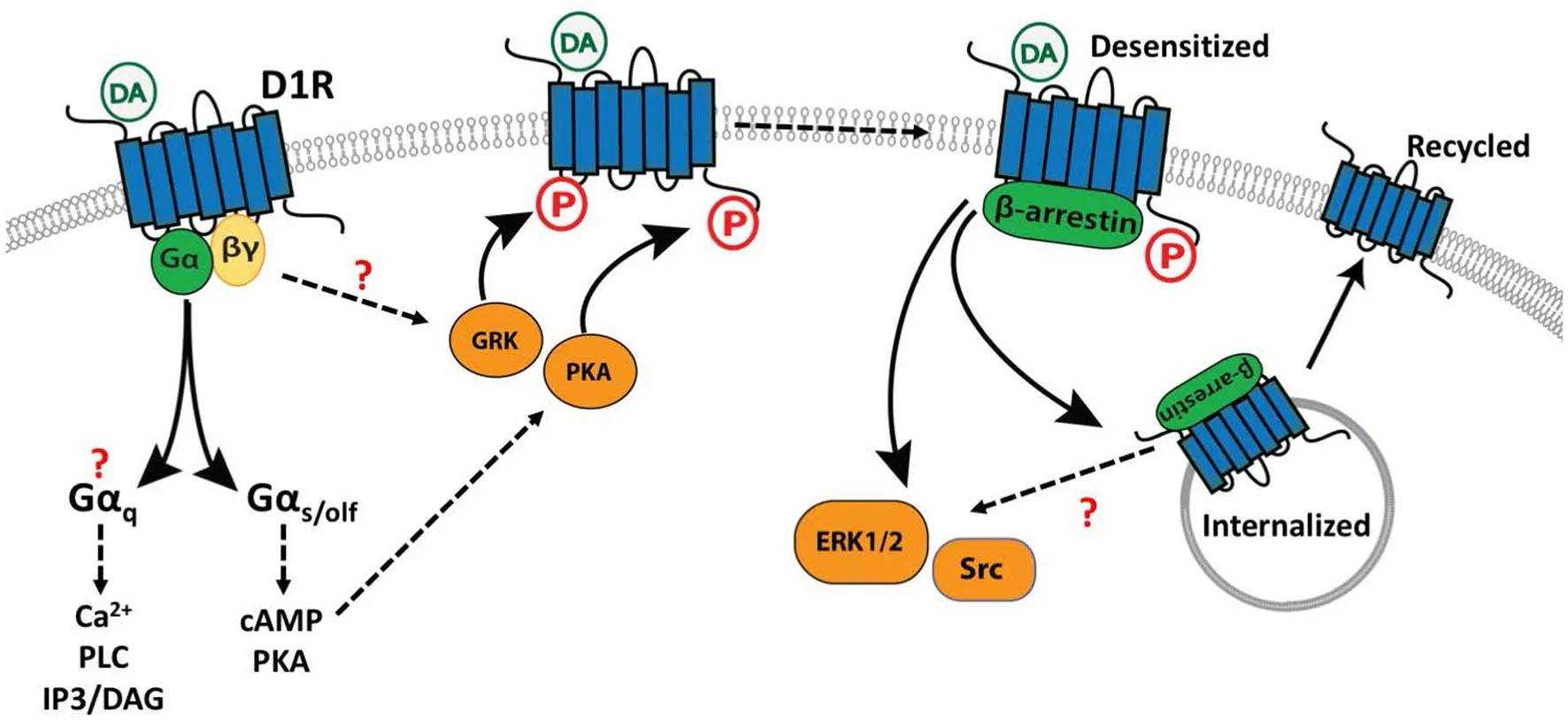 Fig.1 Effector coupling of the D1R.1
Research on DRD1 continues to advance along several interconnected fronts:
All of our DRD1 membrane protein-related products adhere to uncompromising standards: for a dopamine receptor to be safely used in research, it must fully retain its conformational responsiveness and the native cell membrane environment in which it resides. To meet these requirements, all full-length DRD1 preparations we produce come from an optimized eukaryotic expression system. This system is purpose-built to retain the native post-translational modification characteristics of DRD1, and to enable it to correctly fold into its intended conformation, preventing the protein from being irreparably altered during production, or misfolding into useless waste. Every batch of DRD1 released from the factory undergoes testing against multiple core quality metrics: SDS-PAGE is used to detect purity, confirming the batch is free of excess impurities; analytical size-exclusion chromatography is used to verify monodispersity, which ensures the protein does not aggregate into clumps, and can exist in a stable, independent state that will not compromise subsequent experimental results.
Not finding the membrane protein product you need? Contact us to start your one-stop custom service!
Our cell platform for DRD1 research meets three requirements simultaneously: it can precisely regulate receptor expression levels, restore the native presentation state of DRD1 on the cell membrane, and maintain normal signal transduction function. These requirements are not arbitrary thresholds; the reason is simple: DRD1 belongs to the GPCR protein family, and the research value of these proteins has never depended on how much they can be expressed, but on what response they can produce when exposed to an agonist. If a receptor only accumulates in large quantities but cannot respond to signals normally, that quantity is meaningless. We can also customize stable cell lines that highly express DRD1. These cell lines are constructed via sequence-optimized stable integration technology, ensuring that all cell surfaces continuously and stably express DRD1 within a consistent cellular background, eliminating the problem of irreproducible results caused by inconsistent cell states between experiments. Our cell line library includes cell lines that stably express wild-type DRD1—that is, cells carrying the natural, normal version of DRD1—as well as DRD1 mutant cell lines with engineered substitution mutations for related research, covering a wide range of research needs. Every cell clone must undergo comprehensive phenotypic validation, with all its characteristics and functions inspected, before it is confirmed to be fully qualified for use.
Not finding the stable cell line product you need? Contact us to start your one-stop custom service!
You can advance your own DRD1 research projects using our pre-validated recombinant antibody panels. These antibodies are purpose-designed to guarantee target specificity and quantitative accuracy for any type of analytical or functional experiment in dopamine receptor research, eliminating issues of misidentified targets or inaccurate measurements. These high-affinity monoclonal and recombinant antibody clones are generated to target multiple antigenic sites on the extracellular loops and amino terminus of DRD1—that is, they are specifically developed to target the structural regions of DRD1 that extend outside the cell. They can even be distinguished from other dopamine receptors in the same D1 class, exclusively recognizing DRD1 without cross-reacting with other similar receptors. Every antibody clone has undergone complete sequence verification, and is expressed from a defined recombinant construct during production, ensuring consistency of experimental results in long-term research. Even for multi-year long-term projects, the antibody used each time is in the same state, and batch-to-batch variation will not affect experimental conclusions. Our antibody validation work covers all the experimental scenarios most commonly used by DRD1 researchers, and these antibodies can adapt to your needs regardless of your research direction.
Not finding the recombinant antibody product you need? Contact us to start your one-stop custom service!
In addition to our catalog products, Creative Biolabs specializes in custom services for membrane protein and antibody discovery & development. Using our deep knowledge and sophisticated platforms we can support you with:
Yes. Clones are screened for selective DRD1 recognition and counter-screened against D1-like and D2-like family members using recombinant protein panels.
We do. Custom constructs carrying substitutions can be produced and purified under the same quality framework as wild-type material.
oth constitutive and inducible formats are available. Each clone ships with measured data, so receptor expression tier can be matched precisely to your experimental design.
All DRD1 products and services are provided strictly for preclinical research. They are not designed, validated, or authorized for any use involving human subjects.









