
Creative Biolabs is offering the most comprehensive services for antibody development projects. With strict regulation and effective execution, we are dedicated to providing the most valuable solutions to complete your projects.
HighlightsCreative Biolabs is offering the most comprehensive services for antibody development projects. With strict regulation and effective execution, we are dedicated to providing the most valuable solutions to complete your projects.
HighlightsCreative Biolabs has established a broad range of platforms for developing novel antibodies or equivalents. These cutting-edge technologies enable our scientists to meet your demands from different aspects and tailor the most appropriate solution that contributes to the success of your projects.
HighlightsWith deep understanding in antibody-related realms and extensive project experience, Creative Biolabs offers a variety of references to help you learn more about our capacities and achievements, including infographic, flyer, case study, peer-reviewed publications, and all kinds of knowledge that can assist your projects. You are also welcome to contact us directly for more specific solutions.
HighlightsGet a real taste of Creative Biolabs, one of the most professional custom service providers in the world. We are committed to providing highly customized comprehensive solutions with the best quality to advance your projects.
Highlights Loading...
All listed services and products are For Research Use Only. Do Not use in any diagnostic or therapeutic applications.
Tumor-associated calcium signal transducer 2 (TACSTD2), more widely known as TROP2, is a type I transmembrane glycoprotein—in simple terms, it is a protein with one end exposed outside the cell, one end extending inside the cell, and linked to glycan chains. In basic oncology research, scientists have discovered that TACSTD2 is significantly upregulated in expression, meaning its abundance becomes extremely high, in a variety of cancer tissues. It drives continuous proliferation and division of cancer cells by activating the PI3K/AKT, MAPK, and β-catenin signaling axes, and can also remove the restriction that cells must attach to a fixed site to grow, allowing cancer cells to survive and grow even after detaching from their original tissue. Meanwhile, it also supports the migration ability of cancer cells, assisting their spread and metastasis. In some specific scenarios, its extracellular domain will be cleaved by proteases, releasing a small soluble fragment that may participate in paracrine signaling, that is, transmitting signals to other surrounding cells. Its baseline expression in multiple normal epithelial tissues, together with its frequent upregulation in several epithelial cancers, makes TACSTD2 an extremely valuable research object in structural biology, basic disease mechanism research, and compound research target pathway characterization research.
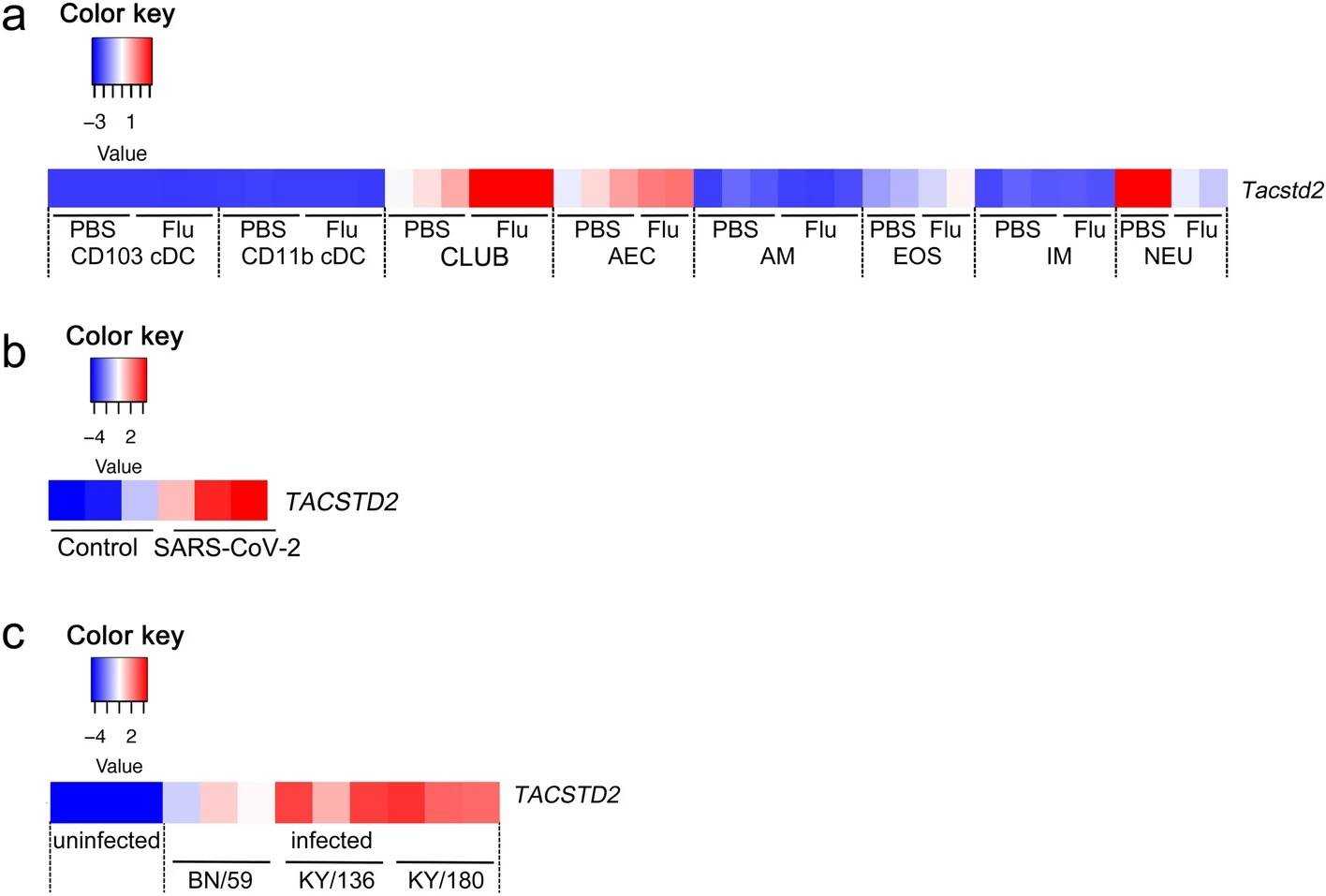 Fig.1 Tacstd2 expression is increased in lung epithelial cells after infection with influenza virus and SARS-CoV-2.1
TACSTD2 can regulate a wide range of cellular activities, far exceeding the simple calcium signal transduction noted in its name:
Our team has developed a complete set of post-translationally modified TACSTD2 membrane proteins, specifically to address the inherent challenges that naturally arise in biochemical research on epithelial cell transmembrane glycoproteins. The production process for these proteins integrates advanced membrane protein expression technologies adapted for membrane protein targets. Every batch of the resulting product undergoes strict quality inspection to ensure stable and reliable performance.
Not finding the membrane protein product you need? Contact us to start your one-stop custom service!
To deliver high-quality epithelial-related research, as well as the early-stage evaluation of compound development, one essential requirement must be met: the construction of a cell platform that aligns with the native state, which can accurately reproduce the native biological characteristics of natural TACSTD2 on the cell surface. We have used cutting-edge technology to create stable TACSTD2 cell lines, with a comprehensive range of available types: wild-type strains that support long-term continuous expression, natural variant strains associated with signaling pathways, and systems coupled with reporter genes — this system enables real-time quantitative analysis of the activation of downstream pathways. Every cell line has undergone comprehensive and rigorous characterization. These scalable, performance-consistent cell resources serve as an essential experimental foundation for conducting research on epithelial action mechanisms, screening regulatory molecules, and optimizing reagents targeting the TACSTD2 axis.
Not finding the stable cell line product you need? Contact us to start your one-stop custom service!
Recombinant antibodies targeting TACSTD2 can be developed and characterized for target specificity and compatibility with research applications. Antibody formats, sample requirements, and cross-reactivity considerations can be evaluated according to project needs; application-specific performance should be supported by relevant validation data.
Not finding the recombinant antibody product you need? Contact us to start your one-stop custom service!
Extending well beyond our standard catalog, we deliver fully customizable discovery and manufacturing solutions meticulously tailored to the sophisticated demands of TACSTD2-targeted research and compound development:
Our integrated platform spans three principal material classes: recombinant TACSTD2 proteins in diverse biochemical presentations, stable expression systems with validated surface display, and sequence-defined antibodies mapping to distinct topological regions.
Absolutely. We have created various mutant forms that are provided as either recombinant membrane proteins or as stable cell lines.
Yes. The antibody panel has been functionally validated for selective detection of the target in chemically fixed cellular and tissue specimens, demonstrating minimal cross-reactivity with closely related members of the calcium-signal transducer family.
No. The entire collection of TACSTD2-related materials—recombinant protein preparations, stable expression systems, and affinity reagents—is designated solely for preclinical inquiry. These items have not been qualified for application to biological specimens collected with the purpose of assessing source physiological status or internal state.









