
Creative Biolabs is offering the most comprehensive services for antibody development projects. With strict regulation and effective execution, we are dedicated to providing the most valuable solutions to complete your projects.
HighlightsCreative Biolabs is offering the most comprehensive services for antibody development projects. With strict regulation and effective execution, we are dedicated to providing the most valuable solutions to complete your projects.
HighlightsCreative Biolabs has established a broad range of platforms for developing novel antibodies or equivalents. These cutting-edge technologies enable our scientists to meet your demands from different aspects and tailor the most appropriate solution that contributes to the success of your projects.
HighlightsWith deep understanding in antibody-related realms and extensive project experience, Creative Biolabs offers a variety of references to help you learn more about our capacities and achievements, including infographic, flyer, case study, peer-reviewed publications, and all kinds of knowledge that can assist your projects. You are also welcome to contact us directly for more specific solutions.
HighlightsGet a real taste of Creative Biolabs, one of the most professional custom service providers in the world. We are committed to providing highly customized comprehensive solutions with the best quality to advance your projects.
HighlightsAt Creative Biolabs, our custom hybridoma development services provide high-quality, validated antibodies specifically developed for Western blotting (WB) and immunoprecipitation (IP) applications. Leveraging our advanced hybridoma technology and extensive expertise, we deliver reliable and consistent results, empowering your protein research and accelerating your scientific discoveries. We are committed to offering tailored solutions and robust technical support.
WB represents a fundamental technique in molecular biology. This method enables the detection and quantification of specific proteins within a complex mixture. Proteins are resolved based on their molecular weight through gel electrophoresis, subsequently transferred to a membrane, and then probed with particular antibodies. The visualization of the antibody-antigen interaction provides crucial information about protein expression levels and molecular weights.
The selection of appropriate antibodies is paramount for successful WB analysis. A primary antibody must exhibit high specificity for the target protein to minimize off-target binding and ensure accurate results. Factors such as the target protein's isoforms, the species of the sample, and whether to use monoclonal or polyclonal antibodies must be carefully considered. Ultimately, a well-validated antibody is indispensable for reliable and reproducible WB data.
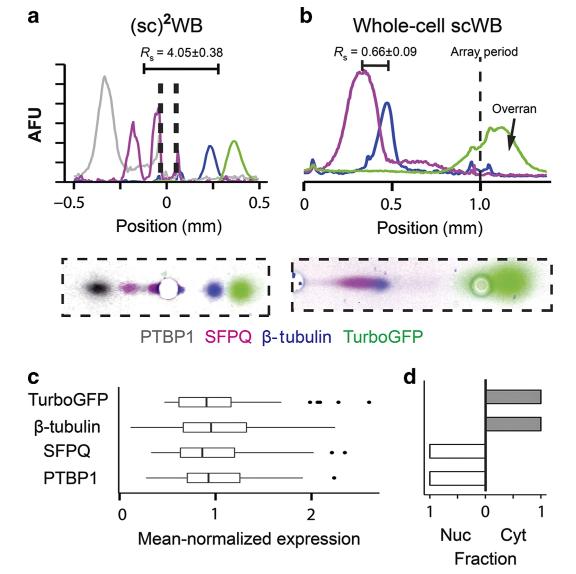 Fig.1 Spliceosome protein localization and expression in single mammalian cells.1, 3
IP is a technique employed for the isolation and purification of a target protein from a complex biological milieu. This approach harnesses the great specificity of the interaction between an antibody and its corresponding antigen. In a standard IP procedure, a specific antibody is introduced into a cell lysate containing the protein of interest. The antibody binds to its target, and the resulting immune complex is subsequently captured using a solid-phase matrix, typically composed of Protein A or Protein G conjugated to beads.
Following several washing steps to remove unbound proteins, the captured protein of interest is eluted and can be further analyzed. IP is frequently used to study protein-protein interactions, post-translational modifications, and the assembly of protein complexes. Similar to WB, the choice of a high-quality, specific antibody is critical for IP success. The antibody's affinity and specificity directly influence the efficiency and purity of the target protein isolation.
Our service offers customized solutions to generate antibodies specifically validated for both WB and IP. We understand the critical role of antibody quality in these techniques, and our service is designed to provide you with antibodies that meet the most demanding requirements.
We work closely with you to understand your specific research needs, including the target protein, desired applications, and any unique assay requirements. This collaborative approach ensures that the final antibody product is perfectly suited to your experiments.
The process commences with meticulous antigen design and preparation. Our scientists leverage their expertise to create optimal antigens, be it recombinant proteins, peptides, or other molecules, to elicit a strong and specific immune response.
We employ carefully designed immunization protocols, including the selection of appropriate adjuvants and administration routes, to maximize the production of high-affinity antibodies in our host animals.
Utilizing advanced hybridoma technology, we fuse antibody-producing B cells with myeloma cells to create hybridomas. These hybridomas are then rigorously screened using a combination of techniques, including ELISA, WB, and IP assays, to identify clones that secrete antibodies with the desired specificity and affinity for both WB and IP.
Only antibodies that demonstrate exceptional performance in both WB and IP assays are selected for further development. We perform extensive validation and characterization, including specificity testing, affinity determination, and cross-reactivity analysis, to ensure the quality and reliability of the final antibody product.
Positive hybridoma clones are expanded to produce sufficient quantities of the desired antibodies. We offer flexible production scales to meet your specific needs, from small-scale research projects to large-scale production for industrial applications.
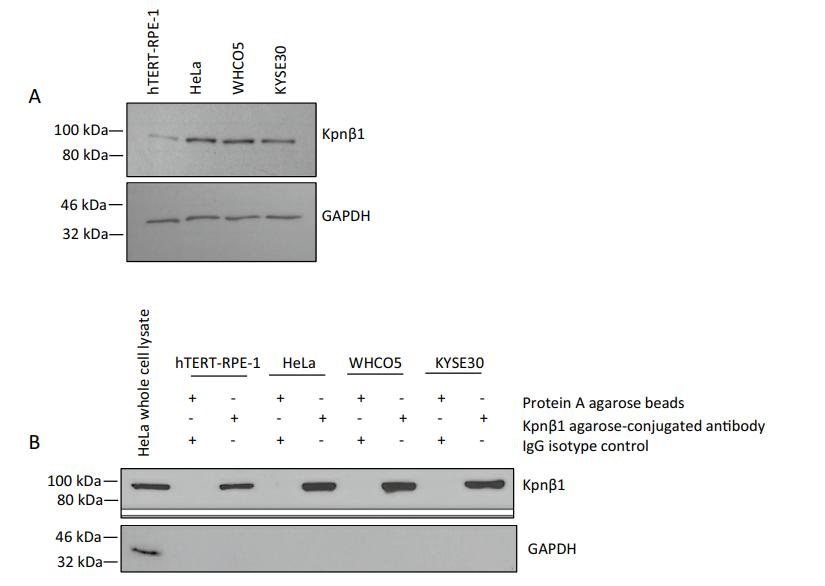 Fig.2 Immunoprecipitation of Kpnβ1.2, 3
The integration of IP with MS offers a potent and sensitive approach to uncover and characterize the binding partners of a specific protein, allowing for the simultaneous identification of multiple binding partners in a single sample. To determine the binding partners of Kpnβ1 in both normal and cancerous environments, Okpara, Michael O., et al. carried out co-IP experiments.2,3 The findings indicated that Kpnβ1 could be successfully immunoprecipitated from both normal and cancer cell extracts, with the amounts of immunoprecipitated Kpnβ1 closely reflecting their endogenous levels. Significantly, employing an IgG isotype control antibody in place of the Kpnβ1-specific antibody resulted in the absence of Kpnβ1 detection, thereby validating the specificity of the interaction.
A: Using validated antibodies in WB and IP is critical for getting accurate and trustworthy findings. Validated antibodies have undergone rigorous testing to confirm their specificity and performance in the intended applications, minimizing the risk of false positives or false negatives. This validation ensures that the experimental data accurately reflects the protein expression or interactions being studied, leading to sound scientific conclusions.
A: We take multifaceted strategies for ensuring antibody specificity. This includes careful antigen design, rigorous screening of hybridoma clones using a variety of techniques, and thorough validation of the final antibody product. We also perform cross-reactivity studies to assess the antibody's binding to non-target proteins, further confirming its specificity.
A: Yes, we have extensive experience in generating antibodies against a wide range of target proteins, including challenging antigens. Our expertise in antigen design, immunization strategies, and hybridoma technology enables us to overcome common difficulties associated with difficult targets, such as low immunogenicity or poor solubility. We work closely with our clients to develop customized strategies tailored to their specific antigens.
A: Monoclonal antibodies offer several advantages over polyclonal antibodies in WB and IP. Monoclonal antibodies demonstrate great specificity for a single epitope, reducing the risk of cross-reactivity and ensuring consistent results. They also provide a renewable and consistent source of antibodies, minimizing batch-to-batch variability.
A: To get started, simply contact us via our website or by phone to discuss your project requirements. Our team of experts will work with you to develop a customized plan and provide a detailed proposal illustrating the scope of work, timeline, and cost. We are committed to delivering a seamless and efficient experience to help you achieve your research goals.
As a leader in the production of hybridoma antibodies, we are willing to provide you with a full range of WB & IP hybridoma screening services. If you are looking for WB&IP-positive hybridoma development services, please feel free to contact us for more information.
All listed services and products are For Research Use Only. Do Not use in any diagnostic or therapeutic applications.








