
Creative Biolabs is offering the most comprehensive services for antibody development projects. With strict regulation and effective execution, we are dedicated to providing the most valuable solutions to complete your projects.
HighlightsCreative Biolabs is offering the most comprehensive services for antibody development projects. With strict regulation and effective execution, we are dedicated to providing the most valuable solutions to complete your projects.
HighlightsCreative Biolabs has established a broad range of platforms for developing novel antibodies or equivalents. These cutting-edge technologies enable our scientists to meet your demands from different aspects and tailor the most appropriate solution that contributes to the success of your projects.
HighlightsWith deep understanding in antibody-related realms and extensive project experience, Creative Biolabs offers a variety of references to help you learn more about our capacities and achievements, including infographic, flyer, case study, peer-reviewed publications, and all kinds of knowledge that can assist your projects. You are also welcome to contact us directly for more specific solutions.
HighlightsGet a real taste of Creative Biolabs, one of the most professional custom service providers in the world. We are committed to providing highly customized comprehensive solutions with the best quality to advance your projects.
HighlightsCreative Biolabs, with over two decades of industry-leading expertise, offers a sophisticated Yeast Three-Hybrid (Y3H) based Protein Interaction Identification Service designed to explore these complex interactions with unparalleled precision and depth. Our state-of-the-art Y3H platform is a powerful extension of the classical yeast two-hybrid (Y2H) system. It is ingeniously engineered to identify molecules that mediate or stabilize the interaction between two other molecules, acting as a crucial "bridge." This makes the Y3H system an indispensable tool for investigating RNA-protein interactions, identifying protein targets of small molecules, and dissecting the components of multi-protein complexes. By harnessing the latest advancements in Y3H technology, we provide our clients with actionable insights that accelerate research in drug discovery, functional genomics, and systems biology.
The Y3H system is a powerful in vivo method for detecting interactions between two proteins that are mediated by a third molecule, or identifying a protein that binds to a specific RNA or small molecule bait. The principle relies on the reconstitution of a functional transcription factor (commonly GAL4) within the yeast nucleus. This transcription factor is split into two distinct domains: a DNA-Binding Domain (DBD) and a Transcriptional Activation Domain (AD).
To identify proteins that bind to a specific RNA sequence (RNA-X), the system is engineered as follows:
When a prey protein from the library binds to RNA-X, it brings the AD into close proximity with the DBD, reconstituting the active transcription factor. This complex then binds to the upstream activating sequence (UAS) of a reporter gene, driving its expression (e.g., HIS3, ADE2, lacZ), which allows for selection and identification of positive interactions.
To identify protein targets of a specific small molecule, the system is adapted:
The hybrid molecule acts as a bridge. The ligand portion binds to the DBD-fusion protein, and if the small molecule portion binds to a prey protein, the DBD and AD are brought together, activating the reporter gene.
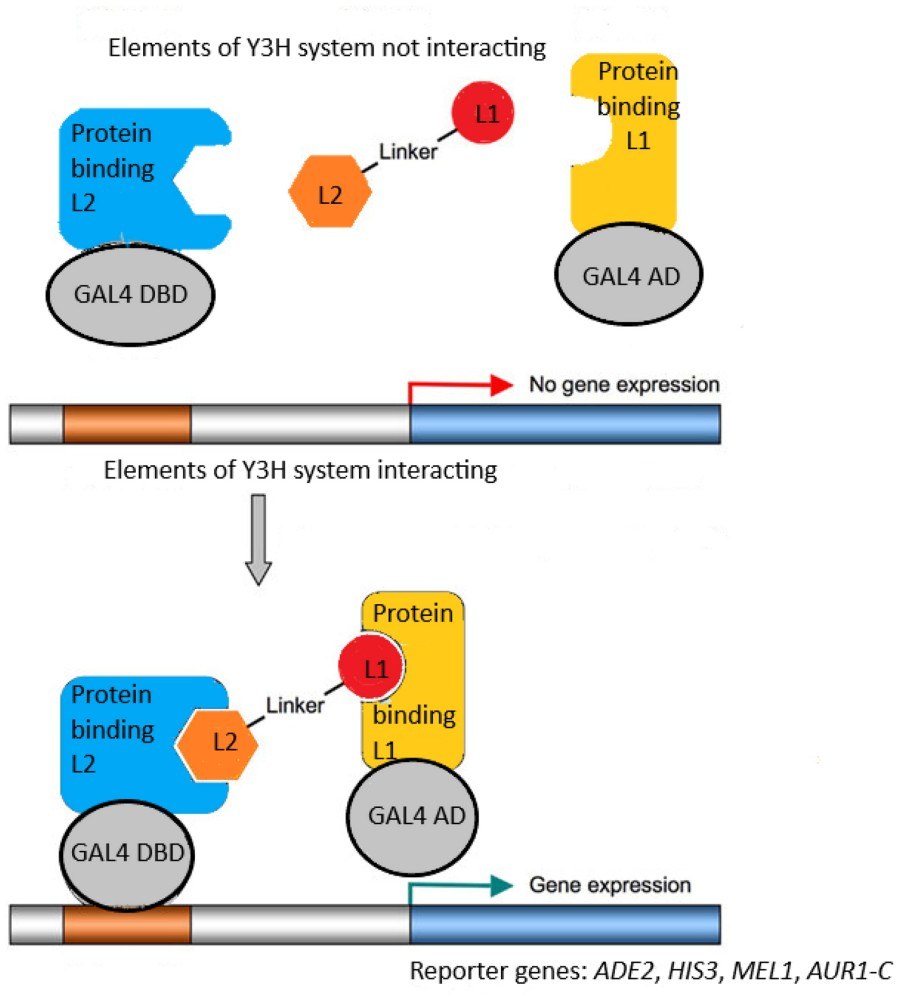 Fig. 1 The idea of yeast three-hybrid (Y3H) system.1
Creative Biolabs is committed to staying at the vanguard of interaction screening technology. We offer a suite of advanced Y3H platforms tailored to your specific research objectives.
| Platform | Principle | Key Applications |
| Classical Y3H | Detects ternary complexes where a third molecule (RNA or small molecule) bridges two proteins. |
|
| Reverse Y3H (R-Y3H) | Screens for molecules that disrupt a pre-existing ternary complex. Uses a counter-selectable marker (e.g., URA3). |
|
| Chemical Y3H (YChemH) | A specialized platform optimized for identifying the direct protein targets of bioactive small molecules. |
|
| Y3H-Seq | Couples the Y3H screening process with Next-Generation Sequencing (NGS) for deep, quantitative analysis of interactors. |
|
Our service is a comprehensive, end-to-end solution, meticulously designed to deliver reliable and publication-ready data. Our expert team will guide you through every step of the process.
Choosing Creative Biolabs' Y3H service provides numerous advantages over other interaction discovery methods:
Our Y3H services can be applied to a wide range of research areas to address fundamental biological questions:
Creative Biolabs offers a comprehensive portfolio of services to explore molecular interactions from every angle. Complement your Y3H study with our other world-class offerings:
Take the next step in unraveling the complex molecular networks that drive your research. Contact us today to discuss your project with one of our Y3H specialists and receive a no-obligation quote.
Q: What is the fundamental difference between the Yeast Two-Hybrid (Y2H) and the Yeast Three-Hybrid (Y3H) system?
A: The primary difference lies in the number of components being studied. The Yeast Two-Hybrid (Y2H) system is designed to detect a direct, binary interaction between two proteins (a "bait" and a "prey"). In contrast, the Yeast Three-Hybrid (Y3H) system is engineered to identify interactions within a ternary complex. It can identify a third molecule (often an RNA or a small molecule) that acts as a bridge between two proteins, or it can identify a protein that binds to a specific RNA or small molecule "bait". Y3H is the system of choice when your hypothesis involves a mediating molecule.
Q: My RNA molecule is highly structured. Can it still be used as a bait in a Y3H screen?
A: Yes, this is a key strength of the Y3H system. Because the screening occurs in vivo within the yeast cell, your RNA bait molecule is transcribed and can fold into its native, functional conformation. This cellular environment is far more representative of physiological conditions than in vitro assays, making it ideal for studying proteins that recognize specific secondary or tertiary RNA structures. Our team can also provide expert advice on bait design to optimize presentation and stability.
Q: Can any small molecule be used in a Chemical Y3H (YChemH) screen?
A: For a successful YChemH screen, the small molecule of interest must be chemically linked to a known "handle" or "ligand" (like methotrexate) to create a bifunctional bait. This requires that the small molecule has a suitable functional group for chemical conjugation that does not abolish its protein-binding activity. Furthermore, the resulting hybrid molecule must be cell-permeable to enter the yeast cell and nucleus. Our chemistry experts can assess the feasibility of your molecule and advise on the best synthetic strategy.
Q: What materials do I need to provide to start a Y3H project?
This depends on the project's nature.
Our project managers will provide a detailed list of requirements during the initial project consultation.
All listed services and products are For Research Use Only. Do Not use in any diagnostic or therapeutic applications.








