
Creative Biolabs is offering the most comprehensive services for antibody development projects. With strict regulation and effective execution, we are dedicated to providing the most valuable solutions to complete your projects.
HighlightsCreative Biolabs is offering the most comprehensive services for antibody development projects. With strict regulation and effective execution, we are dedicated to providing the most valuable solutions to complete your projects.
HighlightsCreative Biolabs has established a broad range of platforms for developing novel antibodies or equivalents. These cutting-edge technologies enable our scientists to meet your demands from different aspects and tailor the most appropriate solution that contributes to the success of your projects.
HighlightsWith deep understanding in antibody-related realms and extensive project experience, Creative Biolabs offers a variety of references to help you learn more about our capacities and achievements, including infographic, flyer, case study, peer-reviewed publications, and all kinds of knowledge that can assist your projects. You are also welcome to contact us directly for more specific solutions.
HighlightsGet a real taste of Creative Biolabs, one of the most professional custom service providers in the world. We are committed to providing highly customized comprehensive solutions with the best quality to advance your projects.
HighlightsAs a world-leading expert in antibody engineering with over two decades of experience, Creative Biolabs provides a state-of-the-art Antibody Caninization (Convert to Dog Ab) Service. We specialize in transforming non-canine monoclonal antibodies (mAbs) from species such as mouse, rat, rabbit, or even human into fully functional canine antibodies with minimized immunogenicity and preserved, or even enhanced, affinity. Our service is a critical enabling step for the development of novel veterinary therapeutics and for advanced preclinical studies in canine models.
The development of antibody-based therapeutics for veterinary medicine, particularly for companion animals, has lagged significantly behind human medicine. A primary hurdle is the immunogenic response. When a non-canine antibody (e.g., murine) is administered to a dog, its immune system recognizes the antibody as "foreign," leading to a potent Canine Anti-Drug Antibody (CADA) response.
This CADA response can have severe consequences:
To overcome this, the antibody must be "caninized"—engineered to resemble a natural dog antibody as closely as possible. Antibody Caninization is a sophisticated protein engineering process that involves grafting the essential antigen-binding regions (CDRs) from a parent non-canine antibody onto the framework (FR) of a native canine antibody. The goal is to create a chimeric molecule that retains the precise specificity of the original antibody while appearing "canine" to the dog's immune system. Creative Biolabs has refined this process into a science. We don't just "cut and paste" sequences. We employ a deep, structure-guided approach to ensure the final dog antibody is not only non-immunogenic but also highly stable and fully functional.
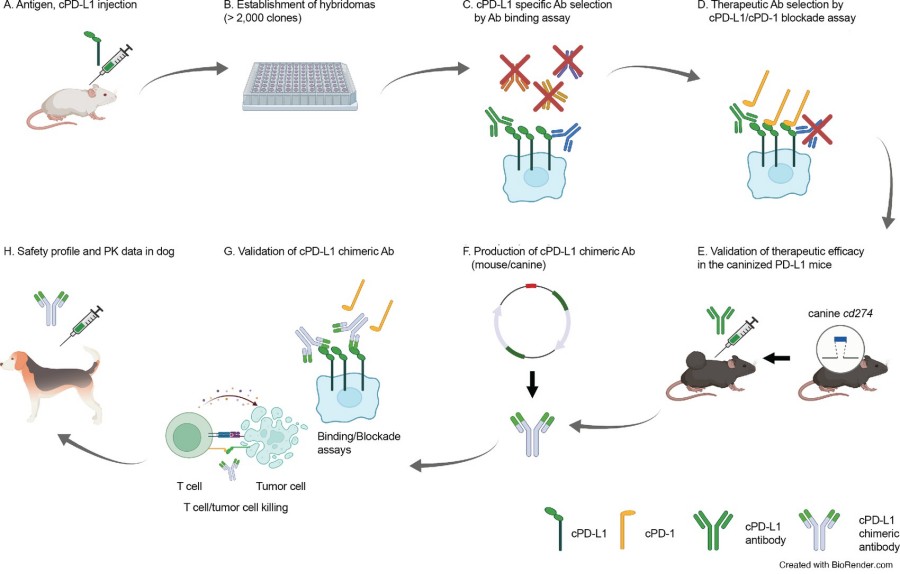 Fig. 1 Working flow chart for production and validation of the canine PD-L1 antibody.1
To deliver superior results, Creative Biolabs has developed the proprietary caninization platform. This integrated system combines advanced computational biology with high-throughput molecular biology to produce caninized antibodies that consistently meet the most demanding specifications.
We use powerful in silico tools to model the parent antibody's structure. This allows us to:
Instead of creating a single "best guess" caninized antibody, we use our computational data to design and construct a focused library of caninized variants. This library typically includes:
This library-based approach dramatically increases the probability of identifying a candidate with affinity and stability equal to or better than the parent antibody.
The constructed library of caninized antibody variants (often in scFv or Fab format) is expressed and screened using high-throughput methods, such as phage display or yeast display. We screen for:
The best candidates are then converted to full-length canine IgG format (e.g., canine IgG-A, -B, -C, or -D, per client specification), expressed in a mammalian system (CHO or HEK293), and subjected to rigorous biophysical validation, including affinity measurement by SPR or BLI.
We offer a complete, end-to-end service package, guiding your project from sequence to a purified, validated dog antibody.
Client provides the parent hybridoma, antibody sequence, or purified protein. If sequences are unknown, we perform de novo antibody sequencing using our advanced mass spectrometry-based platform. We then perform initial characterization (affinity, specificity) of the parent mAb to establish a baseline.
3D homology modeling of the parent VH and VL domains. CDRs are precisely delineated. Our algorithm scans our canine germline database to select the most homologous and stable acceptor framework. A comprehensive analysis identifies critical framework residues for potential back-mutation.
The genes for the designed caninized VH and VL variants are synthesized. A focused library (phage or yeast display) is constructed, encompassing the most promising back-mutation candidates.
The library is screened against the target antigen to isolate high-affinity binders. Multiple rounds of selection and screening identify the top lead candidates.
The variable genes of the best candidates are subcloned into a mammalian expression vector containing the client-specified canine constant regions. Transient expression in CHO or HEK293 cells. High-yield purification of the full-length recombinant dog antibody.
The final caninized antibody is validated.
Our Antibody Caninization service is fueling the next generation of veterinary medicine and translational research.
Development of novel biologics for treating canine diseases, including:
The dog is increasingly recognized as a powerful, outbred model for human cancers. Caninized antibodies allow for relevant therapeutic studies in dogs that can inform human clinical trials.
When developing a human therapeutic, regulatory agencies often require toxicology studies in a non-rodent species, frequently the dog. We can caninize your lead human antibody to create a pharmacologically-active surrogate for accurate in vivo PK/PD and safety profiling.
As a full-service antibody engineering partner, Creative Biolabs offers a complete suite of services to support your veterinary or preclinical antibody development pipeline.
Don't let immunogenicity hinder your veterinary therapeutic or preclinical program. Partner with Creative Biolabs and leverage two decades of antibody engineering expertise. Let us convert your lead antibody into a dog antibody that is potent, stable, and ready for in vivo success.
Q: What is antibody caninization?
A: Antibody caninization is a genetic engineering technique used to convert to dog Ab a monoclonal antibody from a different species (like mouse or rat). It involves replacing the non-canine framework regions (FRs) with canine FRs while retaining the original antigen-binding loops (CDRs). This process makes the antibody look like a native dog antibody, significantly reducing its immunogenicity when administered to dogs.
Q: Is a caninized antibody better than a chimeric dog antibody?
A: Yes, in most cases. A chimeric antibody simply fuses the entire murine variable domain (VH + VL) to a canine constant domain (CH + CL). While this reduces immunogenicity compared to a full murine antibody, the murine variable domain itself is still foreign and can elicit a CADA response. A fully caninized antibody, where the variable frameworks are also canine, presents the lowest possible immunogenicity risk and is the gold standard for therapeutic development.
Q: What source species can you caninize?
A: Our platform is species-agnostic. We have extensive experience caninizing antibodies from all common research species, including mouse, rat, rabbit, hamster, chicken, and even human antibodies (for creating surrogate molecules for dog toxicology studies).
Q: Will the affinity of my antibody change after caninization?
A: A poorly executed caninization (like simple CDR grafting) can lead to a dramatic loss of affinity. This is because the framework residues that support the CDRs' 3D structure are changed. However, our advanced computational platform identifies these critical residues and uses rational back-mutations to preserve the original CDR conformation. We are so confident in our structure-guided approach that we guarantee the final caninized antibody will have an affinity comparable to or greater than the parent antibody.
Q: What do I need to provide to start a project?
A: To begin, you can provide us with the hybridoma cell line, the purified parent antibody protein, or simply the VH and VL sequences. We will handle the rest.
All listed services and products are For Research Use Only. Do Not use in any diagnostic or therapeutic applications.








