
Creative Biolabs is offering the most comprehensive services for antibody development projects. With strict regulation and effective execution, we are dedicated to providing the most valuable solutions to complete your projects.
HighlightsCreative Biolabs is offering the most comprehensive services for antibody development projects. With strict regulation and effective execution, we are dedicated to providing the most valuable solutions to complete your projects.
HighlightsCreative Biolabs has established a broad range of platforms for developing novel antibodies or equivalents. These cutting-edge technologies enable our scientists to meet your demands from different aspects and tailor the most appropriate solution that contributes to the success of your projects.
HighlightsWith deep understanding in antibody-related realms and extensive project experience, Creative Biolabs offers a variety of references to help you learn more about our capacities and achievements, including infographic, flyer, case study, peer-reviewed publications, and all kinds of knowledge that can assist your projects. You are also welcome to contact us directly for more specific solutions.
HighlightsGet a real taste of Creative Biolabs, one of the most professional custom service providers in the world. We are committed to providing highly customized comprehensive solutions with the best quality to advance your projects.
HighlightsIn the critical path of therapeutic antibody development, preclinical evaluation in non-human primate (NHP) models stands as a vital step for assessing safety, toxicity, pharmacokinetics (PK), and pharmacodynamics (PD) before first-in-human (FIH) trials. NHPs, such as cynomolgus and rhesus macaques, are the gold standard for this evaluation due to their high physiological and immunological homology to humans. However, a significant challenge arises when the candidate antibody is of non-monkey antibody origin (e.g., murine, rabbit, hamster). The immune system of the NHP host can recognize these foreign antibodies, leading to a rapid anti-drug antibody (ADA) response. To bridge this critical translational gap, Creative Biolabs offers a premier Antibody Simianization (Convert to NHP Ab) Service. This sophisticated antibody engineering process involves modifying the sequence of a non-monkey antibody to make it "simian-like," thereby minimizing its immunogenic potential in NHP models. Leveraging over 20 years of experience, our service ensures you receive a high-affinity, low-immunogenicity antibody construct, paving the way for robust and reliable preclinical data.
The primary goal of preclinical NHP studies is to predict how a therapeutic antibody will behave in humans. The introduction of a non-monkey antibody into an NHP model often triggers an immune cascade that invalidates these studies.
Consequences of Immunogenicity in NHP Studies:
Non-monkey Antibody Simianization is the definitive solution to this problem. By re-engineering the antibody to match NHP germline sequences, we effectively "cloak" it from the NHP immune system, ensuring that the data collected reflects the true properties of the drug, not an immune artifact.
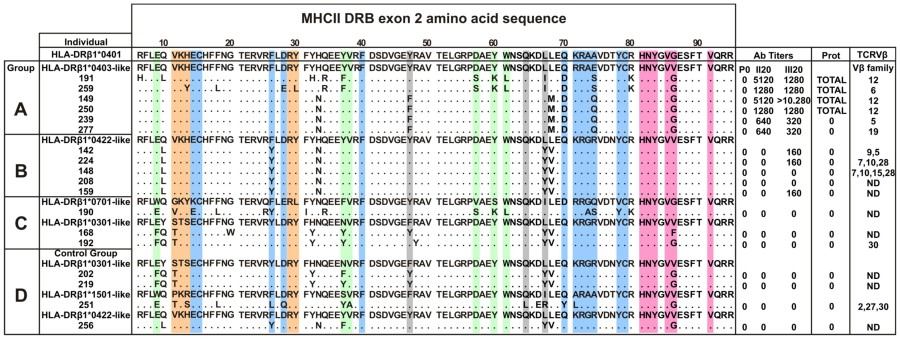 Fig. 1 Genotyping, immune response and preferential TCR Vβ usage of immunized Aotus monkeys.1
At Creative Biolabs, we have moved beyond simple chimeric constructs. We employ our proprietary platform, a multi-layered, computation-guided approach to Antibody Simianization that guarantees optimal affinity retention and minimal immunogenicity. This platform integrates comprehensive sequence analysis, 3D structural modeling, and rational back-mutation to create a simianized antibody that is functionally identical to the parent but invisible to the NHP immune system.
Our process begins by sequencing the parent non-monkey antibody variable (VH and VL) domains. We then query these against our extensive, curated database of NHP (e.g., Macaca fascicularis, Macaca mulatta) germline genes. Our algorithm selects the NHP framework that shares the highest sequence homology and structural compatibility with the parent antibody's frameworks and CDRs.
We do not simply "copy-paste" the CDRs. We generate a high-resolution 3D structural model of the parent antibody's variable domain. This model allows us to identify the precise amino acids in the framework (e.g., in the Vernier and canonical zones) that are critical for supporting the structural conformation of the CDR loops. This structural insight is the key to preserving affinity.
This is what sets our Antibody Simianization (Convert to NHP Ab) Service apart. A straight CDR graft onto a simian framework often results in a significant drop in binding affinity. Our platform identifies a minimal set of key framework residues from the original parent antibody that must be "back-mutated" (re-introduced) into the simian framework. This rational back-mutation ensures that the CDR loops maintain their native, high-affinity conformation.
Before synthesis, every designed variant is subjected to rigorous in silico immunogenicity analysis. We use advanced algorithms to scan the sequence for potential T-cell and B-cell epitopes that could be presented by common NHP MHC-I and MHC-II alleles. We optimize the sequence to remove these potential "hotspots," ensuring the final simianized construct has the lowest possible immunogenic potential.
We match the engineered variable domain with the appropriate NHP constant region (e.g., cynomolgus IgG1, IgG2, or IgG4) to create a full-length, biologically relevant simianized antibody ready for in vivo studies.
Creative Biolabs manages your entire Non-monkey Antibody Simianization project from sequence to validated protein, providing a seamless, end-to-end solution.
| Phase | Step | Description |
| Phase 1: Project Initiation & Analysis | Consultation & Material Receipt | Our Ph.D.-level team consults with you to define project goals. We receive your starting material (hybridoma, sequences, or purified antibody). |
| Parent Ab Sequencing | If sequences are not provided, we perform de novo antibody sequencing on the parent antibody to obtain the precise VH and VL sequences. | |
| Phase 2: Simianization Design & Engineering | Computational Design | Using the platform, we perform 3D modeling, NHP framework selection, and identify key back-mutations. |
| Variant Design | We typically design 3-5 simianized variants with different levels of back-mutation to balance low immunogenicity with high affinity. | |
| Phase 3: Gene Synthesis & Expression | Gene Synthesis | The designed VH and VL genes, along with the chosen NHP constant regions, are codon-optimized and synthesized. |
| Vector Construction & Expression | Genes are subcloned into our proprietary high-yield mammalian expression vectors. We perform transient expression (e.g., HEK293 or CHO) to produce milligram-to-gram quantities of each variant. | |
| Phase 4: Purification & Validation | Antibody Purification | Antibodies are purified to >95% purity using multi-step chromatography (e.g., Protein A/G affinity, SEC). |
| Comparative Validation | This is the most critical step. We perform parallel binding assays (e.g., ELISA, SPR, or BLI) to directly compare the binding affinity of the simianized variants to the original parent antibody. | |
| Phase 5: Final Reporting & Delivery | Data Package & Delivery | We provide the best-performing simianized antibody (with affinity and stability comparable to the parent) along with a comprehensive report, including all design, expression, and validation data (SDS-PAGE, SEC-HPLC, binding kinetics). |
When reliable preclinical data is non-negotiable, your choice of service provider is paramount. Creative Biolabs offers an unparalleled combination of technology, experience, and commitment to success.
Creative Biolabs is your one-stop solution for the entire antibody engineering cascade. Explore our related services to support your program:
Antibodies developed through our Convert to NHP Ab service are purpose-built for demanding preclinical applications, providing the high-quality reagents you need for. Contact the experts at Creative Biolabs today.
Q: What is the primary difference between antibody simianization and humanization?
A: The two processes are similar in technique but different in purpose. Antibody Simianization modifies a non-monkey antibody (like murine or rabbit) to resemble an NHP antibody. Its sole purpose is for preclinical studies in NHP models. Antibody Humanization modifies a non-human antibody (e.g., murine, rabbit, or even a simianized antibody) to resemble a human antibody, with the goal of creating a therapeutic for clinical use in humans.
Q: Will the simianization process negatively affect my antibody's affinity or stability?
A: This is a common risk with naive CDR grafting. However, Creative Biolabs' advanced Antibody Simianization service is specifically designed to prevent this. By using 3D structural modeling and performing minimal, rational back-mutations, our simianization platform ensures that the critical CDR-supporting framework residues are maintained. We validate this with binding assays (like SPR) to confirm the final simianized antibody retains affinity comparable to the parent antibody.
Q: What starting material do I need to provide for the Convert to NHP Ab service?
A: The ideal starting material is the hybridoma cell line or the known variable (VH and VL) domain sequences of your non-monkey antibody. If you only have the purified antibody protein and no sequence, we can first perform our de novo antibody sequencing service to obtain the high-fidelity sequence and then proceed with simianization.
Q: Which NHP species do you target for simianization?
A: Our platform is flexible and robust. We most commonly perform Antibody Simianization for the two most-used NHP models: Macaca fascicularis (cynomolgus monkey) and Macaca mulatta (rhesus monkey). We can also target other NHP species upon request, based on your specific preclinical model.
Q: What if my parent antibody is a rabbit monoclonal antibody?
A: Rabbit antibodies are an excellent starting point due to their unique antigen-binding properties and high affinity. We have extensive, specialized experience in rabbit Non-monkey Antibody Simianization. Our platform effectively handles the unique disulfide bond structures and framework characteristics of rabbit antibodies, successfully converting them into low-immunogenicity simianized antibodies.
All listed services and products are For Research Use Only. Do Not use in any diagnostic or therapeutic applications.








